🎧 Listen to this story
Narrated by Kore · 6,772 characters
For about three years, I had a nightly ritual. The house would go quiet, the dishes would be done, and I would climb into bed with my phone held six inches from my face. I told myself I was winding down. What I was really doing was running.
This is the story of the night I stopped, and what happened when I let the quiet catch up with me.
The Ritual I Didn’t Know I Had
It never felt like avoidance. It felt like relaxing. A video here, a headline there, a stranger’s vacation photos, a recipe I would never cook. Twenty minutes became an hour. An hour became the strange, glassy-eyed stretch past midnight where time simply disappears.
What I did not notice, for a long time, was the pattern underneath it. The scrolling got worse on the nights something was bothering me. A tense conversation at work. A text I should have answered. A memory that floated up uninvited while I was brushing my teeth. The moment the thought arrived, my thumb moved, and the thought dissolved into noise.
I was not resting. I was outrunning.
The Night It Stopped Working
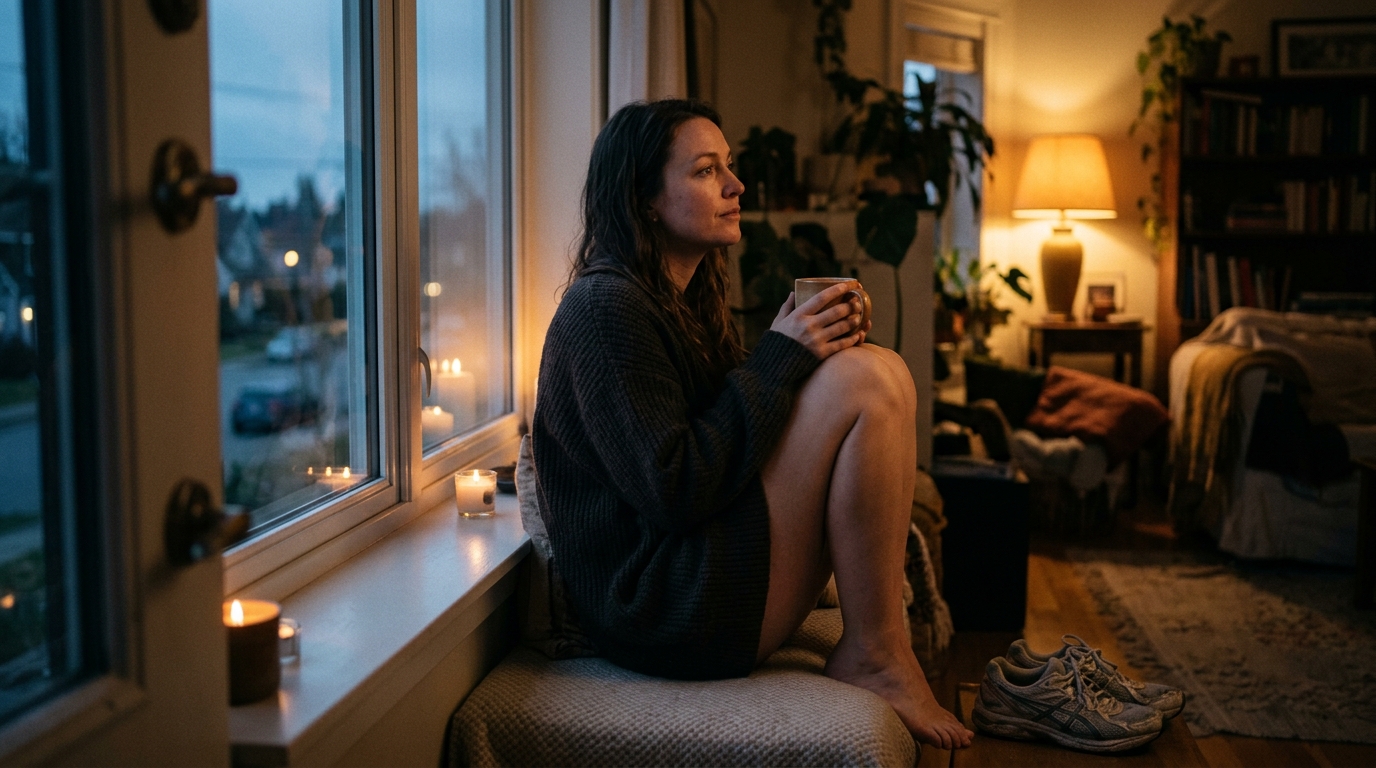
It was a Tuesday in late October. My phone had died around 11:40, and I had left the charger downstairs. I lay there in the dark, and for the first time in months there was nothing between me and my own head.
The first thing that surfaced was my father.
We had not spoken properly in almost two years. There was no dramatic falling out, just a slow drift that started with one unreturned call and hardened into silence. I had always had a reason. I was busy. He had said something careless at a holiday dinner. It was his turn to reach out. But lying there, with no screen to hide behind, I could not make any of those reasons sound true anymore.
My chest tightened. The old instinct kicked in, a sharp little tug toward the nightstand. I reached for a phone that was not there, and I laughed at myself, quietly, in the dark.
Then I did something unfamiliar. I stayed.
What It Actually Feels Like to Sit With a Regret
I want to be honest here, because I think we imagine this as a serene, candle-lit experience. It is not. It is uncomfortable, and it is a little boring, and it is a little frightening at first. Here is what I noticed in those first quiet minutes:
- The urge to flee comes in waves. It crests, and if you do not feed it, it passes. Usually within a few minutes.
- Regret is louder when you are running from it. Once I stopped pushing it away, it actually got quieter, almost like it had only been shouting because no one was listening.
- The body tells you things. My shoulders were up near my ears. My jaw ached. I had been carrying that tension for who knows how long.
- The feeling had a shape. It was not vague dread. It was specific: I missed him, and I was ashamed of how long I had let it go.
Naming it changed everything
There is a difference between a cloud of unease and a sentence. “I feel bad” is a fog. “I miss my dad and I am embarrassed that I let two years pass” is something you can actually hold. Once I had the sentence, the regret stopped feeling like a threat and started feeling like information.
The Lesson That Settled In Around 1 A.M.
Somewhere past midnight, with the house ticking and settling around me, something shifted. I realized that regret is not a punishment. It is a compass. It was pointing, quite clearly, at the thing I cared about most and had neglected longest.
All those years of scrolling past it, I had treated the feeling as an enemy to be drowned out. But the discomfort was never the problem. It was the message. It was saying: this matters to you, and you have not tended to it.
I also noticed something gentler. The regret did not demand that I be perfect. It only asked me to do one small, honest thing. Not to fix two years in an evening, just to make a start.
The Call
I did not call him that night, and I want to say so plainly, because I do not trust stories where everything resolves at 1 a.m. with a tidy phone call. Midnight is a good time for clarity and a poor time for conversations.
I called him the next evening, just after dinner, when the light outside was turning amber. My heart was pounding. He answered on the fourth ring, and there was a long pause where neither of us knew the first line.
“I’ve been thinking about you,” I said.
“I’ve been thinking about you too,” he said, and his voice cracked a little on the last word.
We talked for forty minutes about nothing and everything: the garden, his knee, a movie he had watched twice. We did not litigate the past. We simply picked the thread back up. It was not a grand reconciliation. It was something quieter and, I think, more durable: two people deciding to show up again.
How I Practice Evening Stillness Now
I did not become a monk. I still pick up my phone more than I should. But I have built a small habit around the end of the day, and it has changed how my nights feel. If you want to try it, here is the simple version:
- Charge the phone outside the bedroom. This removes the reflex entirely. You cannot reach for what is not there.
- Give yourself ten quiet minutes. No audio, no screen. Just lie or sit and let whatever surfaces, surface.
- Name the feeling in one honest sentence. Be specific. Specific is survivable.
- Ask what it is pointing toward. Regret usually has an address. A person, a choice, a thing left undone.
- Choose one tiny action for tomorrow. A text, a call, an apology, a small step. Not a overhaul, just a start.
- Let the rest go until morning. You are allowed to put it down and sleep.
What Dusk Teaches That Noon Cannot
There is a reason so many cultures treat the end of the day as a threshold. In the evening, the world quiets and the loud, useful distractions fall away. What is left is truer. The things we have been too busy to feel arrive, one by one, like guests who waited politely until everyone else had gone home.
We spend so much energy keeping them waiting at the door. But they are rarely as frightening as we imagine. Most of them just want to be acknowledged. A few moments of attention, and they say what they came to say, and they settle.
A Gentle Invitation
If you are reading this late at night, perhaps with the same glow on your face that I used to have, I will not tell you to put the phone down. I know how that sounds. I only wonder if there is something you have been scrolling past lately. A name. A conversation. A small ache you keep stepping around.
You do not have to solve it tonight. You only have to notice it, and maybe, just for a few minutes, let it sit beside you in the dark. In my experience, it is far gentler company than the running ever was.
Tomorrow, when the light turns golden and the day begins to soften, you might even pick up the phone, not to scroll, but to call someone who has been waiting to hear from you.