🎧 Listen to this story
Narrated by Kore · 7,688 characters
There is a particular kind of quiet that settles over a repair shop around seven in the evening. The impact wrenches go silent. The radio gets turned down. The smell of motor oil and cold coffee hangs in the air like a held breath. For most mechanics, this is the hour when the day finally lets go and they lock up and head home.
For a man I will call Walt, it is the hour the real work begins.
This post is told as a short reported profile, pieced together from conversations with Walt, a few of the people he has helped, and one neighbor who has watched the shop’s lights burn late for the better part of a decade. Some names and small details have been softened to protect privacy, but the heart of it is exactly as it was told to me.
The Problem Nobody Talks About
Walt has run a small independent garage on the edge of a modest town for more than thirty years. He is the sort of person who wipes his hands on a rag out of habit even when they are already clean. And in all those years, he noticed the same quiet tragedy repeating itself.
A car breaks down. The owner cannot afford the repair. Without the car, they cannot get to work. Without work, they cannot pay for the repair. It is a loop that tightens like a knot, and it catches people who are already stretched thin.
“People think a broken car is an inconvenience,” Walt told me, leaning against a workbench. “For a lot of folks, it’s the first domino. Car dies, job goes, rent slips. I got tired of watching dominoes fall.”
The Evening Shift Nobody Asked For
So a number of years ago, Walt made a decision that his wife says he announced over dinner as if he were mentioning the weather. After his paying customers were gone for the day, he would keep the bay doors open for one more car, free of charge, for anyone who could not afford the fix and could not afford to lose a day’s work.
The rules are simple, and they are the kind of rules that only a person with real experience would think to make:
- The car gets dropped off in the evening, usually between five and six.
- Walt works on it after hours, while the shop is empty and quiet.
- The owner picks it up before their shift the next morning, so no hours are ever missed.
- No paperwork, no interrogation, and no proof of hardship required.
- If parts are needed, he covers what he can, and a small fund built from tips and a few anonymous donations covers the rest.
That last rule matters most to him. “I never ask why you can’t pay,” he said. “If you’re standing in my shop at dusk with a dead alternator and a worried face, that’s all the explanation I need.”
What Evening Does to a Person
I asked Walt why evenings. Why not take free cases during the day, when things are busy and bright?
He took a long moment before answering.
“Daytime is for business,” he said. “The shop’s loud. People are watching the clock. But after hours, it’s different. There’s no rush. Nobody’s embarrassed in front of a waiting room full of strangers. It’s just me, a car, and a good light. It’s the only time of day I feel like I can do this kind of work properly, and do it kindly.”
There is real wisdom in that. Evening has a way of softening things. The pressure of the day drains out, and what remains is honest and slow. Walt says some of his best thinking happens under the hood of a stranger’s car as the sky outside the bay doors turns from gold to violet to deep blue.
The Ritual of the Last Hour
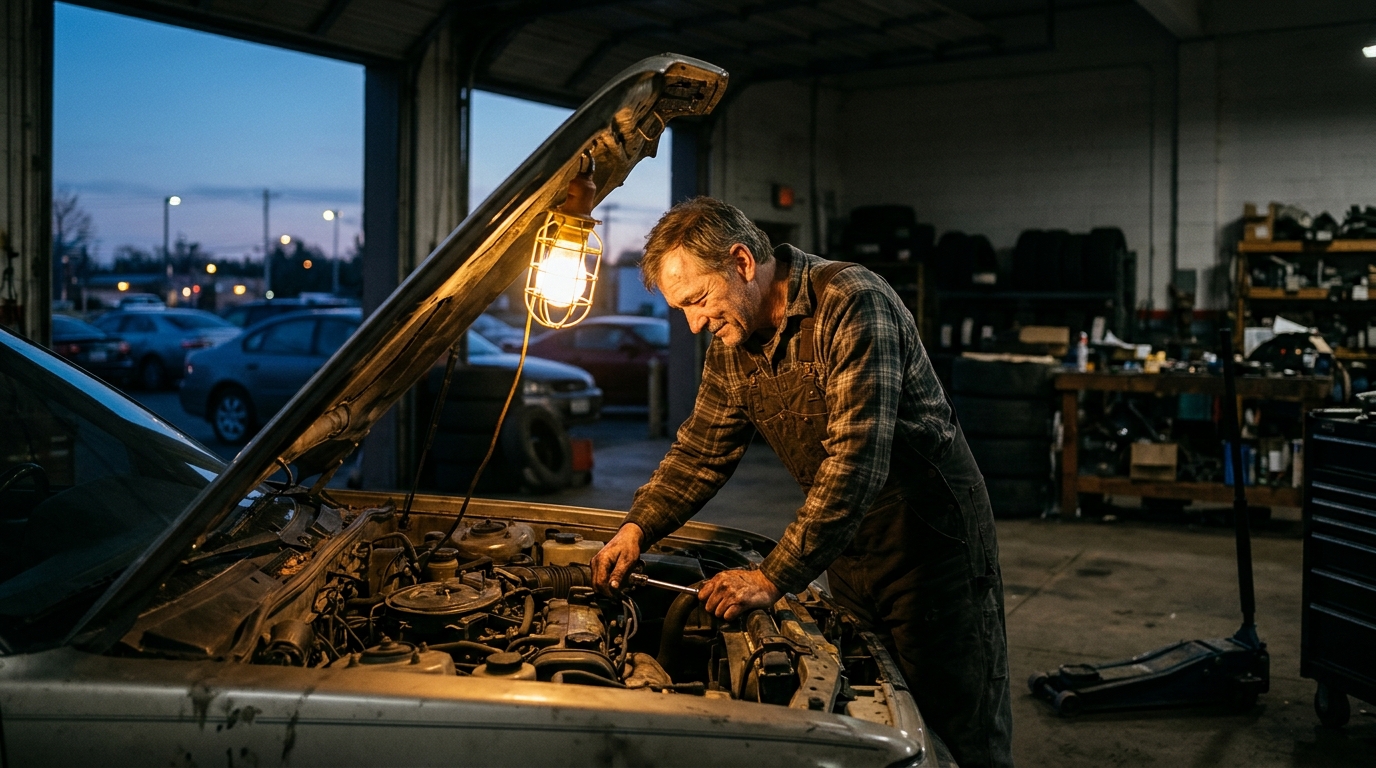
He has developed a small ritual over the years. Before he starts on the evening’s car, he makes a cup of tea, sets it on the shelf above the workbench, and turns on a single warm work lamp rather than the harsh overhead fluorescents. He says the fluorescents feel like daytime, and he wants the work to feel like a gift rather than a transaction.
By the time he finishes, it is often close to ten. He wipes down the steering wheel, leaves the keys on the driver’s seat, and writes the owner a single line on a scrap of paper: All set. Drive safe. That is it. No invoice, no speech.
Three Mornings That Changed
I spoke with a few of the people Walt has helped. Their stories are different, but they share a common thread: the quiet relief of waking up to a problem that had simply been solved overnight.
The Night-Shift Nurse
One woman works as a nursing assistant and had been taking two buses and a long walk to reach her shift after her car’s brakes failed. “I was exhausted before I even clocked in,” she said. “The morning I got my car back, I sat in the driver’s seat and just cried. Not because it was a big thing, but because someone had decided I was worth the trouble.”
The Delivery Driver
A young man who drives for a food delivery app told me his transmission gave out in the middle of a week when he needed every single order to make rent. “A day without the car would have cost me more than the repair itself,” he said. “Walt gave me the day back. Do you know how rare that is?”
The Retired Teacher
An older woman on a fixed income needed a new battery and a belt replaced, a small repair that would have eaten a large part of her monthly budget. “I tried to pay him in banana bread,” she laughed. “He took the bread. I think that’s the only payment he’s ever accepted.”
Why It Works
It would be easy to say Walt is simply a generous man and leave it there. But the more time I spent around his shop, the more I realized there is a method inside the kindness, a few lessons that any of us could borrow:
- Remove the shame. By working after hours and asking no questions, Walt lets people accept help without having to justify themselves.
- Solve the real problem. The goal is not just a fixed car. It is a kept paycheck, a kept routine, a kept sense of dignity.
- Make it sustainable. He gives what he can without running himself or his business into the ground, which is why he has been able to keep going for years.
- Do it quietly. He has never advertised the program. People find out by word of mouth, which keeps it human and unforced.
The Quiet Return
Here is the part that surprised me. Walt insists he gets more out of this than the people he helps. “I’ve had my share of hard days,” he said. “Some nights I’m tired and my back hurts and I think, why am I still here? Then I get that car running, and I turn the key, and it catches. That sound, that little roar coming back to life? It’s the best thing I know. It sends me home lighter than I came in.”
Others have started to follow his lead. A local parts supplier now quietly discounts anything Walt marks for the evening fund. A retired welder drops by some nights just to hold the flashlight and keep him company. A teenager from the neighborhood, who first showed up as a customer, now sweeps the floor on Thursdays and says he wants to become a mechanic.
A Thought to Carry Into Tonight
When the sun goes down tonight and the noise of the day starts to fade, it is worth asking a small question: what could I quietly fix for someone, without needing credit, without needing thanks?
You do not need a garage or a wrench. You might simply be the person who notices a worry and removes it. The late-evening hours are good for that kind of noticing. The world is slower then, and kindness has room to breathe.
Walt is out there right now, most likely, with a warm lamp glowing and a cup of tea cooling beside him, bent over an engine that belongs to someone he may never meet. Somewhere across town, a person is falling asleep with a little less dread than they had this morning, because they know that when the sun comes up, the car will be waiting.
And sometimes, that is how a good life gets held together: not by grand gestures, but by one patient person, working late, so that someone else can make it to tomorrow.