🎧 Listen to this story
Narrated by Kore · 7,603 characters
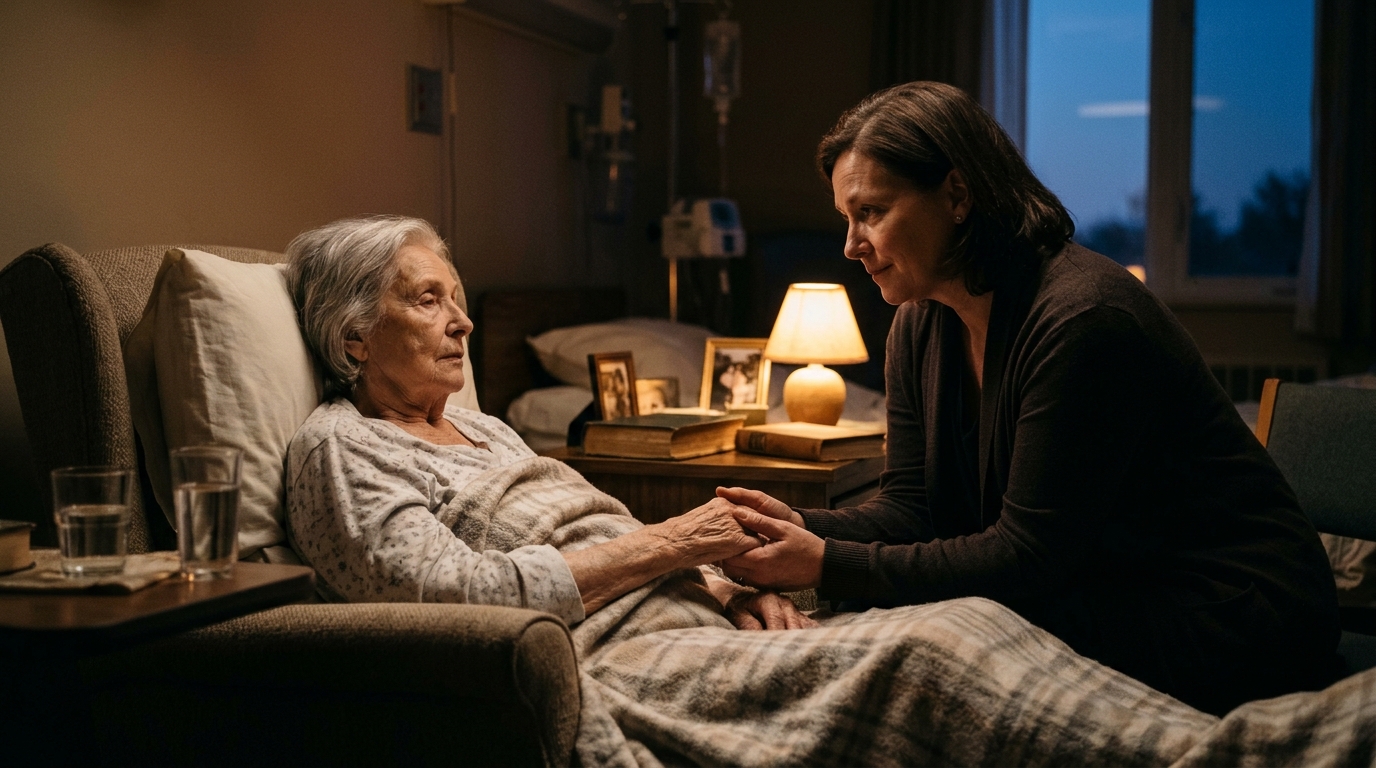
The sun is going down over a quiet wing of a hospice in the Midwest, and Reverend Daniel Okafor-Brennan is doing what he has done for nineteen years. He is walking the hallway, softly, in no hurry, toward a room where someone is about to leave the world. He has no medicine to offer. He has no cure. What he brings is a folding chair, a warm presence, and a promise that nobody will be alone.
By his own careful count, he has sat with more than a thousand people in their final hours. Most of them were strangers when he walked in. Almost none of them were strangers by the time he walked out.
We spoke with Daniel on a rainy evening, in the small chapel where he keeps a thermos of tea and a worn notebook. What follows is a reflection on what he has seen, shaped by the hours he knows best: the ones after the sun goes down.
Why Evening Is When the Work Begins
Ask any hospice nurse and they will tell you the same thing: the evening is different. During the day, a room is full of motion. Visitors come and go, doctors make rounds, the television murmurs, and a person can stay busy being brave.
Then dusk arrives. The hallway lights dim to amber. The visitors go home to rest. And the person in the bed is left with the oldest quiet there is.
“The day is loud, and the evening is honest,” Daniel told us. “People say things at seven o’clock at night that they would never say at noon. The fear comes out. So does the love. Sometimes the two come out together, tangled up, and my job is just to be the one who can hold both without flinching.”
How a Stranger Becomes a Companion
Daniel does not begin with scripture or sermons. He rarely begins with words at all. He pulls up a chair, sits at the level of the person’s eyes, and waits.
“The first thing I learned,” he said, “is that I am not there to fix anything. For years I wanted to. I wanted to find the perfect sentence that would make the fear go away. There is no such sentence. What takes the fear down a notch is company. That’s it. Just company.”
He has developed a few quiet habits over the years, the kind of small rituals that make a room feel safe:
- He asks about the ordinary things first. Where did you grow up? What did you do for work? What did your mother’s kitchen smell like?
- He lets silence stretch. A pause is not a failure. It is often where the real conversation lives.
- He never rushes a goodbye. If someone wants to talk about a garden for two hours instead of God for two minutes, the garden wins.
- He keeps the light low. A lamp, not an overhead bulb. Evening should feel like evening, even at the end.
The Night a Retired Bus Driver Taught Him Everything
Daniel remembers one man above the rest. His name was Walter, a retired city bus driver, eighty-seven years old, with no family left and no visitors in the weeks before he died.
“The staff asked me to sit with him because he had no one,” Daniel recalled. “I walked in expecting a sad room. Instead, Walter wanted to tell me about his route. Route 14. He could name every stop. Every single one, in order, with the story of the people who got on and off.”
For three evenings, Daniel listened to Walter recite his route like a prayer. A baker who always gave him a roll. A schoolgirl who grew up and became a nurse. A man who rode every Tuesday to visit his wife’s grave.
On the last evening, Walter grew quiet. Then he said something Daniel has never forgotten.
“He said, ‘I spent my whole life carrying people to where they were going. Nobody ever told me that was a good life.’ And I said, ‘Walter, it was one of the best I have ever heard.’ He smiled, and he closed his eyes, and he went peacefully a few hours later.”
Daniel paused when he told us this, turning his teacup slowly in his hands. “That is the whole job, really. Telling people that their life mattered, and meaning it, because it did.”
What a Thousand Goodbyes Have Taught Him
We asked Daniel what he would pass on to the rest of us, those who are not standing in hospice hallways but are living full, busy, distracted lives. He took his time answering, the way he does with everything.
1. Almost no one talks about their accomplishments at the end
“Nobody has ever asked me to read their résumé aloud,” he said with a small laugh. “They talk about who they loved, who they hurt, and who they wish they had called. That is the whole list.”
2. Reconciliation is almost always possible, and almost always worth it
He has watched estranged siblings reunite across a bedside after twenty years of silence. He has helped dictate letters of apology. “The tragedy is never the argument,” he said. “The tragedy is the years of not speaking after it.”
3. Fear and peace can live in the same room
“People assume a peaceful death means no fear. I have not found that to be true. I have found that people can be afraid and at peace at the same time. They are not opposites. They are just two things a human heart can hold.”
4. Presence is the gift
“I used to think I had to bring something. Now I know that showing up, and staying, is the whole offering.”
The Part No One Sees
It would be easy to imagine that a man who has sat with a thousand dying people carries a heavy sorrow everywhere he goes. Daniel does carry something, but he is careful to describe it differently.
“People expect me to be sad all the time,” he said. “I am not. I am something closer to grateful. Every person I sit with trusts me with the most vulnerable hours of their life. That is a sacred thing. You do not walk away from that feeling heavy. You walk away feeling like you were let in to see something true.”
He does have his own evening ritual, though. When the shift ends, he drives home with the window cracked, no radio, just the sound of the road and the cool air. He stops at the same small park every night, sits on the same bench, and watches the last light fade from the sky.
“It is how I put the day down,” he said. “I sit, I breathe, and I say a quiet thank-you for the people I met. Then I go home and hug my wife and eat whatever she has made. Life, after all that, tastes extraordinary.”
An Invitation for Your Own Evening
You do not have to sit in a hospice room to practice what Daniel practices. Tonight, as the day winds down and the house goes quiet, you might try something small and brave:
- Think of one person you have been meaning to call, and send the message before you sleep.
- Sit with someone for ten unhurried minutes, with the phone face down.
- Ask an older relative about the street they grew up on, and just listen.
- Before bed, name one person whose life was a quiet gift to yours.
Daniel believes that most of what matters in a life is built from exactly these small, unglamorous acts of staying. Not grand gestures. Not perfect words. Just a chair pulled close, and a light left on.
A Last Thought as the Lights Go Down
When we finished our conversation, the rain had stopped and the windows of the chapel had gone the soft blue of early night. Daniel stood, tucked his notebook into his coat pocket, and glanced down the hallway where a single lamp was glowing in one of the rooms.
“Someone is waiting for me,” he said gently. “I should go.”
He walked down the corridor in no particular hurry, a man who has made peace with the fact that the hardest hour of a stranger’s life is also, somehow, the most important place he could possibly be. Tonight, in a quiet room somewhere, a person who might have been alone will not be. A chair will be pulled close. A voice will say, softly, I am here. Tell me about your life.
And for the thousand-and-first time, a stranger will become a friend, just in time.