🎧 Listen to this story
Narrated by Kore · 6,865 characters
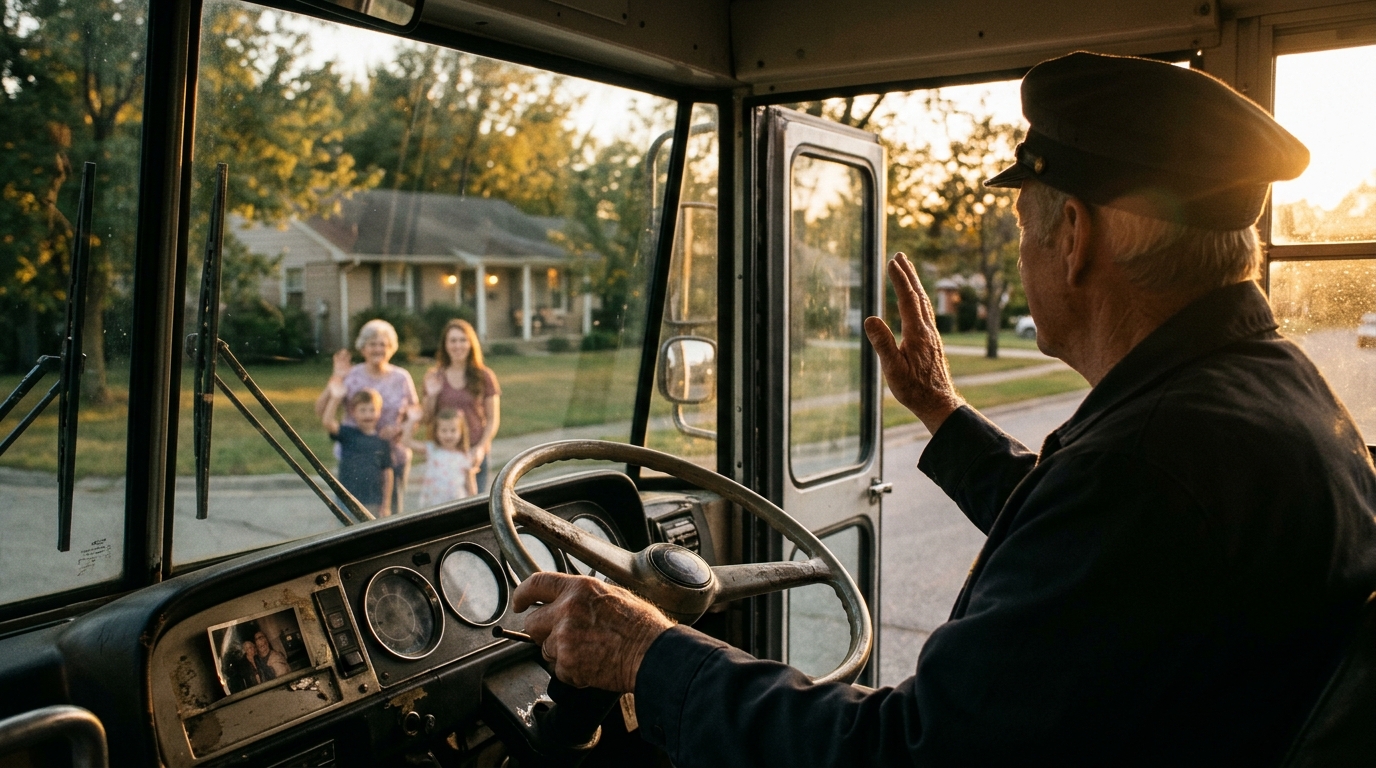
There is a particular hour, somewhere between four and five in the afternoon, when the light turns the color of weak tea and a yellow school bus begins to empty out, one stop at a time. Ray Dolan has watched that light for thirty-one years. He has never once called it the end of his workday. He calls it the hand-off.
This is a reported profile, pieced together from conversations with Ray, a few of the parents on his route, and two grown adults who rode with him as kids. Some names have been shortened at the request of the people involved. The rest is exactly as it was told to us.
The Quiet Job Nobody Writes Songs About
Ray drives Route 14, a winding loop through farm country and a few cul-de-sacs that were cornfields when he started. At its busiest, the bus carries around a hundred children across two runs, morning and afternoon. He knows every one of them by name, and he knows something more useful than names: he knows who is loud on Monday and silent by Thursday.
“You learn their weather,” he told us. “A kid steps on and you can tell if it’s going to be a sunny ride or a stormy one. My job isn’t to fix the storm. My job is to make sure they’re not alone in it for the next twenty minutes.”
That sentence, we came to realize, is the whole philosophy. And it matters most in the afternoon, when the bus is carrying children away from the structure of school and toward whatever evening is waiting for them at home. For some kids that is a warm kitchen. For others it is an empty house, a loud house, or a house where nobody asks about the day.
Why the Afternoon Run Is Different
Ray will tell you the morning ride is about nerves and the afternoon ride is about feelings. In the morning, kids are bracing. In the afternoon, they are unspooling. All the things they held together for seven hours come loose somewhere around the third stop.
“The back of the bus gets real honest after three o’clock,” he said with a small laugh. “Things come out. A kid who got a bad grade. A kid whose parents are splitting up. A kid who just wants to tell somebody a joke that didn’t land in class.”
Ray keeps a short list of rules he has never written down but never breaks. The parents we spoke with described them almost word for word:
- Greet every child by name, every single time, even on the days they don’t answer.
- Never let the last stop be a silent one. Say something, even if it is only “see you in the morning.”
- Watch the front door of each house until it opens. Never pull away from a child who is still standing alone at the curb.
- Keep a small stash of granola bars, because a hungry kid cannot hear kindness.
The Boy Who Rode to the End of the Line
One story came up in nearly every conversation. A few years back, a fourth grader we will call Marcus began staying on the bus past his own stop. He wasn’t misbehaving. He would simply sit there, backpack in his lap, as the other kids filed off, until he was the only one left.
Ray did not scold him and did not report it as a problem. He did something quieter. He started taking the long way, extending the last leg of the route by a few minutes, and he began asking Marcus to help him “spot the deer” along the tree line at dusk.
“Turned out his mom worked a night shift,” Ray said. “The house was dark and empty when he got home. He wasn’t ready to walk into that yet. So I gave him ten more minutes of somebody being glad he was there.”
Ray eventually mentioned it to the school counselor, gently and without drama, and Marcus ended up in an after-school program with a hot snack and a homework table. But Marcus, now in his twenties, remembers the deer more than the program. “Mr. Ray never made me feel like a problem,” he told us. “He made me feel like company.”
What Settles In After the Bus Goes Quiet
When the last child has stepped down and the engine ticks as it cools in the lot, Ray does something he has done for decades. He walks the aisle with a small flashlight, checking for forgotten mittens, lunchboxes, a stray library book, and, more than once, a folded note a child meant to give to a parent and lost their nerve.
It is the quiet part of his evening, and he treats it almost like prayer. The seats are still warm. The windows hold a little fog from a hundred small breaths. He stands at the back for a moment and lets the day settle.
“People think the job is driving,” he said. “The driving is the easy part. The hard part is carrying a hundred little worlds for twenty minutes at a time and then handing each one back safe at the door.”
The Small Things Parents Remember
We asked the families on Route 14 what they would want Ray to know. The answers were not grand. They were specific, the way real gratitude usually is.
- A mother remembered the winter he waited an extra minute at the end of her driveway because her daughter had forgotten a mitten and was running back inside for it.
- A father remembered that Ray noticed his son flinching at loud noises and quietly moved him to a seat near the front, away from the rowdier kids.
- A grandmother, who is raising her grandson, said Ray is the only person outside the family who asks how she is holding up.
None of these were official duties. None appear in a job description. They are the kind of thing that happens when someone decides that a small, repeating, easily overlooked job is actually a chance to be the steady thing in a child’s day.
A Lesson That Arrives at Dusk
There is something that settles in once the noise of a day fades, and for many of us it is the quiet realization of who held us up when we weren’t paying attention. Most of us can name a teacher or a coach. Fewer of us think to name the person who simply showed up, same time, same smile, every afternoon, and made the ride home feel safe.
Ray would be embarrassed by all of this. When we told him we wanted to write about him, he asked if we were sure there wasn’t someone more interesting. “I just drive a bus,” he said.
But a hundred children’s evenings begin with the sound of his doors folding open and his voice saying their names. That is not nothing. That may be one of the quietest forms of heroism there is.
Carry This Into Your Own Evening
You may not drive a bus, but you probably have a route of your own: a hallway, a front desk, a checkout lane, a kitchen table. As the day winds down tonight, consider these small questions:
- Who passed through your day looking a little unseen, and did you say their name?
- Is there someone who is steady in your life that you have never thanked?
- Where could you wait an extra moment, the way Ray waits at the curb until the door opens?
Somewhere tonight, a child is walking up a dark driveway toward a lit window, and behind them a yellow bus is idling, waiting, watching until the door swings open. Then it pulls away slowly, headlights sweeping the trees, already thinking about tomorrow’s first stop.