🎧 Listen to this story
Narrated by Kore · 6,704 characters
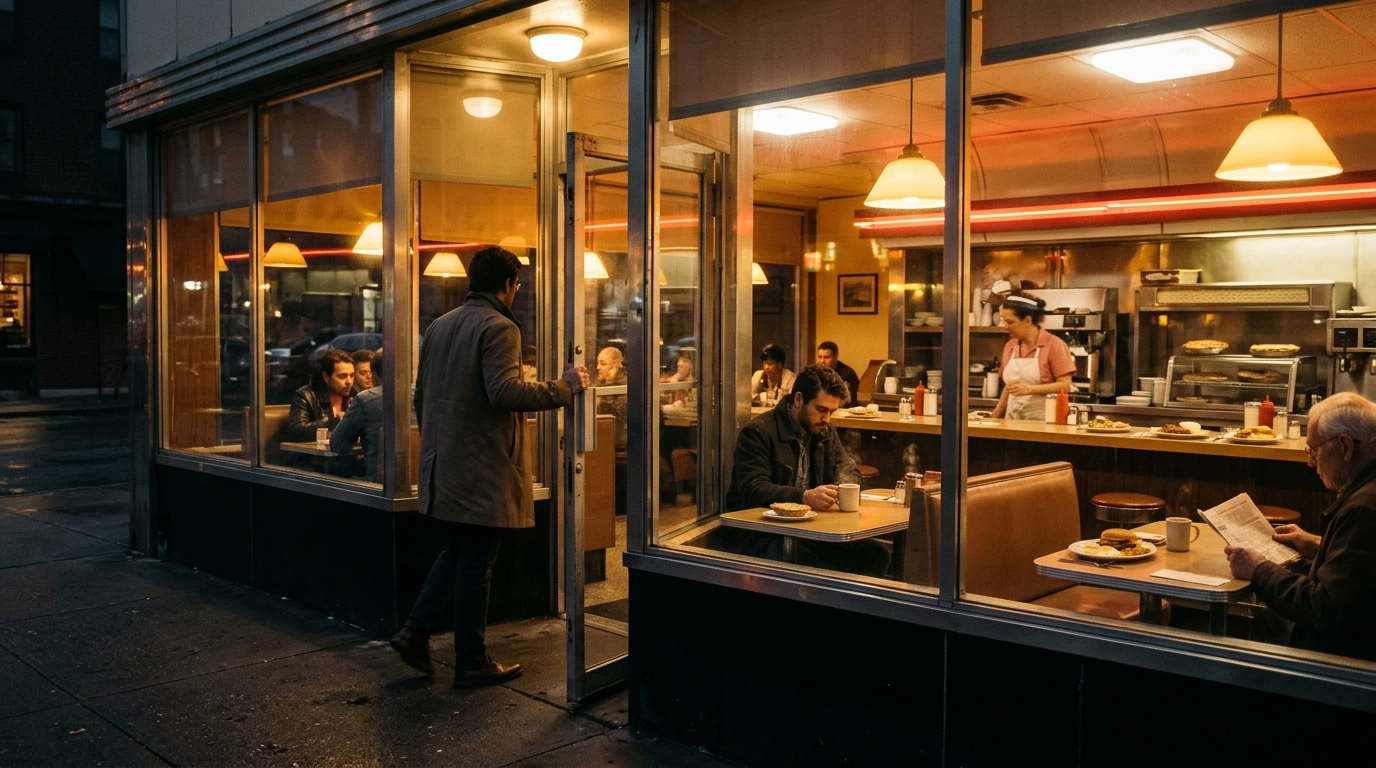
At 12:47 a.m., when the last bus has gone and the streetlights hum over empty pavement, a bell jingles above the door of Marlow’s Diner. A man in a rain-dark jacket slips into the corner booth. He doesn’t pick up a menu. He doesn’t need to. Before he has even settled, a plate of eggs, toast, and a mug of coffee is already on its way.
The cook who sent it is named Dolores Abernathy, and she has been working the overnight shift at this little diner for twenty-two years. She does not ask the man why he is out so late. She never does. She simply sets the plate down, says, “You’re right on time,” and goes back to her grill.
The Hour After the World Goes Quiet
Most of us know the strange feeling of evening settling into night. The emails stop, the phone goes still, and the house gets very quiet. For some people, that quiet is a gift. For others, it is the loudest part of the day, the hour when loneliness finally has room to speak.
Dolores understands this hour better than almost anyone. She describes the first stretch after midnight as “when people stop pretending.” During the day, everyone is busy, and busyness is a wonderful disguise. But once the sun has been gone for a while, the disguises come off.
“They come in with the look,” she told me, wiping her hands on a dish towel. “You know the look. Like they’ve been holding their shoulders up all day and they just can’t anymore.”
How It Started
Dolores did not set out to become anyone’s quiet hero. Years ago, a young woman came in around 1 a.m. and ordered only a glass of water. She sat there for nearly an hour, turning the glass in slow circles. Dolores, on a whim, made her a grilled cheese and slid it across the counter without charge.
The young woman cried, just a little, and then she ate every bite. Before she left, she said something Dolores has never forgotten: “I haven’t had anyone make me food in three years.”
That sentence changed the way Dolores saw her job. She had thought she was cooking breakfast for the night owls. She realized she was doing something older and simpler. She was telling people, with a hot meal, that somebody had noticed they were there.
The Unwritten Rules of the Overnight Counter
Over two decades, Dolores has built a small set of habits. Nobody wrote them down, but every regular seems to know them by heart.
- No one is asked to explain themselves. You can come in at 2 a.m. in your pajamas or your work uniform, and the first question is always about whether you want your eggs soft or firm.
- The coffee is never rushed. Refills arrive before the cup is empty, and no one is ever nudged toward the door.
- Silence is welcome. Some nights the best thing she can offer is to leave a person alone with their thoughts while making sure they are not truly alone.
- If someone cannot pay, the plate stays. A small jar by the register, funded by the regulars, quietly covers the difference.
- Everyone gets a name. Even if it takes a few visits, Dolores learns it, and from then on she greets them like she has been waiting all evening.
A Few of the Faces
The Nurse Who Comes Off Shift
Around 1:30 most nights, a hospital nurse still wearing her scrubs takes the stool nearest the kitchen. She has spent twelve hours holding other people’s worst moments, and she needs somewhere to set the weight down before she drives home to an empty apartment. Dolores gives her pancakes and says almost nothing. “Some people carry the whole building on their backs,” she says. “They need a place to set it down.”
The Man Who Lost His Wife
One of the regulars, a retired machinist, began coming in the month after his wife passed. He found that the evenings were the hardest part, because that was when the two of them used to sit together. Now he sits at Marlow’s instead, and Dolores always places a second cup of tea across from him without comment. He has never asked about it. He drinks from his own, and she lets the other one cool.
The Teenager Who Was Not Ready to Go Home
Not every visitor is lonely in a gentle way. One winter, a teenage boy started arriving after midnight, hovering near the door like he was ready to bolt. Dolores fed him, kept the conversation light, and asked nothing. After a few weeks he began talking on his own. Eventually she helped him find the right people to call. He is in college now, and he still sends a postcard every December.
What Evening Teaches
There is a lesson in all of this that settles in slowly, the way most true lessons do. When the day’s noise fades, what remains is a simple human question: Did anyone see me today?
We spend our daylight hours trying to be useful, productive, impressive. But in the quiet of late evening, none of that matters. What matters is whether we were welcomed somewhere, whether someone set out a cup for us, whether our presence made any small difference to another person.
Dolores has never given a speech about this. She has no platform and no plan to start a movement. She just keeps the grill hot and the light on. Yet over twenty-two years she has quietly given thousands of people the thing they were hungriest for, and it was never really the eggs.
Small Ways to Be Someone’s 1 A.M. Plate
You do not need a diner to do what Dolores does. The heart of it is available to anyone willing to notice. Here are a few gentle ways to carry that spirit into your own evenings:
- Send the late text. Think of the person you know who tends to go quiet at night, and reach out before you turn off the lamp.
- Leave the porch light on. A small sign of welcome means more than we realize, especially to someone walking home alone.
- Learn the names. The night cashier, the security guard, the delivery driver. Using someone’s name tells them they are more than a function.
- Ask, then really listen. When someone says they are fine, wait a beat longer. Sometimes the true answer needs a moment to arrive.
- Share a meal when you can. Food has always been the oldest language of care, and it requires no special words.
The Light That Stays On
When I asked Dolores why she has never moved to a daytime shift, she laughed and shook her head. “Daytime has plenty of people,” she said. “The night is where somebody has to stay.”
Then the bell above the door jingled, and she was already reaching for a plate. A woman stepped in out of the cold, shoulders high, eyes tired, and Dolores looked up with a smile like she had been expecting her all along.
“You’re right on time,” she said.
Tonight, as the day finally loosens its grip on you, consider who in your life might be sitting in the quiet, waiting to be noticed. A warm plate, a kind word, a light left on. It is such a small thing. And as one tired night after another proves, it can be everything.