🎧 Listen to this story
Narrated by Kore · 7,310 characters
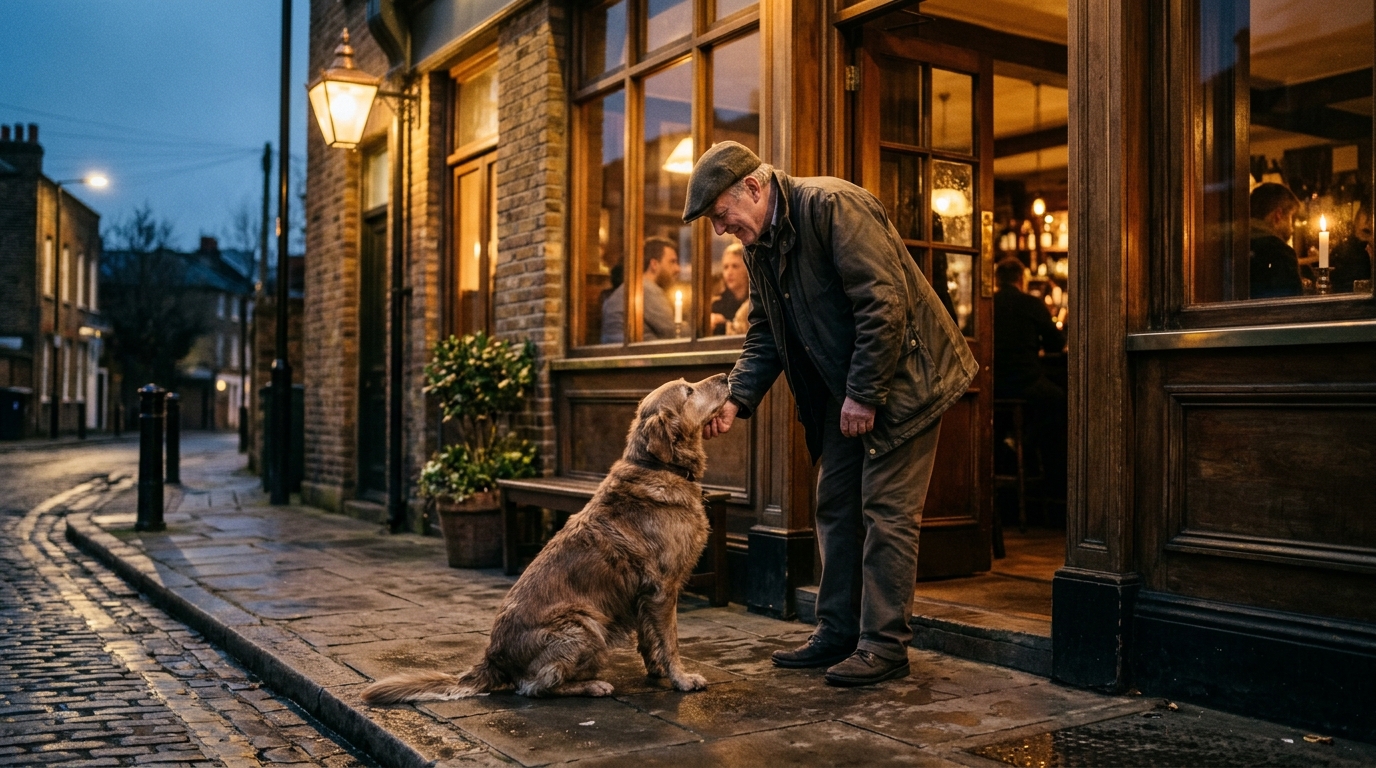
There is a particular hour in a small town when the light goes from amber to blue, the shop awnings roll up, and the last few lamps flicker on along Delancey Street. If you stand near the corner by the old hardware store around ten o’clock, you might notice something small and easy to miss: a shaggy, tan-and-white dog sitting patiently on the sidewalk outside a tavern door, tail sweeping slowly against the concrete, waiting for someone.
The people in town call him Biscuit. Nobody is sure who named him, and nobody owns him. But everyone who lives within a few blocks of that tavern knows what Biscuit is doing there, and most of them have quietly decided to let it be one of the best things about living where they do.
The Man Who Closes the Place Down
His name is Walter. He is seventy-one, a retired machinist who spent forty years running lathes at a plant that has since shut its doors. His wife, Dolores, passed away three winters ago. They had no children, and his brother lives two states away. For most of his adult life, Walter’s evenings had a shape to them: dinner at six, Dolores humming in the kitchen, the television murmuring in the next room.
After she died, the house became too quiet to bear. So Walter started doing something he had never done before. He began walking to the tavern at the end of his street, taking the same stool at the end of the bar, and nursing two beers over three hours. He did not go for the drinking, exactly. He went for the sound of other people, the clink of glasses, the low rumble of a ballgame on the corner television. It was company without the obligation to be company.
The bartender, a woman named Renata, says he never causes trouble. “He tips well, he says goodnight, and he always looks a little like he’s trying to stretch the evening out,” she told me. “I think he dreads the walk home more than anything.”
The Night the Dog Showed Up
About fourteen months ago, on a damp October evening, Walter stepped out of the tavern and found a skinny, mud-spattered dog sitting by the door. The animal looked up at him, did not bark, did not beg, and simply fell into step beside him as he started down the sidewalk.
Walter assumed the dog would wander off at the first intersection. It did not. It trotted beside him past the laundromat, past the shuttered bakery, past the church with the crooked steeple, all the way to his front porch. There it sat down, looked at the door, and waited.
“I told it, go on home,” Walter recalled with a small laugh. “But I didn’t have the heart to say it twice. I put out a bowl of water and some leftover chicken. In the morning, it was gone.”
The next evening, when Walter left the tavern, the dog was sitting in the exact same spot.
A Ritual Takes Shape
It has been over a year now, and the routine has hardened into something close to sacred. Here is how an average evening unfolds, according to the neighbors who have watched it happen:
- Around nine-thirty, Biscuit appears at the tavern’s side door, usually from the alley behind the hardware store.
- He lies down on the cool concrete and does not move, not for foot traffic, not for passing cars, not for the occasional friendly stranger who stops to scratch his ears.
- When Walter finally emerges, Biscuit stands, stretches, and falls in on the left side, close enough that his fur brushes Walter’s trouser leg.
- They walk the nine blocks home at an unhurried pace, stopping at the same streetlamp where Walter pauses to catch his breath.
- At the porch, Walter says, “Goodnight, buddy,” and Biscuit watches the door close before trotting off into the dark.
No leash. No command. No treat in a pocket, though Walter has taken to keeping a few biscuits there, which is likely where the name came from.
What the Quiet Teaches
I think about this story most in the evening, when my own day has finally loosened its grip. There is something about the hour after dark that strips away the performance of being fine. During the day, grief can hide inside errands and conversations and the thousand small tasks that keep us moving. But at night, when the doors close and the lights go low, loneliness has room to stretch out and fill the space.
That is exactly the hour Biscuit has chosen to be there.
He is not solving anything. He cannot bring Dolores back, cannot fill the empty chair at the kitchen table, cannot repair the thing that broke when a long marriage ended. What he offers is smaller and, in its way, larger: the simple, steady fact of a presence beside you in the dark. Someone to walk with. Someone who noticed you were alone and decided that was not acceptable.
Walter put it best when a neighbor asked him about it one evening. “For three years, I walked home to a house where nobody was waiting,” he said. “Now I walk home with somebody. It’s a different walk entirely.”
The Neighbors Take Notice
The town has quietly folded the pair into its evening rhythm. Mrs. Okafor, who sits on her porch with a cup of tea most nights, says she can set her clock by them. “When I see them pass, I know it’s time to bring in the cushions and lock up,” she said. “It’s become a comfort for all of us.”
A few people have offered to adopt Biscuit, give him a proper bed and a bowl and a name tag. Walter has gently declined to make any such arrangement, though not for lack of affection. “He’s chosen his own life,” he explained. “I don’t think it’s my place to put a fence around it.”
And so Biscuit remains a free dog with a single, devoted purpose, a small guardian who works the night shift for no pay and no recognition.
Three Quiet Lessons From a Stray
If you turn the story over in your hands, a few simple truths fall out of it, the kind that tend to settle in when the house is dark and the day has finally exhaled:
- Presence is a gift that costs nothing. Biscuit never fixes Walter’s sorrow. He just shows up, every night, without fail. Sometimes that is the whole job.
- Kindness does not need an audience. Most of the town did not even realize the ritual existed for weeks. The dog was not performing. He simply cared.
- Loneliness hides at the edges of the day. The people who need us most are often those who are fine at noon and fragile at ten p.m. Learning to notice the evening hours might be the most generous habit any of us can build.
Before You Turn Out the Light
Tonight, somewhere in a small town, a man in a worn flannel jacket will push open a heavy wooden door and step into the cool dark. A tan-and-white dog will rise from the sidewalk, shake out his coat, and settle in at his side. The two of them will pass beneath the crooked steeple, past the sleeping bakery, under the one streetlamp that always hums a little too loud.
Neither will say a word. Neither needs to.
And when the porch light clicks on and the door closes behind Walter, Biscuit will linger for a moment on the step, watching the glow in the window. Only when he is sure the house is warm and the man is safe inside will he turn and disappear into the night, his work done for another day.
Maybe tonight, as your own day winds down, you can think of someone who walks home a little too quietly. Maybe you can be, for them, a small and steady presence in the dark. It does not take much. Sometimes it only takes showing up at the same door, at the same hour, and falling into step.