🎧 Listen to this story
Narrated by Kore · 7,032 characters
There is a particular sound a cellblock makes when the day finally gives up. It is not silence, exactly. It is the hum of fluorescent tubes dimming, the clank of a distant gate, a cough, a radio turned low. For Father Daniel Okafor, a prison chaplain who has worked in a state correctional facility for nearly twenty-two years, this is the hour the real work begins.
Most people picture chaplains in the daytime, leading services, handing out paperbacks, signing forms. But Daniel will tell you, without any drama, that the daytime is the easy part. It is when the lights go down and the noise drains out that men start thinking about their mothers, their children, and the people they used to be.
The Hour Nobody Talks About
Daniel does not pretend this is a glamorous job. He keeps a worn gray cardigan in his locker and a thermos of tea that has long gone lukewarm by the time he gets to use it. His evening rounds begin around six, when most of the staff are thinking about going home.
“People assume the loneliest time in prison is a holiday or a birthday,” he says. “Those are hard. But the loneliest moment is actually quite ordinary. It is a Tuesday at dusk, when the day has run out of distractions and a man is left alone with the whole weight of his life.”
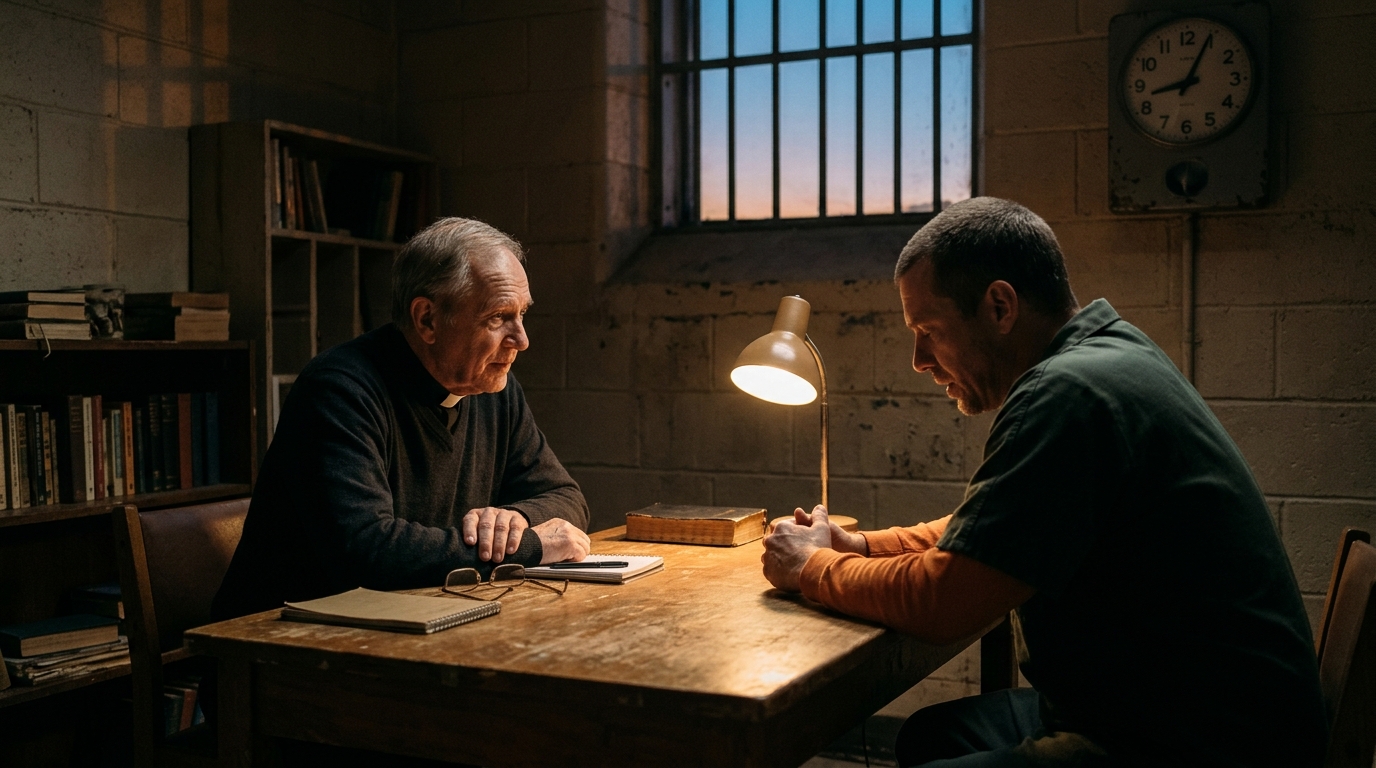
That is when he walks the tiers and stops at doors. Sometimes he is invited in to the common area. Sometimes he just stands at the bars and listens. He has learned that most men do not want advice. They want someone to stay.
A Thousand Conversations, Roughly
Daniel stopped keeping an exact count years ago, but a colleague once estimated, half joking, that he has sat through more than a thousand late evening visits. When he thinks back over them, certain patterns emerge. He shares a few of the things he has come to understand.
What Men Say When the Lights Go Low
- “I just need someone to know I am still here.” Many men fear being forgotten more than they fear the sentence itself.
- “I wrote my daughter a letter and tore it up.” Regret rarely arrives loudly. It arrives in small, unsent gestures.
- “Do you think a person can really change?” This is the question Daniel hears most, and he never answers it quickly.
- “I do not know how to pray, but I wanted to sit with someone who does.” Faith, for many, begins as simple company.
The Night He Almost Said the Wrong Thing
There is one evening Daniel returns to often. He had been called to the cell of a man in his late fifties, serving a long sentence, who had just learned that his sister, the last person who still wrote to him, had passed away.
Daniel arrived with a speech half formed in his head. Something about grief, something about hope, something comforting and tidy. He opened his mouth to begin, and the man looked at him and said quietly, “Please do not fix this. Just sit.”
So he sat. For two hours, on a metal stool, with the cell door open and the tier going dark around them. The man talked about the way his sister used to braid his hair as a boy, about a creek behind their childhood home, about a summer when nothing was wrong. Daniel said almost nothing at all.
“That night rewired how I understand my job,” he says. “I used to think I was there to bring something in. Now I think I am there to be a witness. To say, with my body and my presence, that this man’s sorrow is real and that it is not happening in a vacuum.”
Why the Evening Matters
There is something about the end of the day that strips away performance. In the morning, men in a prison yard have to be tough, guarded, composed. By night, the armor loosens. A man who spent the afternoon posturing may spend the evening staring at a photograph of his child.
Daniel has noticed that the people who truly heal tend to do it quietly and late. Not in the middle of a grand gesture, but in a small, tender exchange when nobody else is watching. He describes it as a kind of dusk of the soul, a softening that happens when the demands of the day finally lift.
This is true outside prison walls too. Most of us know the strange honesty of the hour before sleep, when worries we outran all day catch up with us. A chaplain simply learns to be present in that hour for people who have nobody else.
Small Practices That Keep Him Steady
People often ask how Daniel carries so much sorrow without being crushed by it. He says he does not carry it alone, and he is careful about how he sets it down.
His Evening Rituals
- A slow walk to the parking lot. He lets himself feel the tiredness before he drives home, rather than rushing past it.
- One name each night. Before bed, he says the name of one man he sat with that day and wishes him rest.
- Silence in the car. No radio, no podcasts, just the road and the fading light.
- A porch chair and a cup of tea. Ten minutes, no phone, simply watching the sky change color.
“If I do not practice rest,” he says, “I have nothing to offer the men who need me to be steady. I have learned that gentleness toward myself is not selfish. It is how I stay able to be gentle toward them.”
The Men Who Write Back
Years after some of these men are released, Daniel receives letters. They are rarely long. A few lines in uneven handwriting, a photograph of a new job or a child’s graduation, sometimes just a single sentence: “I remember you sat with me.”
He keeps them in a shoebox at home, and on difficult days he reads one. Not because he needs credit, but because the letters remind him that presence is never wasted. The conversations that felt like they went nowhere often turn out to be the ones a man remembers for the rest of his life.
One former inmate, now working as a carpenter, wrote that he did not remember a single word Daniel said during his hardest night. “But I remember the stool,” he wrote. “I remember that you pulled it up and did not look at your watch.”
What We Can Take From a Quiet Hero
You do not need to work behind prison walls to practice what Daniel does. Most of us are surrounded by people whose loneliest moments arrive at dusk: an elderly neighbor, a friend going through a divorce, a coworker who has gone quiet. The invitation is simple.
- Stay a little longer than is comfortable. Healing often lives in the extra ten minutes.
- Resist the urge to fix. Sometimes the kindest thing is to say nothing and stay.
- Notice the hour. Evening is when many people feel their solitude most sharply.
- Pull up the stool. Offer your presence, unhurried, with no agenda attached.
A Closing Thought as the Day Ends
When Daniel finally switches off the last hallway light and heads home, the prison settles into its long night. Somewhere behind those doors, a man is lying awake, but he is a little less alone than he was yesterday, because someone sat with him and did not leave.
As you wind down your own evening tonight, perhaps with a cup of tea and the sky going soft outside your window, consider who in your life might be lying awake with something heavy. A text, a call, a knock on the door. You may not have the right words. You do not need them. You only need to be willing to stay.