🎧 Listen to this story
Narrated by Kore · 8,128 characters
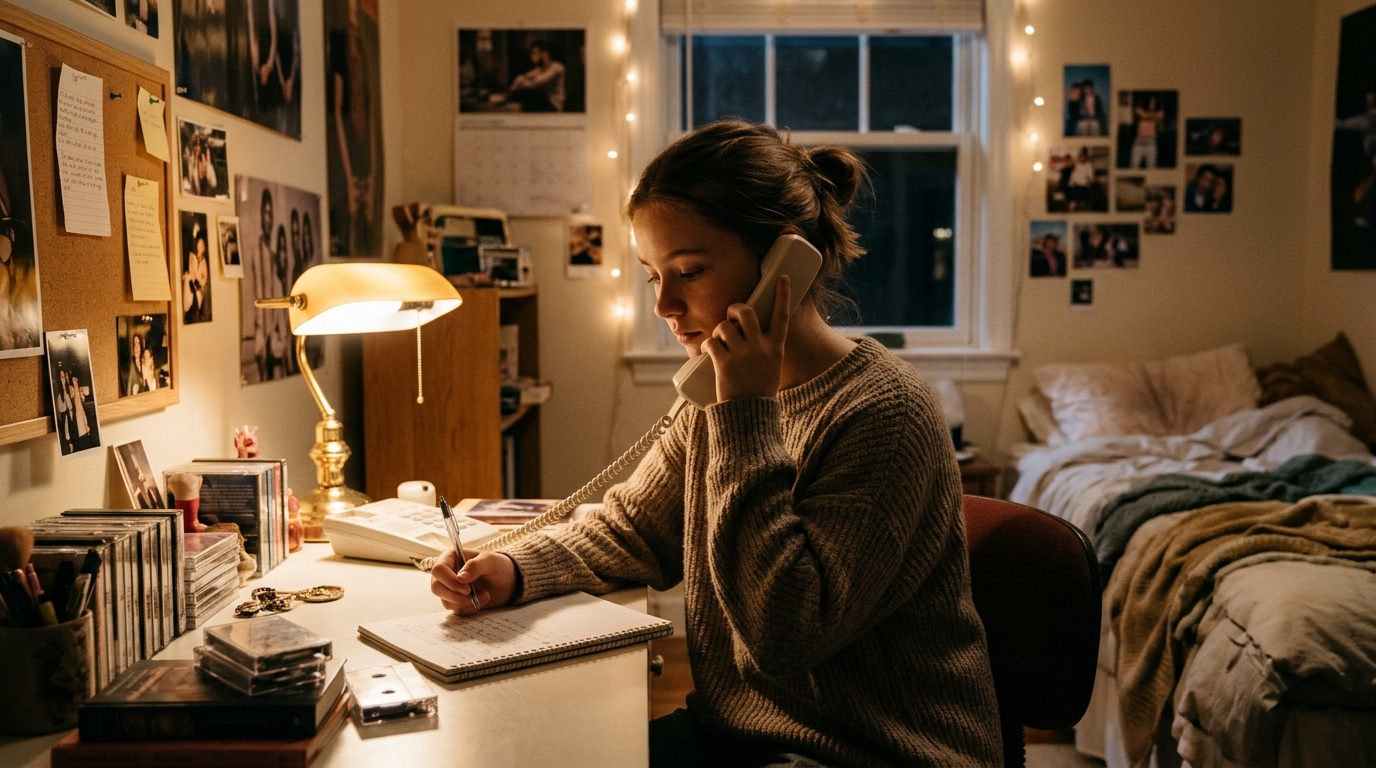
Every night at 9:00, a teenage girl in a small town sits cross-legged on her bed, props a laptop against her knees, and opens a chat window that has become, for hundreds of kids, the safest place on the internet. Her desk lamp is turned low. A mug of chamomile tea cools beside her. Outside, the streetlights flicker on one by one.
She is seventeen now. Two years ago, she could barely get through an evening without feeling like the walls were closing in.
This is the story of how the hardest year of Maya’s life became a nightly lifeline for other kids, and why the quiet hours after dark turned out to be exactly where the healing needed to happen. (Maya asked us to use only her first name, and a few details have been changed to protect the privacy of the young people she serves.)
The Year Everything Went Quiet
It began, Maya says, the way these things often do: slowly, and then all at once. When she was fifteen, her family went through a painful stretch. A parent lost a job, a move to a new school followed, and the friend group she had counted on quietly rearranged itself without her. She stopped eating lunch in the cafeteria. She stopped answering texts. By winter, she had stopped feeling much of anything at all.
“The days were survivable,” she told me. “There’s noise during the day. Class, bells, people talking. You can hide inside all of that. It was the nights that were hard.”
That is a pattern counselors recognize well. When the structure of the day falls away, when the house goes silent and the phone stops buzzing, everything a young person has been holding at bay tends to arrive at once. Evening is when the loneliness gets loudest.
The Search That Found Nothing
One night around 10 p.m., Maya typed a few clumsy words into a search bar, looking for somewhere, anywhere, to talk to someone her own age. She found hotlines staffed by adults, forums that felt chaotic and unmoderated, and resource pages that closed at five o’clock. Nothing felt built for a kid in her exact situation at her exact hour.
“I remember thinking, there has to be a place for this,” she said. “And there wasn’t. So I just sat there.”
It would be easy to end the story there, with a girl alone in the dark. But what Maya did next is the part that stays with you.
The Small Decision at the Kitchen Table
Maya got through that year with the help of a school counselor, a patient aunt, and, she is quick to add, a lot of time. Slowly, the weight began to lift. But she kept thinking about that night, the empty search results, the feeling of reaching out into nothing.
So in the spring, she sat down at the kitchen table with her counselor’s blessing and a notebook, and she started sketching out an idea.
Here is what she knew she wanted:
- It would run in the evenings. Not during school hours, but in the stretch from nine to eleven, when the quiet gets heavy.
- It would be peer-led, with adult backup. Kids would talk to kids, but trained adults would be watching quietly in the background for anything serious.
- It would never pretend to be therapy. It would be a place to be heard, and a bridge to real help when needed.
- It would be free, always. No sign-ups that felt like paperwork, no names required.
Building It the Right Way
Maya was careful about one thing from the start: she did not want to put anyone at risk. Before a single message was sent, she worked with her school counselor and a local nonprofit that supports youth mental health. Together they wrote a simple protocol. Volunteers would complete a short training. Any message suggesting a young person was in danger would immediately be routed to a trained adult and to crisis resources like the 988 Suicide and Crisis Lifeline.
“I’m not a doctor,” Maya said. “I’m a kid who remembers what it felt like. That’s the whole point. But I also know what I’m not qualified to do, and I never wanted to pretend otherwise.”
That humility, the counselors told me, is exactly what makes the project trustworthy.
What 9 P.M. Looks Like Now
The line launched with six volunteers, most of them classmates, and a handful of messages in the first week. Today it has grown to a rotating team of about thirty trained teen volunteers, with a small group of adult mentors overseeing every shift.
Maya still takes the first shift of the night herself, several evenings a week.
“I like to start it,” she said. “Because that’s the hour it got hard for me. If I can be there when it starts, maybe someone doesn’t have to sit in it alone.”
The conversations are rarely dramatic. Mostly, she says, they are small and honest.
- A freshman who cannot stop replaying an embarrassing moment from the school day.
- A boy who feels invisible at home and just wants someone to ask how his day went.
- A girl whose best friend moved away and who does not know how to fill the evenings now.
- Someone who simply types, “I don’t know why I’m here, I just didn’t want to be alone.”
“That last one,” Maya said, “is my favorite kind. Because that person did the hardest part already. They reached out.”
Why Evening Is Where the Healing Happens
There is something worth pausing on here, and it is not just about Maya’s project. It is about the hour itself.
The evening is a strange, tender time. The performance of the day is over. You are no longer expected to smile in the hallway or answer a teacher or keep up appearances. For a lot of us, that is the moment the mask slips and the real feelings come looking for us.
It can feel frightening. But it can also be the most honest hour we get.
“When the lights go down and the house gets quiet, people stop performing,” one of Maya’s adult mentors told me. “The kids who write in at night are often the most real version of themselves. They are tired of pretending. That is a gift, if someone is there to receive it.”
Maya has come to think of the line as something like a porch light left on. Not a rescue. Not a cure. Just a small, steady glow that says, someone is awake, and you can come in.
The Message She Keeps
Maya keeps a folder on her laptop of notes that volunteers have shared with her over the months, stripped of any identifying detail. One of them she can recite from memory.
A young person wrote, near the end of a long chat: “I think I can sleep now. Thanks for staying.”
“That’s it,” she told me, a little quiet. “That’s the whole thing. Thanks for staying. I never needed someone to fix my year. I needed someone to stay.”
What We Can Take From Her Evenings
You do not have to start a nonprofit to carry something of Maya’s spirit into your own life. Her story is a reminder of a few quiet truths worth sitting with at the end of a day.
Small things you can do tonight
- Check in on someone at dusk. A short text in the evening, not to fix anything, just to say “thinking of you,” can land harder than we imagine.
- Be the one who stays. When someone is struggling, we rush to solve. Often they only want company.
- Turn pain into a doorway. The thing that hurt you most may be the thing that equips you to help someone else.
- Know your limits, and name them. Caring well means knowing when to bring in a professional. That is not weakness. It is wisdom.
A Gentle Note, If Tonight Is Hard
If you are a young person reading this and the evenings feel heavy right now, please know you are not the only one, and you do not have to carry it alone. In the United States, you can call or text 988 any time, day or night, to reach the Suicide and Crisis Lifeline. If you are outside the U.S., a quick search for your country’s crisis line can connect you with someone ready to listen. Talking to a trusted adult, a counselor, or a friend can be the first small step.
The Lamp Is Still On
When I asked Maya what she hopes for the line in five years, she did not mention numbers or expansion or recognition. She smiled and looked toward her window, where the sky was going that soft violet it turns just after sunset.
“I hope it’s still just a lamp,” she said. “Somewhere a kid is up at night, scared and thinking nobody’s out there. I just want there to always be a light on.”
Tonight at 9:00, in a small bedroom with a cooling cup of tea, it will be.