🎧 Listen to this story
Narrated by Kore · 8,522 characters
There is a particular kind of quiet that settles over a university library after midnight. The crowds thin out, the coffee cart shutters, and the fluorescent hum seems louder than it did at noon. For the students who remain, hunched over textbooks and half-finished essays, it can feel like the loneliest place on earth. And yet, for a few hundred students at one mid-sized college, that same late-night quiet has become the backdrop for one of the gentlest traditions anyone can remember.
It started with a granola bar and a sticky note.
The Man Behind the Cart
His name is Walter Okonkwo-Reyes, though almost no student knew that for the first two years he worked the overnight shift. They knew him as the night custodian, the man with the squeaky cart and the quiet nod. He started at 10 p.m., after the evening crowd dispersed, and worked until six in the morning, long after the last student stumbled home.
Walter has spent twenty-three years in custodial work, the last seven at this campus. He is soft-spoken, a little shy, and slow to talk about himself. What he will talk about, when asked, is the students he sees at the edges of the night.
“You notice things when you work these hours,” he told a student reporter who tracked him down for the campus paper. “You see who’s still here at two in the morning. You see the ones who forgot to eat. You see the ones who are trying not to cry in the stairwell.”
How It Began
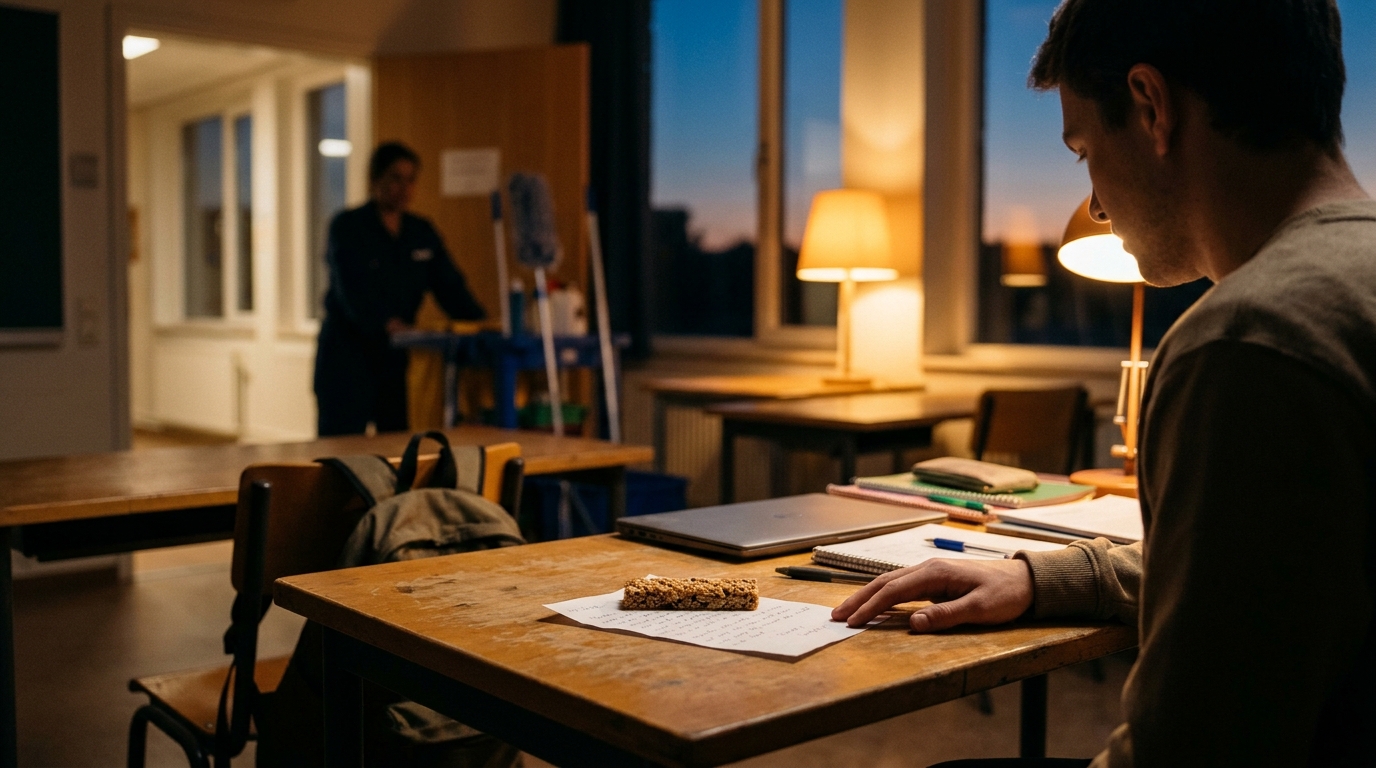
The first note appeared during a brutal finals week. A sophomore named Dani had fallen asleep at a carrel, her head resting on a chemistry textbook, an untouched vending machine bag of pretzels beside her. Walter finished emptying the bins nearby, hesitated, then reached into his lunch bag and set down a granola bar. On a torn piece of paper towel he wrote four words: You’ve got this. Rest.
Dani found it when she woke at 4 a.m. She took a photo of it. She did not know who had left it, only that it was the first time in weeks she had felt like someone, somewhere, was on her side.
The Evening Reflection: Why the Hour Matters
There is something about the last stretch of the day that strips away our armor. By the time the sun has long set and the world has gone quiet, the tough face we wear for daylight starts to slip. The worries we outran all day catch up with us. This is the hour when a deadline feels impossible, when a failing grade feels like a verdict on your whole worth, when homesickness lands like a stone in the chest.
Walter understands this hour better than almost anyone. He works inside it.
“Daytime is for performing,” he said. “Night is when people are just themselves. Tired, scared, hopeful. That’s when a small thing can mean the most. Somebody hands you a cup of water at noon, you barely notice. Somebody leaves you a snack at 2 a.m. when you think nobody’s looking, that sticks with you.”
It is a lesson that settles in once the noise fades: kindness lands differently in the dark. It carries more weight because it asks for nothing. No audience, no thank-you, no credit. Just a small light left on for someone who needed it.
What Walter Leaves Behind
Over time, the practice grew. Walter began keeping a small stash in his cart, funded entirely from his own pocket, which students would only later learn. Here is what a typical night’s offerings might include:
- Granola bars, fruit snacks, and crackers tucked beside sleeping or struggling students
- Bottled water set quietly near the carrels where people had been studying for hours
- Hand-written notes on index cards, never signed, always warm
- Occasionally a single piece of wrapped chocolate on the hardest nights, like the eve of organic chemistry exams
The notes became the heart of it. They were never grand or preachy. They were simple, human, and somehow always exactly right. A few that students later shared online:
- “The version of you who finishes this is already proud of you.”
- “Eat something. The essay can wait ten minutes.”
- “Whatever grade you get, you showed up tonight. That counts.”
- “You are not behind. You are exactly where you are.”
The Mystery and the Unmasking
For nearly two years, students speculated about the identity of the “Midnight Angel,” as the campus social media pages affectionately dubbed whoever was leaving the notes. Theories ranged from a graduate student to a professor with insomnia to an alumnus secretly returning at night. Someone started a thread where students posted photos of notes they had received, and it quickly filled with hundreds of replies.
The truth came out almost by accident. A junior named Marcus, pulling an all-nighter before a thesis defense, glanced up from his laptop around 1 a.m. and saw Walter gently place a bottle of water by a sleeping student three tables over, then pause to scribble something on a card.
Marcus did not say anything that night. But the next evening, he left a thank-you note on Walter’s cart. And the evening after that, so did dozens of others, once word spread.
A Cart Covered in Gratitude
By the end of that semester, Walter’s cart had been transformed. Students had taped cards, drawings, and handwritten letters along its sides. One international student had left a note in three languages. A nursing major wrote simply: “You are why I want to take care of people.”
Walter, characteristically, tried to deflect the attention. “I’m not doing anything special,” he insisted. “I just remember what it was like to be young and tired and far from home.”
The Story Behind the Kindness
It turns out Walter knows that feeling intimately. He came to the country as a young man, working two jobs, sending money home, sleeping in short bursts between shifts. He never had the chance to attend college himself. He remembers what it was like to be exhausted and invisible, and how a stranger’s small gesture once carried him through a hard week.
“A woman at the bus stop gave me half her sandwich once,” he said. “She didn’t say a word. I never saw her again. But I think about it all the time. That’s what I’m passing on. It’s not mine. I’m just carrying it forward.”
That phrase, carrying it forward, has since become a kind of unofficial motto on campus.
What the Students Say Now
The ripple effects have been remarkable. The library now hosts an informal tradition during finals week: students leave small snacks and encouraging notes for one another at empty carrels. A group of seniors organized a quiet fundraiser, not to repay Walter but to stock a “kindness shelf” in the library lobby, refilled weekly, free for anyone who needs it.
Dani, the sophomore who received that very first granola bar, is now a senior. She graduates this spring. She kept that paper towel note in her wallet through all four years.
“I almost dropped out that semester,” she admitted. “I’m not exaggerating when I say a granola bar and four words changed the direction of my life. It reminded me that somebody noticed. When you’re drowning, being noticed is everything.”
Lessons That Settle In With the Night
As the day winds down and the house grows still, Walter’s story offers a few quiet truths worth carrying to bed:
- Small things are not small. A snack, a sentence, a moment of attention can be the lifeline someone was waiting for.
- Kindness does not need an audience. Some of the most powerful acts are the ones done in the dark, with no expectation of being found out.
- You do not need much to give much. Walter’s budget was modest. His generosity was enormous. The two are not connected.
- The people we overlook are often the ones holding us up. Behind the cart, the uniform, the quiet nod, there is a whole life and a whole heart.
- We can pass on what we once received. Every act of kindness we have ever been given is a seed we get to plant elsewhere.
A Thought Before You Sleep
Tonight, somewhere, a student is staring at a screen at 2 a.m., wondering if they are good enough. Somewhere a custodian is pushing a squeaky cart through an empty hallway, a granola bar tucked in a pocket, a pen at the ready.
And somewhere in your own life, there is someone who is tired in a way they have not told anyone. Someone who would be undone by the smallest unexpected kindness.
You do not have to do something grand. You only have to notice. Leave the light on. Slip a note under a door. Send the text you have been meaning to send. Then turn out your own lamp and let the quiet do its work.
Walter would tell you the same thing, in his gentle way, scribbled on a scrap of paper and left where you would find it: You are not alone out here. Rest.