🎧 Listen to this story
Narrated by Kore · 7,207 characters
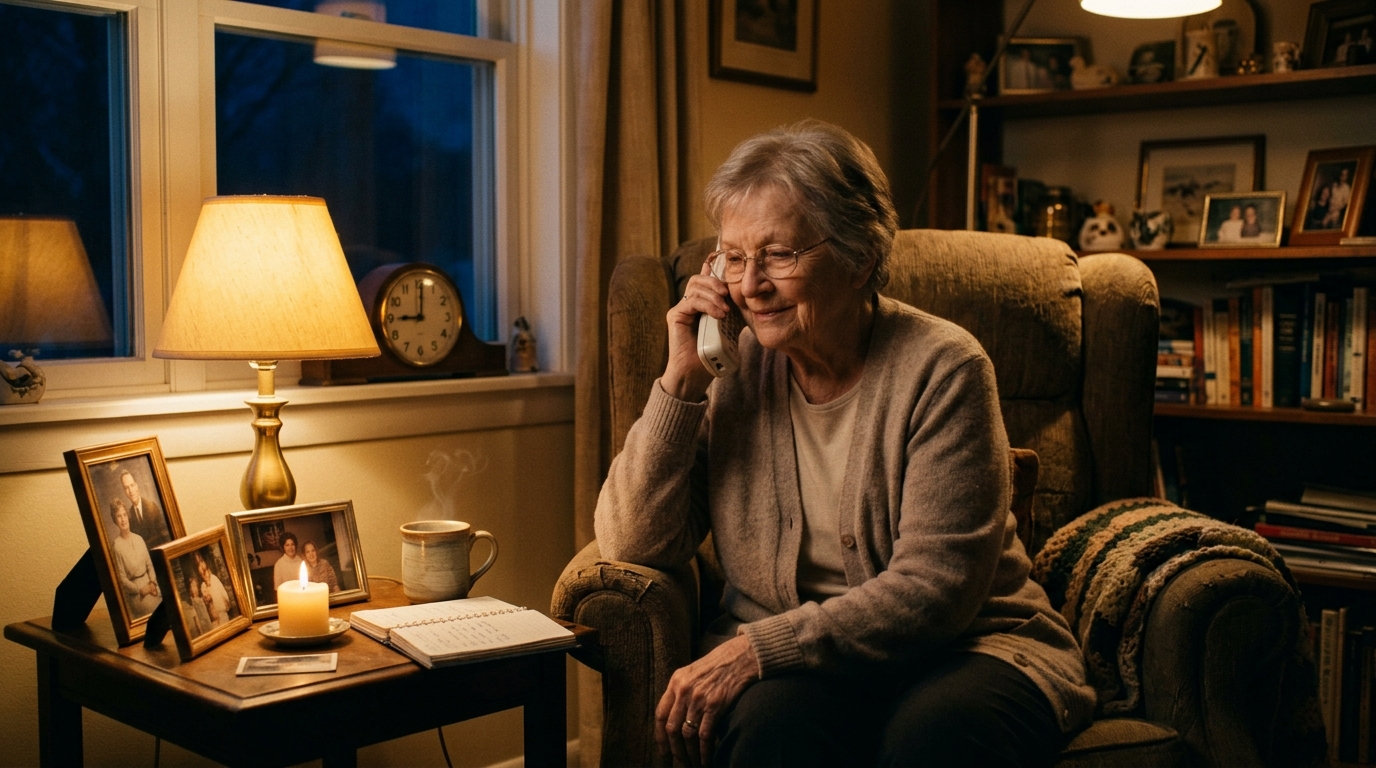
At nine o’clock every evening, in a small brick duplex at the end of Alder Lane, a phone rings twice. Then a voice says the same four words it has said roughly four thousand times: “Goodnight, Margaret. Sleep well.”
The voice belongs to Walter Prescott, a retired school bus mechanic who is now seventy-six. The woman on the other end of the line is Margaret Ellison, eighty-nine, who has not left her home on her own in more than a decade. Walter lives next door. He could walk over and knock. But years ago, the two of them settled into a ritual, and neither has been willing to break it since.
How a Single Phone Call Became a Promise
The story begins in the winter of twelve years ago, on a night that Walter remembers more clearly than most of his own birthdays.
Margaret had recently had a fall that left her with a badly broken hip. Her recovery was slow, and her confidence never fully returned. Her daughter lived across the country and called on Sundays. Her friends, once a lively circle from the church choir, had thinned out through illness, relocation, and loss. Slowly, the world outside her front door became something she watched through a window instead of walked through.
Walter noticed that her porch light stayed off most evenings. Then he noticed that no lamp seemed to be on in the front room either. One night, on impulse, he picked up the phone and dialed the number he had only ever used to ask if she needed her walkway salted.
“I just wanted to know you were all right,” he told her. “That’s all. Just checking in before bed.”
Margaret was quiet for a moment. Then she said, “Well, that’s very kind of you, Walter.”
He called again the next night. And the next.
The Hour When the House Gets Quiet
Ask Walter why nine o’clock, and he gets a thoughtful look. He will tell you it was never a calculated decision. It simply turned out to be the hour when the day’s busyness drains out of a house and the silence starts to press in.
“Mornings are easy,” he says. “There’s light, there’s the radio, there’s the mail. Afternoons have their own noise. But evening is when you feel it. That’s when the quiet shows up, and it’s not always a friendly quiet.”
Anyone who has spent an evening alone knows what he means. The dishes are done. The television has said everything it has to say. The windows go dark and turn into mirrors. For a person with no one to talk to, those last hours before sleep can stretch long and heavy.
Walter understood that a short call at that exact hour could do something a visit at noon never could. It could close the day with a human voice instead of an empty room.
What the Call Actually Sounds Like
It is not a long conversation. Most nights it lasts under five minutes. They talk about small things:
- Whether the cardinal came back to the feeder
- What was on the Wednesday crossword that stumped them both
- How Margaret’s tomatoes did that summer, or how they might do next year
- The weather, always the weather
- Whether she remembered to take her evening pills
And then, every night, without fail, the same ending. “Goodnight, Margaret. Sleep well.”
“Goodnight, Walter,” she answers. “See you in the morning.”
Twelve Years, Four Thousand Nights
Over the years, Walter has missed exactly zero calls. Not during a bout of pneumonia he had in his sixties. Not the night his own sister passed away. Not on the evening his granddaughter was born, when he stepped out of the hospital hallway and dialed from the parking lot with the phone cupped against the wind.
“People think it must feel like a burden,” he says. “It doesn’t. It’s the best part of my day. I’ve got a reason to end the evening on a good note, and I never go to bed worried.”
That last part is worth sitting with. We often think of kindness as something we give away, a subtraction from our own time and energy. But Walter describes something closer to an exchange. The call steadies him as much as it steadies her. Two people, each keeping watch over the other’s evening, each sleeping a little easier because of it.
The Night the Phone Did Not Ring Back
There was one evening, about four years in, when Margaret did not pick up.
Walter let it ring. He hung up and tried again. Nothing. He did not hesitate. In his slippers and a cardigan, he crossed the strip of grass between their houses, used the spare key she had given him years earlier, and found her on the kitchen floor. She had slipped reaching for a glass and could not get up.
She was shaken but not seriously hurt. The paramedics told them both that she could have lain there until morning, or longer. Neither of them has ever said so aloud, but they both know what that unanswered ring might have meant if no one had been listening for it.
“That’s when it stopped being just a nice habit,” Walter says quietly. “It became a lifeline. For both of us, really.”
What an Ordinary Hero Looks Like at Dusk
We tend to picture heroism as dramatic, a rescue or a sacrifice that makes the evening news. Walter’s version has no cameras and no applause. It happens on a corded phone beside a recliner, at the same hour, in the same gentle voice.
But consider what this small act protects against. Loneliness is not just an unpleasant feeling. Researchers have linked chronic isolation to poorer health, disrupted sleep, and a heavier toll on the mind. A consistent, caring voice at the right moment of the day is a quiet form of medicine, and it costs nothing but attention.
Lessons That Settle In Once the Day Is Done
If Walter’s story has a lesson, it arrives softly, the way most good lessons do after the noise has faded.
- Consistency is its own kind of love. One grand gesture fades. A small act repeated for years becomes something a person can build her whole sense of safety around.
- Timing matters as much as effort. Walter did not give more. He gave at the moment it counted most.
- You do not need a plan to begin. He started with a single impulsive call and let it grow into a tradition.
- The giver is changed too. Kindness that costs us nothing but time often returns more than we spend.
- Ordinary neighbors are a safety net. The people closest to us are often the ones best placed to notice when something is wrong.
Who Is Waiting for Your Goodnight?
Margaret is ninety now, give or take a few months, and the calls continue. Her daughter visits more often these days, and she has started making a point of being there on some evenings. But on the nights she is not, the phone still rings at nine, twice, and a familiar voice still wishes her a good rest.
When asked what the calls mean to her, Margaret is not a woman of many words. “It means somebody knows I’m here,” she says. “At the end of the day, that’s all anybody really wants.”
As the evening settles around you tonight, perhaps with the lamp low and the house finally still, it might be worth asking a gentle question. Is there someone on your street, in your family, or in your contacts who spends the quiet hours alone? Someone who would feel the difference of a single, steady voice at the end of the day?
You do not need twelve years. You do not need a grand plan. You only need a phone, a few minutes, and the willingness to say four simple words.
Goodnight. Sleep well.