🎧 Listen to this story
Narrated by Kore · 8,261 characters
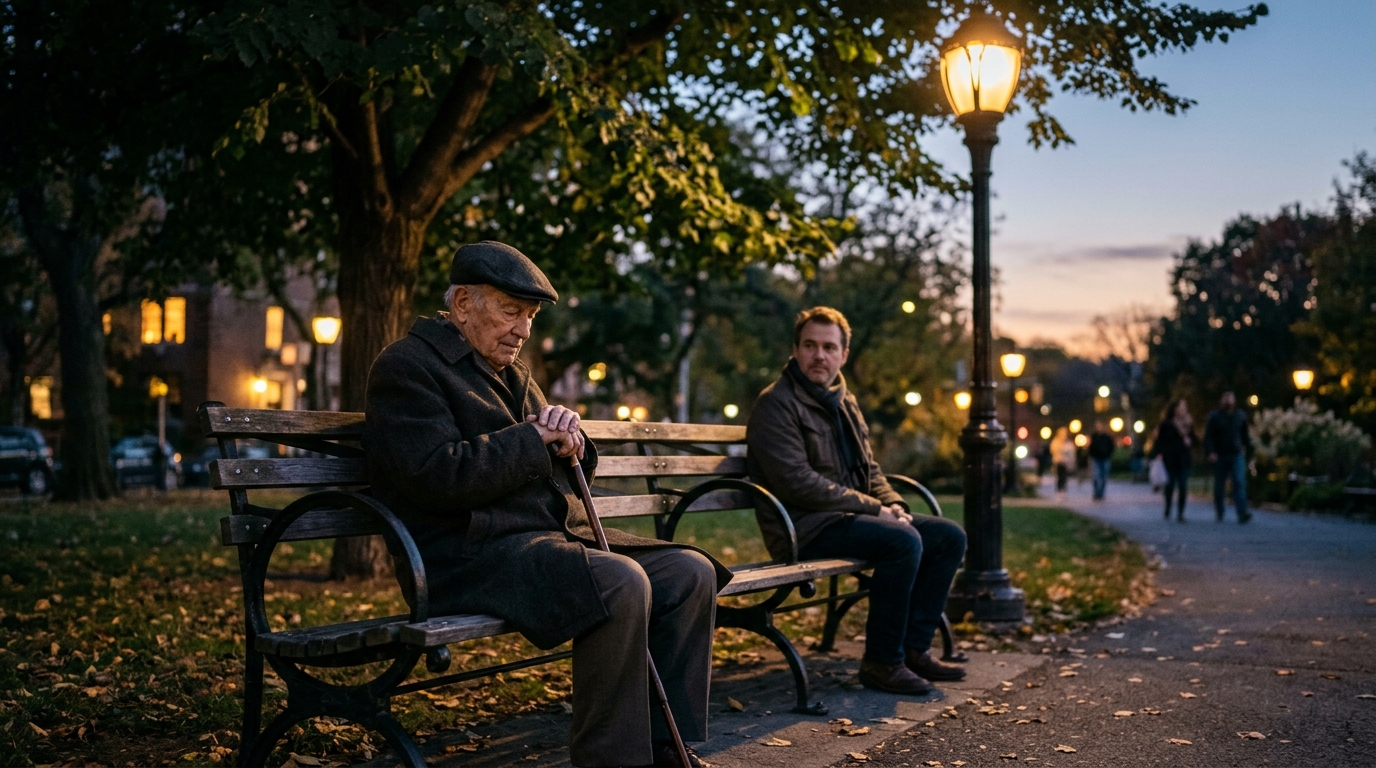
There is a particular hour in late autumn when the park empties out without anyone announcing it. The joggers go first, then the dog walkers, then the parents with their tired, sticky-fingered children. What remains is a soft blue quiet, and the sense that the day is exhaling. It was in that hour, on a green bench near the pond at Alder Creek Park, that a man named Walter Henning sat down and did not get up for a very long time.
This is the story of what happened next, told the way it was told to me: by the stranger who stayed.
The Man Who Couldn’t Go Home
Walter was seventy-three. Six weeks earlier, his wife of forty-nine years, Dorothy, had died after a short illness that moved faster than any of the doctors had predicted. Their daughter had flown in for the funeral, stayed for ten days, and flown home again. The casseroles from neighbors had stopped arriving. The sympathy cards had slowed to a trickle.
What was left was the house, and the house was the problem.
Every evening, around five, Walter would find himself putting on his coat. He told himself he was going for a walk. What he was really doing was avoiding the hour when the kitchen light needed turning on and no one was there to say, as Dorothy always had, “Is it dinner yet, or are we pretending?”
So he walked. And on this particular evening, his legs simply gave out near the pond, and he sat down on the nearest bench and stared at the water as the sky went from peach to lavender to a deep, bruised blue.
Enter Priya
Priya Raman, thirty-four, was a hospice nurse who was supposed to be somewhere else. She had finished a long shift, skipped the bus on purpose, and decided to walk the long way home through the park because, as she put it, “I needed to put the day down somewhere before I carried it into my apartment.”
She noticed Walter first as a shape: an older man, hunched, hands folded between his knees, perfectly still in the way that only people carrying something heavy are still. She had spent eleven years sitting at bedsides. She knew that kind of stillness.
“I almost kept walking,” she told me. “That’s the honest truth. I was tired. It wasn’t my business. But I’d walked maybe twenty feet past him when I thought: nobody is going to sit with him. And I turned around.”
What She Did, and What She Didn’t Do
Here is the part that stayed with me, and the reason I wanted to write this at all. Priya did not do anything dramatic. She did not offer advice or recite comforting phrases. She did not say that Dorothy was in a better place or that time heals. She had learned long ago that those sentences, however well meant, tend to slide off a grieving person like rain off glass.
She sat down at the far end of the bench, left a polite gap between them, and said only: “Mind if I sit? My feet are done for the day.”
Walter nodded without turning his head.
And that was it. For nearly ten minutes, neither of them said a word. The ducks drifted. A last cluster of leaves let go of a maple and spiraled down. Somewhere across the pond, a lamp flickered on in a window.
The Gift of Not Filling the Silence
It was Walter who finally spoke. “She used to feed those ducks,” he said. “Against the rules. There’s a sign.”
Priya laughed softly. “Of course she did.”
And just like that, a door opened. Walter began to talk, haltingly at first, then more freely. He told her about Dorothy’s terrible singing voice and her habit of leaving every cabinet door ajar. He told her about the way she hummed while doing the crossword and refused, absolutely refused, to let him help. He told her about the thirty-fourth anniversary dinner they had spent at a diner because the fancy restaurant lost their reservation, and how it became the best night of the year.
Priya listened. She asked small questions. She let him cry when he cried, and she did not rush to hand him a tissue or fix his face. She just stayed.
When the Streetlights Came On
At some point, without either of them noticing the exact moment, the park lamps flickered awake along the path. One, then another, then the whole row, each pool of amber light stretching toward the water.
Walter looked up and seemed startled. “I’ve been here two hours,” he said.
“You have,” Priya said gently. “I’m glad I got to hear about her.”
He was quiet for a moment. Then he said something Priya has repeated to me almost word for word: “The worst part of the evening is that nobody’s listening anymore. Forty-nine years of somebody listening. And then it just stops.”
That, she told me, was the real wound beneath the grief. Not only the absence of Dorothy, but the absence of an audience for his own life.
What Evening Does to Grief
There is a reason so many people describe the hours after sunset as the hardest part of loss. The day’s tasks, the errands, the small distractions that keep sorrow at arm’s length, all of them fall away. The light changes. The house grows quiet. The mind, no longer occupied, turns toward what is missing.
Grief counselors often note that early evening can be a heightened time for loneliness, particularly for people who once shared a daily ritual with the person they lost. The dinner hour, the television show, the walk before bed. These routines become empty rooms.
Which is exactly why a bench at dusk, and a stranger willing to sit through it, can matter so much.
Small Ways to Be the Person Who Stays
Priya’s example is a gentle template for the rest of us. If you ever find yourself near someone who is quietly struggling, consider these small gestures:
- Offer presence before words. Sitting nearby, without an agenda, can say more than any speech.
- Skip the silver linings. Phrases like “everything happens for a reason” often close a conversation rather than open one.
- Ask about the person they lost. Grieving people usually want to talk about their loved one. Most of the world stops asking.
- Let silence be okay. You do not have to fill every pause. Often, the pause is where healing happens.
- Stay a little longer than is comfortable. The extra ten minutes is often the part that matters.
The Walk Home
When Walter finally stood, his knees stiff from the cold, Priya stood too. She did not ask to walk him home, and he did not offer. But as they reached the park entrance, he stopped and turned.
“Same time tomorrow?” he asked, and then looked embarrassed. “I mean, only if you’re passing through. I don’t want to impose.”
Priya smiled. “I’ll be passing through.”
She was. And the evening after that, too. Over the following weeks, the bench near the pond became something like an unofficial appointment, a place where a retired machinist and a hospice nurse traded stories as the light faded. Eventually, Walter brought a small paper bag of bread crusts. “Don’t tell the sign,” he said.
What the Evening Taught Her
I asked Priya why she thought it mattered so much, that one evening, that one bench.
She thought about it for a long moment. “In my work, I see people at the very end of life,” she said. “And what almost everyone wants, at the end, isn’t a miracle. It’s company. It’s someone who won’t look away. I think that’s true for the people left behind, too. We spend so much energy trying to fix grief. But grief doesn’t need fixing. It needs witnesses.”
She paused, and then added: “That evening, I got more out of it than he did, probably. I went home lighter. It’s strange. You carry your own day a little easier when you’ve helped someone set theirs down.”
A Thought to Carry Into Your Own Evening
Tonight, as the light fades where you are, consider the quiet people in your orbit. The neighbor whose porch light has been on a little too long. The coworker who stopped mentioning weekend plans. The older relative whose phone rings less than it used to.
You do not need a grand gesture. You do not need the right words. You only need to be willing to sit down, leave a gap on the bench, and stay until the streetlights come on.
Walter still walks to the pond most evenings. He says the house has gotten easier, though never easy. He has started humming again, badly, while he makes dinner. And when the kitchen light flickers on at the end of the day, he sometimes answers the silence out loud: “Not yet, Dot. We’re pretending.”
Some evenings, that is its own kind of healing.