🎧 Listen to this story
Narrated by Kore · 7,719 characters
If you drive down Alder Lane in the hour before sunset, you will see her. A small woman in a faded green cardigan, a watering can in one hand and a pair of worn pruning shears tucked in her apron pocket. She has been there every evening for four years, through summer heat, autumn drizzle, and the kind of January cold that makes the soil ring like iron. The neighbors no longer call it Margaret’s garden. They call it the town’s garden, and they mean something deeper than ownership.
The Winter Nothing Grew
Margaret Ellison was seventy-one when her husband Walter died. They had been married forty-six years. The house on Alder Lane held every one of them, in the chipped teacup he insisted on using, in the reading glasses still folded on the arm of his chair, in the quiet that now filled rooms once crowded with his humming.
She told a local reporter that the first winter was the hardest, not because of the cold, but because of the evenings. ‘Mornings, you have errands. Afternoons, there are people. But when the light goes gold and then gray, that was when Walter and I would sit on the porch together. And suddenly I was sitting there alone.’
One evening in early March, she walked out to the overgrown patch of yard beside the porch, the spot where Walter had once grown tomatoes before his knees gave out. It was nothing but weeds and frost-heaved dirt. She knelt down, not because she had a plan, but because she could not bear to sit still another minute. She started pulling weeds. By the time the streetlights flickered on, she had cleared a patch the size of a doormat.
She came back the next evening. And the next.
A Habit Becomes a Promise
Margaret is quick to say she was not a gardener. She killed her first three rounds of seedlings. She planted marigolds too close together and sunflowers in the shade. A neighbor’s teenage son, passing on his bicycle, once stopped to tell her the lavender needed more sun. She laughed for the first time in months, and then she moved the lavender.
What she did have was a rule she made for herself that first spring: she would show up every evening at six, no matter what. Not because the plants demanded it, but because she did. The garden gave the end of her day a shape, a reason to put on her boots and walk out the door instead of sinking into the silence.
She has kept that promise through a broken wrist, two bouts of the flu, and a thunderstorm so fierce that her daughter drove over to drag her indoors. Margaret went back out the moment the lightning passed, in a rain poncho, to check on the tulips.
How a Town Started Watching
At first, people simply noticed. A woman with a watering can, every evening, always at the same hour. Drivers began slowing down. Dog walkers began timing their routes to pass by. A few people waved. Then a few people stopped.
The town itself had been through a hard stretch. A factory that employed a third of the community had closed the year before, and a sense of weariness hung over the main street like fog. Shops had gone dark. Families had left. People spoke in the flat voices of those who had stopped expecting good news.
And yet here was this garden, growing steadily and stubbornly in the fading light, tended by a woman who had every reason to give up and had simply decided not to.
The first gift left at the garden gate was a bag of bulbs, tied with kitchen twine. The second was a rusted trowel with a note that said, ‘My mother used this. She would have liked you.’ Soon there were seedlings in paper cups, a birdbath, a hand-painted stone that read Keep Going. Strangers began leaving small tokens of their own sorrows and hopes, as though the garden had become a quiet place where a person could set something down.
What the Garden Gave Back
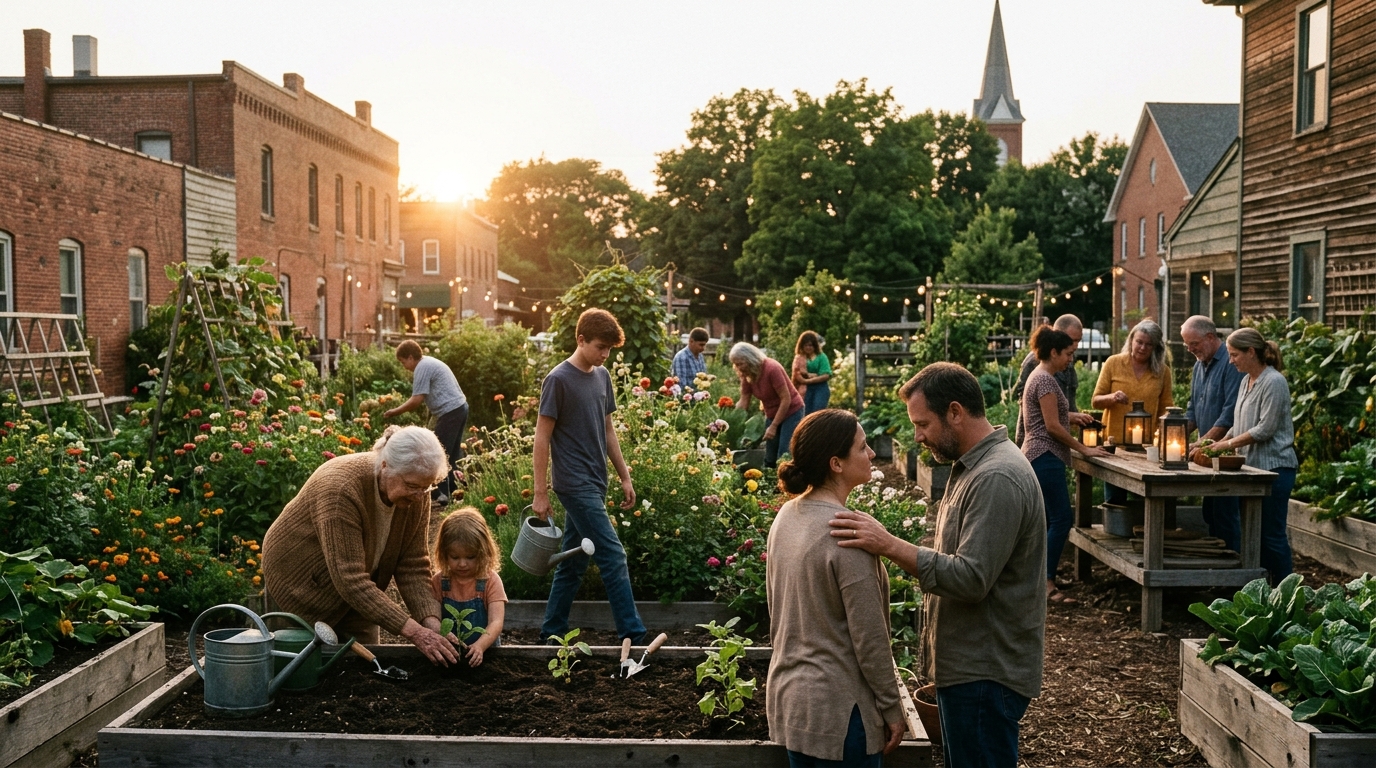
By the second summer, Margaret was no longer alone at six o’clock. Neighbors drifted over to weed beside her, to share a thermos of tea, to sit on the low stone wall and say nothing at all. A retired schoolteacher began reading aloud from the porch. A young man who had lost his job at the factory started building raised beds out of salvaged lumber, and found that working with his hands eased something he had no words for.
The garden did not fix the town’s troubles. It could not reopen the factory or bring back what people had lost. But it offered something else: proof. Proof that you can tend something small and ordinary in the worst season of your life, and that over time the tending adds up to something no one expected.
Here are a few of the quiet lessons the people of Alder Lane say the garden taught them:
- Showing up matters more than doing it perfectly. Margaret’s early plantings were a mess. What mattered was that she came back.
- Grief and growth can share the same soil. She never stopped missing Walter. She simply found a way to carry him forward.
- Healing is rarely a single dramatic moment. It is a thousand small evenings, each one a little easier than the last.
- Hope is contagious. One person’s stubborn routine gave an entire community permission to begin again.
The Hour Between Day and Night
There is something about the evening that Margaret has come to treasure. She says the light does something gentle to a garden at that hour, softening every edge, turning the leaves translucent, making even the humble beans look like they are glowing from within.
‘The day has done its worst or its best by then,’ she says. ‘You can’t change any of it. All you can do is tend what’s in front of you. I think that’s why evening is when I feel closest to Walter. We never needed to say much out there. We just watched things grow.’
It is the same hour when most of us sit with whatever the day left behind: the worry we carried, the words we wish we had said, the small kindness we nearly missed. Margaret’s garden suggests a different way to meet that hour. Not by sitting alone with the weight of it, but by putting our hands in the earth and letting something living answer back.
A Symbol Takes Root
Last spring, the town council voted to dedicate the corner of Alder Lane as a community green space, with Margaret’s garden at its heart. There was a small ceremony. Someone brought folding chairs. A local band played, slightly off key, and no one minded. A child presented Margaret with a crayon drawing of the garden, every flower a different impossible color.
Margaret thanked everyone, a little embarrassed by the fuss, and then she did what she always does. She checked her watch, noticed it was nearly six, and quietly slipped away to water the roses.
The shops on Main Street have begun to reopen, one by one. A young couple bought the old hardware store. A bakery moved in beside it. Nobody credits the garden with a miracle. But more than one person has said, off the record, that it was the first thing in a long time that made the town feel like a place worth staying.
A Question to Carry Into Tonight
As the light fades where you are, consider the small, steady things you could tend. They do not have to be gardens. A friendship you have let go quiet. A habit that steadies you. A kindness you could offer a neighbor who is walking through their own long winter.
Margaret never set out to heal a town. She only set out to get through one evening, and then another. That is how most recoveries begin: not with a grand gesture, but with a person who decides to show up at six o’clock, rain or shine, and keep the promise.
Somewhere on Alder Lane tonight, the porch light is glowing, the watering can is nearly empty, and the first tulips of the season are leaning toward the last of the sun. If you listen closely, you might hear what the whole town has learned to hear: the quiet, unmistakable sound of something beginning again.