🎧 Listen to this story
Narrated by Kore · 7,187 characters
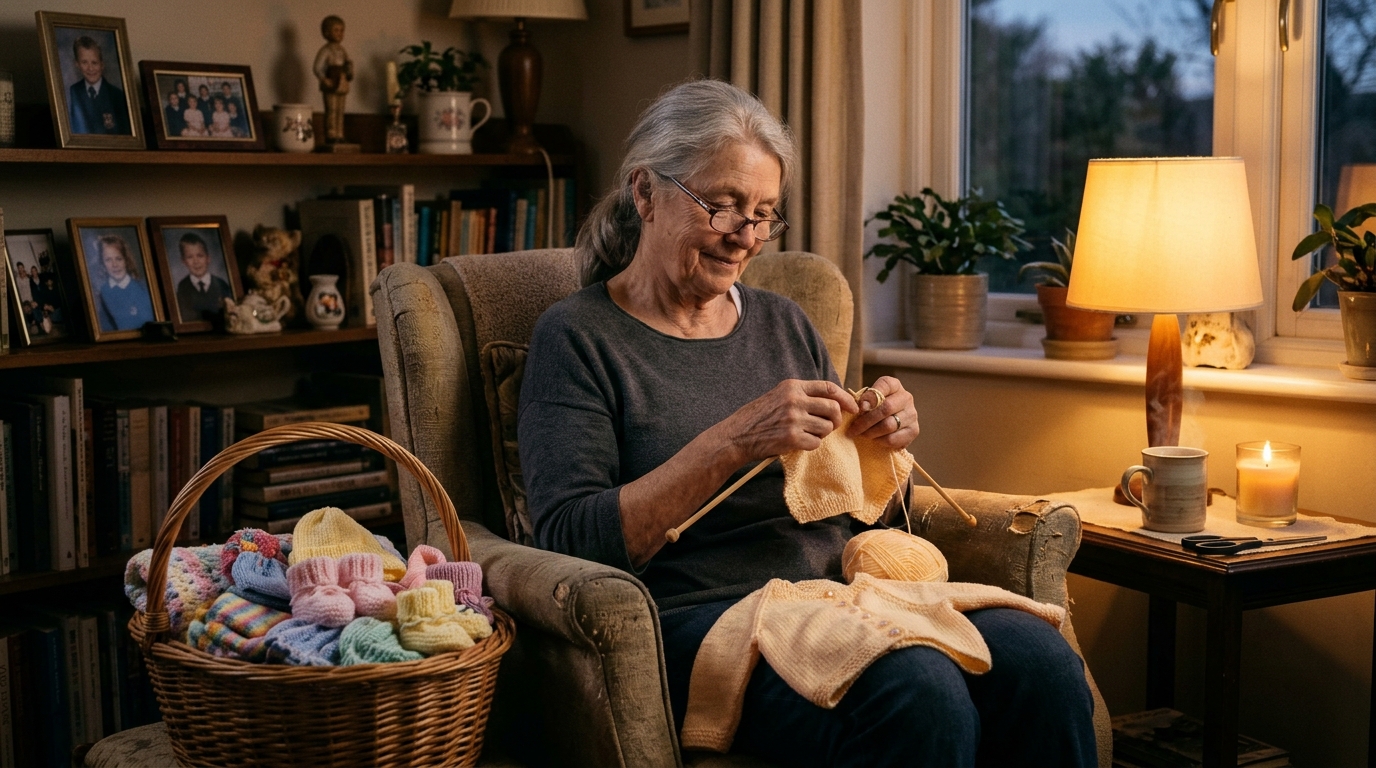
At 6:15 every evening, just as the light outside her kitchen window turns the color of weak tea, Marguerite Delacroix-Hanley sits down in the same worn armchair, pulls a skein of yarn into her lap, and begins to knit. She does not turn on the television. She does not check her phone. She simply lets the needles find their rhythm, and for the next two hours, she makes something small and soft for a child she will never meet.
Marguerite is 71, a retired elementary school teacher from a small town in the Midwest. Since her husband passed four winters ago, she has knit more than 600 blankets for the neonatal intensive care unit at a hospital forty minutes from her home. Not one of the babies who receive them knows her name.
The Evening That Started It All
It began on an ordinary night, though not an easy one. Marguerite had spent the day clearing out closets, the kind of grief work that never really ends. By dusk she was sitting in the quiet house, the silence pressing in around her like a held breath.
She picked up a half-finished scarf her husband had once teased her about, and something shifted. “I realized the evenings were the hardest part,” she told me when we spoke. “The day has structure. You have errands, phone calls, the mail. But when the sun goes down, the house just waits. I needed something for my hands to do and something for my heart to hold.”
A few weeks later, a former colleague mentioned that her granddaughter had been born early and spent six weeks in the NICU. She described the tiny hospital blankets, thin and white and utilitarian, and how a handmade one from a volunteer had been the only thing in that sterile room that felt like home. Marguerite listened, and then she went home and cast on her first stitch.
What a Blanket Means in a Room Full of Machines
A NICU is a place of hushed urgency. There are monitors that chirp, incubators that glow, and parents who hover at the edges of a world that suddenly feels too fragile to touch. In a setting built for survival, softness can feel like a luxury. But nurses will tell you it is anything but.
A small knitted blanket does several quiet things at once:
- It gives parents something to hold. When a baby cannot be lifted from the incubator, a blanket tucked beside them becomes a way to feel connected.
- It carries a scent and a texture of home. Parents can rub a blanket against their skin and leave it with the baby, so the child is surrounded by a familiar smell.
- It marks the baby as a person, not a patient. A bright yellow or sea-green blanket turns an anonymous crib into one belonging to someone loved.
- It stays. Many families take the blanket home, and it becomes the first keepsake of a hard beginning.
One NICU nurse who receives Marguerite’s work put it simply: “We have a hundred things that keep these babies alive. The blankets are what remind their families why it matters.”
The Ritual of the Quiet Hour
What strikes me most about Marguerite is not the number of blankets but the way she talks about the evening itself. She treats it as something almost sacred.
She starts by making tea she rarely finishes. She lights a single lamp beside the chair rather than the overhead light. And she picks her yarn for the night the way some people choose a book, depending on her mood and, often, on a feeling she has about who might receive it.
“I imagine a mother in a hospital chair at three in the morning, so tired she can’t think,” Marguerite said. “I don’t know her. I’ll never know her. But I knit like I’m holding her hand through the stitches.”
There is a particular kind of peace in that, she says. By the time the last row is finished for the night, the grief that arrives with the dark has softened. It has not vanished, but it has found somewhere gentle to go.
Why Evening Work Heals
Psychologists often note that repetitive, creative, hands-on tasks can calm an anxious mind, easing the mental loops that tend to spin at the end of a long day. Knitting in particular has been linked to lower stress and a sense of meaning when it is done for someone else. For Marguerite, the evening has become less a time of absence and more a time of purpose.
The Letter She Never Expected
For most of those four years, Marguerite received no thanks, and she never asked for any. She simply dropped her finished blankets in a bag at the hospital volunteer desk, tucked a small handwritten tag into each one that read Made with love, for you to hold on to, and drove home.
Then, last spring, an envelope arrived in her mailbox. It was from a young father whose daughter had been born at twenty-nine weeks. He had found Marguerite’s address through the volunteer office. Inside was a photograph of a toddler, healthy and laughing, wrapped in a lemon-yellow blanket with a slightly uneven border.
“She still sleeps with it every night,” he wrote. “We never knew who made it. But on the hardest nights of our lives, that blanket felt like someone was looking out for us. Thank you for being that someone.”
Marguerite keeps the photograph on her refrigerator. She told me she cried for an hour after reading it, and then she picked up her needles and knit well past her usual bedtime.
What Marguerite Has Taught Me About Giving
I came to this story expecting to write about knitting. I left thinking about something larger: how much good can be done without an audience.
Marguerite will never see the babies who go home in her blankets. She will not be present for the first birthdays, the first steps, or the first time a child hugs the worn little blanket that carried them through their earliest weeks. She has made peace with that. In fact, she says that is part of the gift.
“Kindness doesn’t need a witness,” she said. “If anything, it’s purer when nobody’s watching. I just have to show up at my chair every evening and let the love do its work.”
A Few Gentle Takeaways
- Small, steady acts outlast grand gestures. Six hundred blankets began with one stitch and a quiet evening.
- You can turn your loneliest hour into your most generous one. The time of day that hurts most may be the time you have most to give.
- You do not need to meet the person you help. Love can travel through yarn, through distance, through strangers.
- Grief and purpose can share the same chair. One does not cancel the other, and together they can be beautiful.
Settling Into the Night
As our conversation wound down, the light in Marguerite’s kitchen had faded to a soft blue, and she reached for her needles almost without thinking. The familiar click began, steady as a heartbeat. Somewhere across town, in a bright and humming hospital ward, a nurse was tucking a tiny sleeper in beside a sleeping infant, and a worried mother was drawing a handmade blanket up to her chest.
They would never know the woman in the armchair. But the warmth she had knit into every row was already there, waiting for them in the dark.
So tonight, as the day loosens its grip, consider what small thing your hands might make or give. You may never see where it lands. That is quite all right. Some of the most beautiful kindnesses are the ones that travel quietly into the evening, and are held by someone you will never meet.