
🎧 Listen to this story
Narrated by Callirrhoe · 8,375 characters
When the Caregiver Became the Patient
For seventeen years, Maya Ellison had been the kind of nurse other nurses looked up to. She remembered names, she sat with frightened families, she squeezed hands during bad news conversations. She was good at her job, and she knew it. What she did not know, until a Tuesday morning in October, was what it felt like to be on the other side of the curtain.
The mammogram had been a formality. She was 41, healthy, diligent about checkups. But the radiologist called her back twice, and then a third time, and by the fourth day she was sitting in an oncologist’s office, staring at the word on a printout that she had said aloud to hundreds of patients herself: malignant.
“I kept thinking, I know this script,” Maya recalls. “I know every word the doctor is going to say. And then he said them, and none of it landed the way I thought it would. I felt like I was underwater.”
What followed was fourteen months of surgery, chemotherapy, radiation, and the particular kind of loneliness that comes from being surrounded by competent, caring people who still cannot quite reach you where you are.
The Things Nobody Warned Her About
Maya was a surgical oncology nurse. She had worked alongside oncologists for nearly two decades. And yet, as a patient, she discovered an enormous gap between what the medical system was designed to do and what patients actually needed in their most vulnerable moments.
She kept a journal throughout her treatment. Not because she planned to do anything with it, but because she needed somewhere to put the things she could not say out loud. What filled those pages surprised her.
The Invisible Moments
It was not the big procedures that wore her down. It was the invisible moments. The long silences in waiting rooms where the television was always tuned to something cheerful and inappropriate. The way no one ever told her what chemotherapy would smell like, or that the smell would follow her home and live in her clothes. The fact that she was handed informational pamphlets at the exact moment her brain was least capable of processing information.
“There’s a thing that happens when you receive a serious diagnosis,” she says. “Your prefrontal cortex basically goes offline. You’re in fight-or-flight. And that is precisely when we hand patients a stack of papers and say, ‘Read these and let us know if you have questions.’ It’s well-intentioned, and it’s almost useless.”
The Question Nobody Asked
During her entire treatment, not one provider asked her how she was sleeping. Not one asked whether she had someone to drive her home after infusions, or whether she was eating, or whether the fear was manageable. The clinical questions were thorough. The human questions were almost entirely absent.
“I’m a nurse,” she says. “I had more health literacy than almost any patient that walks through those doors. And I still felt invisible as a person. I kept thinking: what is it like for someone who doesn’t have this background? What is it like for someone who doesn’t know what questions to ask, or who feels too intimidated to ask them?”
Coming Back Different
Maya returned to work eight months after completing treatment. Her colleagues threw a small party. There were balloons. Someone made a sheet cake with her name on it in pink frosting. It was lovely, and she cried, and then she went home and started drafting a proposal that would take the next two years of her life.
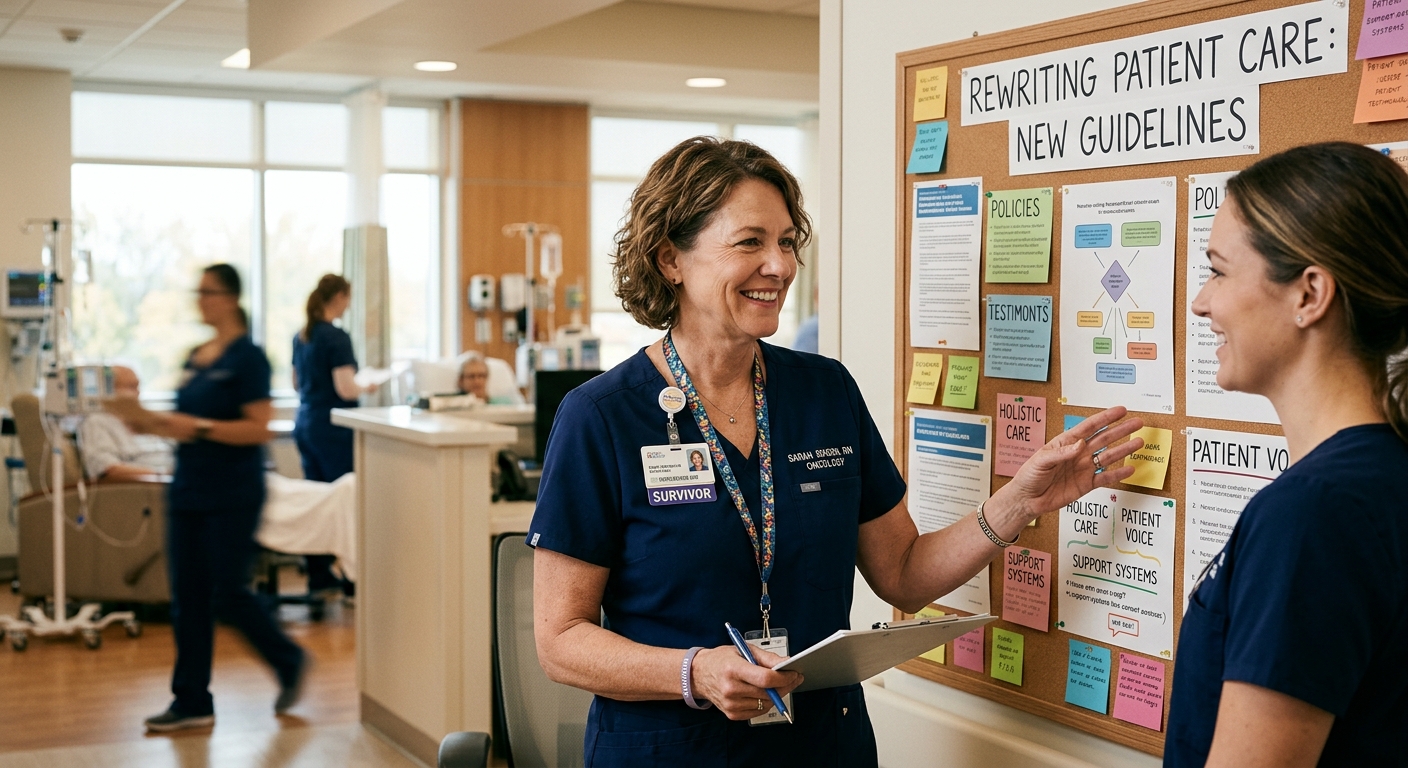
She called it the Patient Experience Initiative, though she always said the name was too formal for what it really was. “It’s just about being a human being to another human being,” she said at the first staff meeting where she presented it. “We already know how to do this. We just need to build systems that give us permission to do it consistently.”
What She Actually Changed
Working alongside hospital administration, patient advocates, and a small committee of fellow nurses, Maya introduced a series of changes that have since been adopted across three departments at Ridgemont Regional Medical Center in Ohio.
The First Appointment Checklist
One of the first things she changed was the new diagnosis appointment. Rather than delivering information in a single overwhelming session, the team developed a phased communication model. Key facts are delivered verbally and then followed up in writing within 24 hours, once the patient has had time to begin processing. Family members or support people are actively encouraged to attend and ask questions.
The Comfort Mapping System
Maya introduced what the team calls a comfort map, a simple one-page form given to every patient at intake. It asks not about symptoms but about preferences: Do you want staff to knock and wait before entering your room? Do you prefer to receive difficult news alone or with someone present? Do you have anxiety about needles, or particular fears related to your diagnosis that you want your care team to know about?
“It takes about four minutes to fill out,” Maya says. “And it changes everything. Because suddenly the patient is not just a chart. They’re a person with a context.”
The Silence Protocol
Perhaps the most quietly radical change was what Maya calls the silence protocol. After delivering significant news, nurses and physicians are now trained to pause and say nothing for a full thirty seconds before offering next steps or additional information. Thirty seconds of silence, in a medical setting, feels like a long time. But Maya had experienced firsthand how often the medical team’s instinct to fill silence with information prevented patients from actually absorbing what they had just heard.
“We’re trained to be helpful,” she explains. “And talking feels helpful. But sometimes the most helpful thing you can do is just stay in the room and be quiet. Let them have the moment. Don’t rush them out of it.”
The Peer Connection Program
Drawing on her own experience of feeling isolated despite being surrounded by people, Maya helped launch a peer connection program that pairs newly diagnosed patients with trained volunteer survivors who have completed treatment. These are not therapists or counselors. They are simply people who have been through it, who can say, “I know what the waiting room feels like at 7 a.m. I know what it’s like to lose your hair in the shower. I know.”
The program now has over sixty active volunteers and a waiting list of patients requesting connections.
What the Data Shows
Two years after the initiative launched, Ridgemont’s patient satisfaction scores in the oncology department rose by 34 percent. Staff reported feeling more equipped to have difficult conversations. Nurse turnover in the department, which had been a persistent problem, dropped by nearly half.
But Maya is careful about leading with numbers. “I don’t want this to be a data story,” she says. “I want it to be a people story. Because that’s what it is.”
She keeps one letter pinned above her desk. It’s from a patient named Gerald, a retired school principal who was treated for colon cancer the year after the initiative launched. He wrote to say that a nurse had filled out his comfort map with him, learned that he was a reader, and left a paperback novel on his tray table before a long procedure. “It was a small thing,” he wrote. “It was everything.”
The Lesson That Outlasts the Illness
Maya is in remission. She has been for three years. She still works the same floor, still remembers names, still squeezes hands. But she moves through her shifts with something she did not have before: a firsthand knowledge of what the curtain looks like from the other side.
“I would not wish cancer on anyone,” she says. “Not for a second. But I’ll tell you this: I am a better nurse than I was before. Not because I suffered, but because I finally understood what my patients needed and couldn’t ask for. And once you understand that, you can’t un-understand it. You just have to do something about it.”
That is exactly what she did. And somewhere in a waiting room right now, a frightened person is being handed a comfort map and feeling, for the first time since their diagnosis, like they are a person and not just a patient.
Sometimes the most powerful changes in how we care for each other begin with someone who was brave enough to say: I have been where you are, and here is what I wish someone had done for me.