
🎧 Listen to this story
Narrated by Aoede · 8,133 characters
When the Fire Took Everything
On a cool Tuesday morning in October, Harold Briggs stood at the edge of his property in rural Tennessee and watched the last of the smoke curl up from the charred remains of the home he had lived in for 43 years. The fire, sparked by an electrical fault in the attic, had consumed nearly everything: furniture, photographs, the wooden rocking chair he had built for his late wife Margaret, the quilt she had sewn the year before she passed. In less than four hours, a lifetime of memories had been reduced to ash and blackened timber.
Harold was 71 years old. He had a bad knee, mild arthritis in both hands, and a fixed income that left little room for surprises. By most reasonable measures, the situation was devastating, perhaps even insurmountable. His daughter drove up from Nashville that same afternoon, ready to help him find a rental, maybe a retirement community, somewhere comfortable and practical for a man his age.
Harold had other plans.
“I Built This Land. I’ll Build It Again.”
The quote is simple, almost stubborn in its plainness. Harold said it standing in the driveway, a cup of coffee in his hand, looking at the rubble. His daughter, Lynn, remembers laughing nervously, thinking it was the shock talking. It was not the shock talking.
Within a week, Harold had cleared a section of the property and set up a used camper trailer as a temporary shelter. He began drawing plans on graph paper at the small fold-out table inside, working by lamplight each evening after a full day of demolition and salvage. He was not an architect. He was not a licensed contractor. What he was, however, was a man who had spent decades working with his hands: farming, repairing, building fences, fixing engines, raising barns. He understood materials. He understood effort. And he understood, in the quiet and particular way that some people do, that rebuilding was not just practical but necessary for his spirit.
The First 30 Days: Doubt, Blisters, and Breakthroughs
The first month was brutal by any standard. Harold rose before sunrise every morning, worked until the light faded, and fell asleep almost immediately after eating a simple dinner in the camper. His hands blistered, then callused. His knee ached in the evenings. There were days, he admitted later in an interview with his local newspaper, when he sat on an overturned bucket and wondered if his daughter had been right.
“I’d look at what I had done that day and it seemed like nothing,” he told the reporter. “Then I’d look at what was still ahead of me and it seemed like everything. But I’d remind myself: you don’t build a house in a day. You build it one board at a time.”
Neighbors began to notice. First they drove slowly past, curious. Then they stopped. A retired carpenter named Dale from two farms over came by one Saturday morning with a toolbox and a thermos of coffee and simply said, “Where do you need me?” By the following weekend, there were six volunteers on the property. Within a month, the number had grown to over twenty regular helpers, ranging in age from a sixteen-year-old from the local high school to an 80-year-old former construction foreman named Ernie who mostly supervised from a lawn chair but whose knowledge of load-bearing walls proved invaluable more than once.
What the Community Brought to the Build
- Lumber and materials: A local hardware store donated a significant portion of the framing lumber after the owner heard Harold’s story through a church group.
- Skilled labor: Plumbers, electricians, and drywall specialists offered their time on weekends, working for nothing but lunch and gratitude.
- Meals: A rotating group of neighborhood families brought food daily, ensuring Harold and his volunteers were fed without interruption to the work.
- Emotional support: Harold’s pastor visited weekly, and a grief counselor from the county offered free sessions to help Harold process not just the fire but the accumulated losses it had stirred up, including the ongoing grief over losing Margaret.
- Fundraising: The local elementary school held a bake sale and raised over $800, which Harold used entirely on insulation materials.
The Design: A Home Built for Memory
Harold did not try to recreate the original house exactly. He made deliberate choices to honor the past while acknowledging the present. He built a slightly smaller footprint, one that would be easier to maintain as he aged. He added wider doorways, a walk-in shower, and a first-floor bedroom, practical adaptations he admitted he should have made years ago.
But certain elements were deeply intentional acts of remembrance. He sourced reclaimed oak for the floors, not unlike the original. He built a window seat in the living room where Margaret used to keep her sewing basket. He constructed a new rocking chair by hand over several winter evenings, using plans he drew from memory, and placed it on the front porch before the house was even fully finished.
“That chair needed to be there first,” he said. “Everything else got built around it.”
Seven Things Harold’s Story Teaches Us About Starting Over
- Age is a chapter, not a conclusion. Harold’s story challenges the quiet assumption that rebuilding, literally or figuratively, is a young person’s pursuit. Resilience does not expire.
- Community is built before it is needed. Harold had spent decades being a good neighbor. When his crisis came, that generosity returned in force. Relationships are infrastructure.
- Grief and action can coexist. Harold mourned deeply, but he did not wait until he stopped grieving to begin working. Movement and mourning are not opposites.
- Small progress is still progress. One board at a time. One day at a time. The cumulative weight of small consistent effort is one of the most underestimated forces in human experience.
- Asking for help is an act of courage. Harold did not refuse when Dale showed up with his toolbox. Accepting help graciously is its own kind of strength.
- Honoring the past does not mean replicating it. The new house is different and that is not a failure. It is an honest acknowledgment that life has changed and the spaces we inhabit should reflect who we are now.
- Purpose is a survival tool. Multiple people close to Harold said they believed the rebuild kept him healthy, focused, and mentally sharp in ways that a passive recovery might not have. Having something to build gave him a reason to get up each morning.
Moving In: A Quiet Celebration
Fourteen months after the fire, Harold Briggs walked through the front door of his new home for the first time as its official resident. He had declined offers of a large celebration or a ribbon cutting. Instead, he invited a small group of the people who had helped build it, shared a meal on the new porch, and watched the sun go down over the same hills he had looked at for over four decades.
His daughter Lynn, who had spent many of those fourteen months alternating between pride and terror at her father’s project, sat beside him and later wrote about the evening on her personal blog. Her description of her father’s face as he sat in the new rocking chair, looking out at the land, was shared thousands of times across social media in the weeks that followed. She wrote: “He looked like a man who had made his peace with every hard thing. Not because the hard things were gone. But because he had proven to himself that he could outlast them.”
A Story That Is Still Being Written
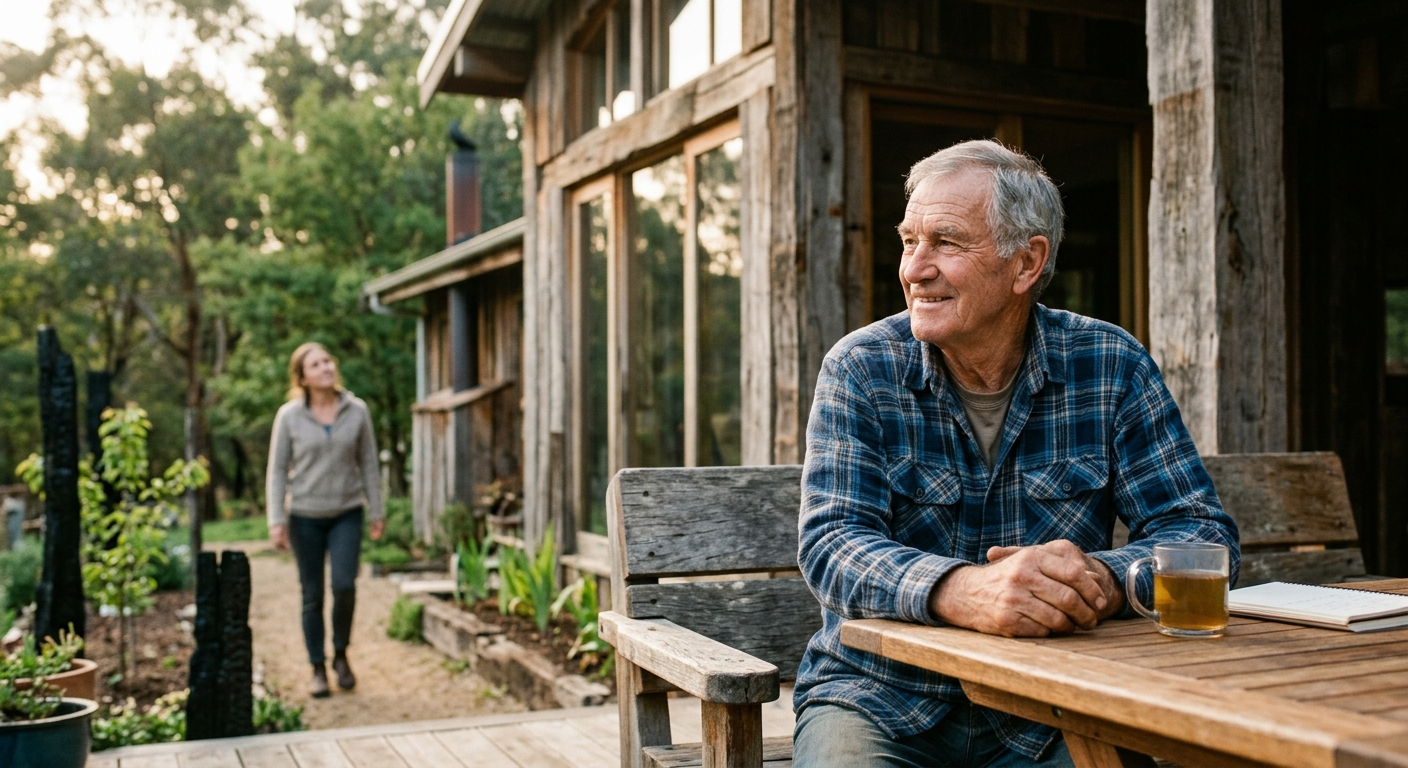
Harold Briggs is 72 now. He tends a garden on the east side of the property. He is teaching the sixteen-year-old volunteer, a boy named Carter, how to do basic carpentry on weekends. He still sits in the rocking chair every evening when the weather permits.
The house is not perfect. There are small imperfections in the trim, a door that sticks slightly in humid weather, a section of tile that does not quite match the rest. Harold does not mind. He says those things remind him that a human being built it, with human hands, under human circumstances, driven by something that has no entry on a construction blueprint: the absolute refusal to let loss be the final word.