
🎧 Listen to this story
Narrated by Leda · 8,129 characters
We Have Declared War on Boredom, and We Are Losing
Think about the last time you were truly, completely bored. Not scrolling-through-your-phone bored. Not half-watching-a-show bored. Genuinely, uncomfortably, staring-at-the-ceiling bored. For most people, that memory is surprisingly hard to find. Somewhere between the podcast queue, the notification badges, and the infinite scroll of social media feeds, we quietly eliminated one of the most quietly powerful states the human mind can enter.
And we did it on purpose. We optimized boredom right out of our lives, proud of ourselves for never wasting a single idle moment. But what if that optimization came at a steep, silent cost?
What if boredom was never the enemy? What if it was always the gift we kept throwing away?
What Actually Happens to Your Brain When You Are Bored
Neuroscientists have a name for what happens when your brain is not focused on a specific task. They call it the Default Mode Network, and for years researchers assumed it was simply the brain idling, like a car engine at a red light. Then they looked closer, and what they found changed everything.
When you are bored, your brain does not shut down. It activates in a completely different way. The Default Mode Network lights up with what researchers describe as self-generated thought: daydreaming, memory consolidation, emotional processing, future planning, creative problem-solving, and the kind of deep self-reflection that simply cannot happen when your attention is constantly being grabbed by something external.
In other words, your brain uses boredom to do its most important work.
Dr. Sandi Mann, a psychologist at the University of Central Lancashire and author of The Upside of Downtime, has spent years studying this phenomenon. Her research found that people who were bored before a creative task consistently outperformed those who were not. The bored participants generated more ideas, more original solutions, and more imaginative thinking. Boredom, she concluded, is a creativity incubator.
7 Things That Quietly Disappear When We Never Let Ourselves Get Bored
- Original ideas: Creative breakthroughs rarely arrive during busy moments. They surface in the shower, on a slow walk, staring out a train window. These are all forms of sanctioned boredom, and we are scheduling them out of existence.
- Emotional clarity: Feelings that we do not sit with do not disappear. They accumulate. Constant stimulation is one of the most effective ways to avoid processing difficult emotions, and avoidance always sends the bill eventually.
- Tolerance for discomfort: When we never practice sitting with an uncomfortable feeling, even a mild one like boredom, we quietly erode our ability to tolerate any discomfort at all. This is one reason anxiety rates are rising alongside screen time.
- Genuine rest: Consuming content is not rest. Scrolling is not rest. Rest requires the brain to step back from external demands, and that is exactly what boredom forces. True restoration happens in stillness, not stimulation.
- Self-knowledge: Your likes, dislikes, values, and dreams need quiet space to surface. When every gap in your day is filled with someone else’s content, you lose access to your own inner voice.
- Present-moment awareness: Boredom forces you to notice where you are, what is around you, and what you are feeling. It is an accidental mindfulness practice that most of us are aggressively avoiding.
- The ability to be alone with yourself: This one matters more than it sounds. People who cannot tolerate being alone with their own thoughts are often people who do not fully know themselves. Boredom is where that relationship gets built.
The Childhood Connection: What We Lost When We Scheduled Everything
Ask anyone who grew up before smartphones what they did on summer afternoons, and you will hear the same kinds of stories. They built things. They invented games. They wandered. They sat in trees and thought about nothing in particular. They were bored, magnificently, productively bored, and out of that boredom came entire imaginary worlds, lifelong friendships, and the quiet discovery of who they were.
Today, children’s schedules are packed from morning to evening. Structured activities, screen time, educational apps, enrichment programs. The intention is loving and the reasoning is understandable. But something essential is being crowded out.
Child development researchers have noted a consistent pattern: children who have unstructured, unstimulated time consistently show higher levels of creativity, stronger internal motivation, and better emotional regulation than those whose time is tightly managed. Boredom teaches children how to generate their own meaning. That is not a small thing. That is one of the foundational skills of a flourishing life.
The same is true for adults. We did not stop needing that skill when we turned eighteen. We just stopped giving ourselves permission to practice it.
How to Actually Give Yourself the Gift of Boredom
This is the part where most articles tell you to put your phone down. That is true, but it is also incomplete. Boredom is not just about removing screens. It is about creating intentional pockets of unstimulated time and then, crucially, resisting the urge to fill them.
Start Smaller Than You Think You Need To
You do not need a weekend retreat or a digital detox. You need five minutes of waiting for your coffee without picking up your phone. You need one commute where you look out the window instead of putting in your earbuds. You need a walk without a podcast. Start there. The discomfort is real, but it is brief, and what comes after it is worth noticing.
Treat the Urge to Fill Silence as Information
When you sit with boredom and feel a powerful compulsion to reach for your phone, pause and get curious about that urge. What are you avoiding? What thought or feeling was starting to surface before you instinctively reached for distraction? You do not have to solve it. Just notice it. That noticing is the beginning of something important.
Create a Boredom Ritual
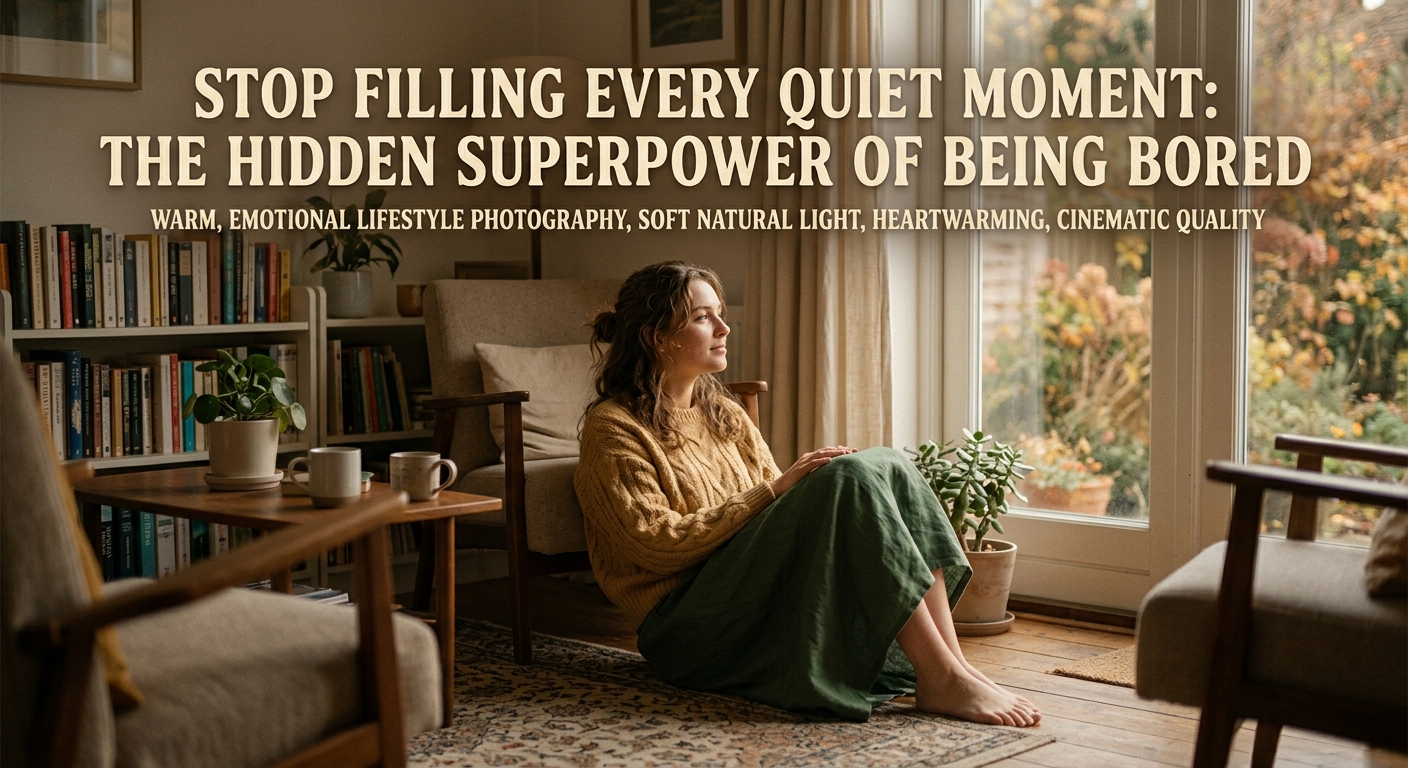
Some people find it helpful to have a specific context for intentional boredom: a favorite chair, a particular time of day, a short walk they take without any audio. The ritual signals to your brain that this is a space for wandering, not for producing. Over time, your mind learns to settle into that space more readily.
Reframe What You Are Doing
One reason we resist boredom so fiercely is that our culture has labeled it as laziness or wasted time. Reframing helps. You are not doing nothing. You are processing. You are consolidating. You are creating the conditions for insight. You are resting in the deepest sense of the word. That is not laziness. That is maintenance of the most important tool you have.
The Quiet Revolution Hiding in Your Idle Moments
Some of the most important moments of clarity in human history happened in unstimulated minds. Newton and the apple. Archimedes in the bath. Einstein daydreaming about riding a beam of light. These are not just charming anecdotes. They are evidence of something the neuroscience is now confirming: the resting mind is not an idle mind. It is a working mind, doing its deepest, most original work.
You do not have to be Newton. You do not need a world-changing insight. But you might need to remember what you actually value. You might need to figure out why you have been feeling vaguely unsettled for months. You might need the right words for a conversation you have been putting off, or the courage to make a change you have been avoiding. Those things do not come from scrolling. They come from stillness.
Boredom is not a bug in the human experience. It is a feature, one that evolution spent a very long time building into you, and one that the modern attention economy is working very hard to eliminate.
The most radical, quietly countercultural thing you can do right now is simple: put everything down, and let yourself be bored. Not forever. Not even for long. Just long enough to remember that the most interesting thing in the room has always been your own mind.