🎧 Listen to this story
Narrated by Gacrux · 7,632 characters
The Lessons That Lived in Their Hands
My mother kept every rubber band that came around the broccoli at the grocery store. She looped them around a doorknob in the kitchen, a small bouquet of green and beige rings that most people would throw away without a second thought. I used to find it embarrassing as a kid. Now, at thirty-four, I find it one of the most quietly profound things I have ever witnessed.
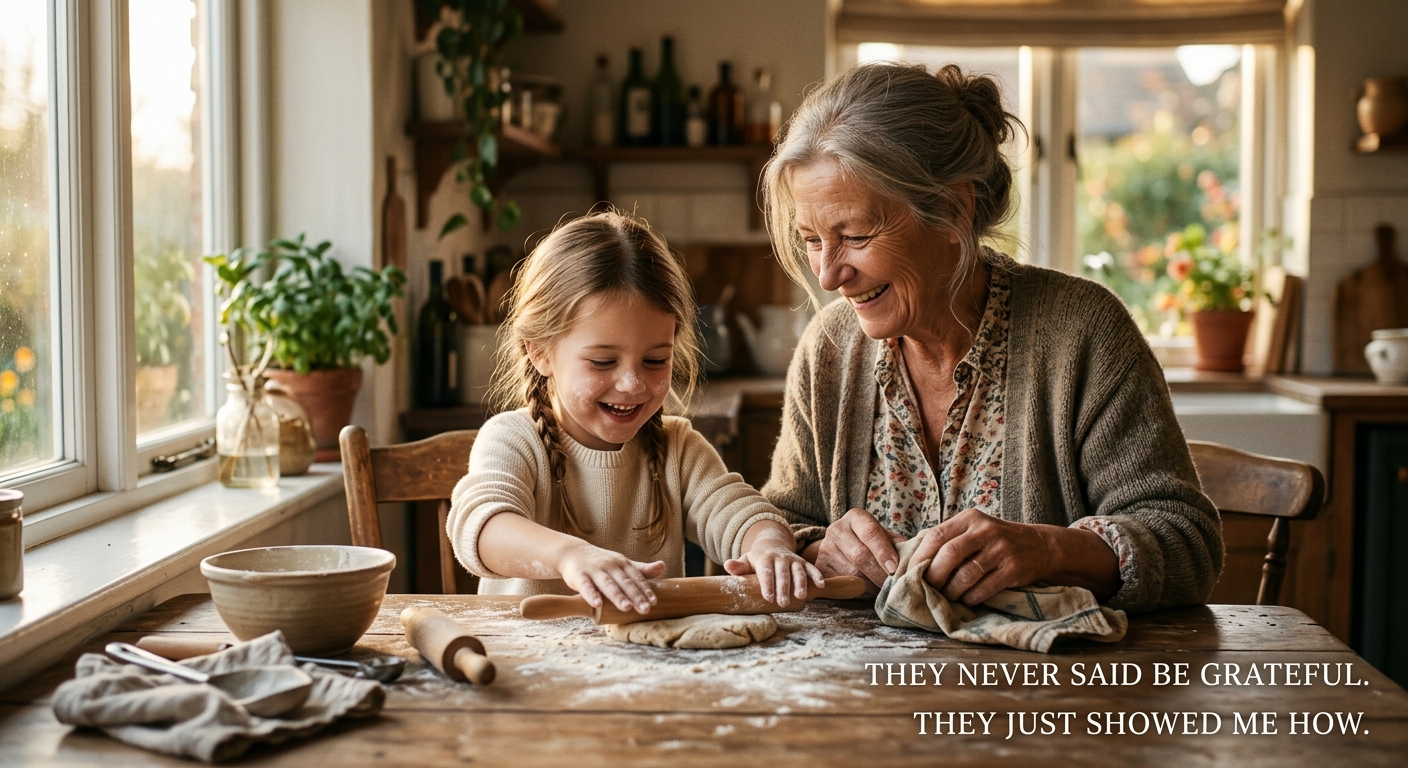
My parents came to the United States from the Philippines in the late 1980s with two suitcases, a folder of documents, and a stubbornness about the future that I did not fully appreciate until I had my own bills to pay. They never sat me down for a lecture about gratitude. They never framed a quote about thankfulness and hung it on the wall. Instead, they practiced something older and more honest: they lived in a way that made waste feel like a small betrayal, and abundance feel like a reason to share.
This is what they taught me, not with words, but with their hands, their habits, and their daily, ordinary lives.
Lesson One: Finishing Your Plate Is Not About Food
Every Filipino child knows the phrase. “There are children starving.” It was not a guilt trip in our house. It was geography. My father had grown up in a province where rice was measured carefully, where a full meal was something you acknowledged with your whole body. When he watched me scrape perfectly good food into the trash, I could see something shift in his face, not anger exactly, but a kind of quiet sadness.
Over time, I began to understand that finishing my plate was not really about food at all. It was about recognizing the chain of effort behind every meal: the person who grew it, the person who bought it, the person who cooked it. Gratitude, in our house, was a full circle. It started at the table and worked its way outward.
What This Looks Like Now
- I plan meals intentionally so that ingredients are actually used
- I compost what cannot be eaten rather than tossing it mindlessly
- I thank whoever cooked, out loud, every single time
Lesson Two: Hard Work Is Its Own Form of Thanksgiving
My mother worked double shifts as a nurse for years. She would come home at 7 in the morning, sleep for five hours, and be back at the hospital by noon. On her days off, she cleaned the house, called her relatives in Manila, made food from scratch, and helped my brother and me with homework. I never once heard her describe herself as tired without immediately following it with “but I am okay.”
For a long time I thought she was just tough. Later, I realized she was grateful. Grateful for the job. Grateful for the visa that allowed her to work. Grateful for children who needed help with math homework, because it meant she had children who were in school. She did not experience her labor as a burden. She experienced it as the concrete expression of a life she had worked very hard to build.
That reframing changed something in me permanently. When I catch myself complaining about a long week, I sometimes hear her voice: not scolding me, but gently asking me to look at the week differently. What does this busy week mean I have?
Lesson Three: You Give Before You Feel Comfortable Giving
The most countercultural thing my parents ever modeled was generosity before security. Every month, without exception, a portion of my father’s paycheck was sent back to family in the Philippines. There were cousins who needed school supplies, an aunt who needed a roof repair, a grandmother who needed medication. And we were not wealthy. We were solidly in the category of people who probably should have held onto every dollar.
But my parents operated from a different logic. They believed that generosity was not something you arrived at after you had enough. It was how you moved through the world regardless of what you had. They gave because they remembered being the ones who needed it. And they gave because giving was the most direct way they knew to say: I have not forgotten where I came from.
Three Things This Taught Me About Generosity
- Giving is a muscle. The more you practice it, the less it costs you emotionally
- There is always someone who is at an earlier stage of the journey you have already traveled
- Generosity without expectation is the only kind that actually feels good
Lesson Four: Celebration Is Serious Business
If you have ever been to a Filipino party, you know that food is not just food. It is a statement. It is a gathering of love made visible in noodles and rice and roasted pork. My parents threw parties for everything: birthdays, graduations, passing a driving test, getting a promotion, sometimes just because it was summer and the cousins were in town.
As a teenager, I found the expense baffling. Why spend so much when we were so careful with money everywhere else? My father explained it once, in the simplest way possible. “When something good happens, you share it. Otherwise what is the point of the good thing?”
That sentence is, I now believe, one of the most complete definitions of gratitude I have ever heard. Gratitude is not a private transaction between you and the universe. It is relational. It spills over. It invites others in.
Lesson Five: Beauty Lives in Small Things, If You Bother to Look
My mother had a habit of noticing. She would point out the color of the sky on a Tuesday afternoon. She would bring home a single flower from the grocery store and put it in a glass on the kitchen windowsill. She remembered what season the mangoes were best in Manila and would close her eyes when she ate a particularly good one in California, traveling somewhere briefly in her mind.
She was not a philosopher. She was a woman who had left everything she knew and built something new, and she understood, in a cellular way, that ordinary moments were not ordinary at all. They were the actual texture of a life. And a life, she seemed to know, was something you should not sleepwalk through.
What the Word ‘Grateful’ Could Never Capture
The word gratitude has become something of a wellness buzzword. We journal about it. We list three things every morning. We wear it on tote bags. And none of that is bad, not really. But it can start to feel thin, like the word has been laundered of its weight.
What my parents practiced was something heavier and more real. It was gratitude as a way of inhabiting the world: carefully, generously, attentively, with memory intact. They never forgot where they had been, and they never took for granted where they had arrived. That dual awareness, of the distance traveled and the fragility of what was built, produced in them a daily orientation toward life that looked, from the outside, like contentment. But from the inside, I now understand it was something more active than that. It was a choice, made again and again, to treat their life as a gift worth tending.
The Rubber Bands on the Doorknob
My mother still saves the rubber bands. When I visited last spring, they were still there, looped on the same doorknob, in the same kitchen. I did not find it embarrassing this time. I stood in front of that doorknob for a moment and felt something I can only describe as reverence.
Because those rubber bands are a record. They are a small, daily refusal to be wasteful in a world that rewards excess. They are a quiet insistence that things have value, that the ordinary should not be discarded, that enough is, in fact, enough.
My parents never said the word gratitude to me. Not once, that I can remember. But they said it every day, in everything they did. And if I am lucky, and if I pay close enough attention, maybe I am starting to say it too.