🎧 Listen to this story
Narrated by Sulafat · 9,972 characters
A Place Where Old Age Looks Different
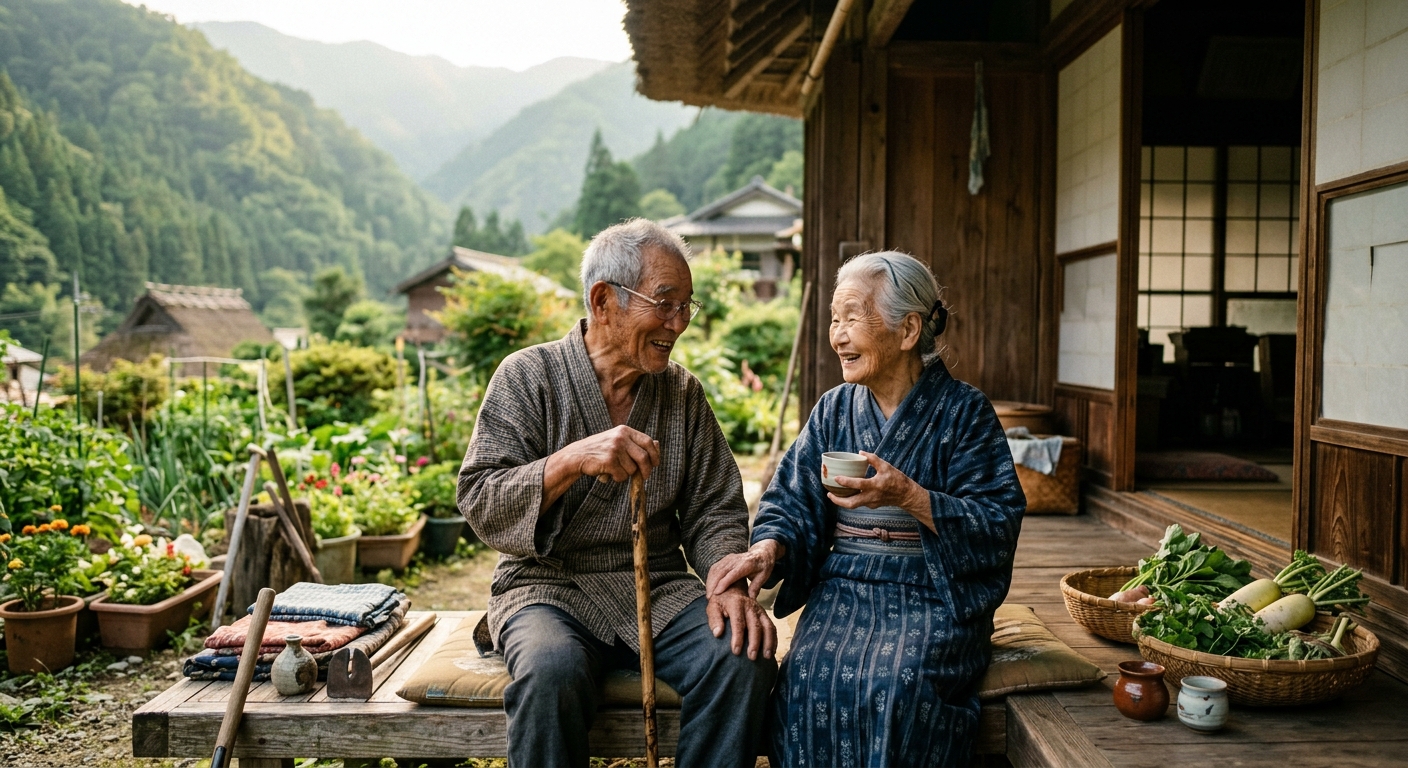
Tucked into the terraced hillsides of Okinawa prefecture, and scattered across a handful of other rural Japanese communities, there exists a phenomenon so consistent and so striking that researchers have given it a name: the Blue Zone. But numbers and academic labels do little justice to what life actually looks like inside these villages. Here, people in their nineties tend gardens. Centenarians gather daily for card games and conversation. A 104-year-old woman recently told a visiting journalist that her secret was not worrying too much about secrets.
This is not the Japan of neon-lit Tokyo or bullet-train schedules. This is quieter, slower, and in many ways, deeper. And the rest of the world is paying close attention.
The Numbers That Stopped Scientists in Their Tracks
Japan already holds the global record for average life expectancy, consistently ranking at or near the top of the World Health Organization’s annual reports. But within Japan, certain rural villages and island communities stand out even further. Okinawa has long been studied as a hotspot of exceptional longevity. At various points in recent decades, it has recorded more centenarians per capita than almost anywhere else on earth.
What makes this especially remarkable is not just the length of life, but the quality. Researchers from institutions including Harvard, the National Institute on Aging, and various Japanese universities have conducted field studies in these communities, and they keep arriving at the same surprising conclusion: these are not people merely surviving into old age. They are thriving in it.
Key Statistics Worth Knowing
- Okinawa has historically had centenarian rates roughly 4 to 5 times higher than those in the United States.
- Rates of heart disease, dementia, and certain cancers in these communities are significantly lower than global averages.
- Many residents over 90 report no major chronic illnesses and take few or no medications.
- Women in these regions have historically lived longer than men, though the gap is narrowing as lifestyles shift.
What They Eat: Simple, Rooted, and Alive
One of the first things researchers examine is diet, and in these Japanese villages, the findings are both fascinating and humbling. There are no complicated meal plans here, no superfoods imported from distant continents, and no wellness influencers telling people what to consume. Instead, there is a deeply ingrained relationship with local, seasonal, and mostly plant-based food.
The traditional Okinawan diet is rich in sweet potatoes (which for centuries were a dietary staple), tofu, miso, seaweed, leafy greens, and small amounts of fish. Pork is eaten, but infrequently and in small quantities. Sugar is minimal. Processed food is largely absent from older generations’ plates.
Perhaps most interesting of all is a guiding cultural principle called hara hachi bu, a Confucian-rooted phrase that roughly translates to: eat until you are 80 percent full. It is not a diet rule enforced from outside. It is a deeply internalized habit, passed down through families and communities over generations. Scientists now recognize it as one of the most effective natural forms of caloric restriction known, associated with reduced inflammation, better metabolic health, and longer cellular life.
Foods Commonly Found in a Longevity Village Kitchen
- Purple Okinawan sweet potato (high in antioxidants)
- Goya, a bitter melon with blood sugar-regulating properties
- Tofu and miso (fermented soy products rich in protein and probiotics)
- Kombu and other sea vegetables
- Green tea, consumed throughout the day
- Turmeric, used in cooking and as a tea
Movement as a Way of Being, Not a Workout
Nobody in these villages is training for a marathon. There are no gym memberships, no fitness trackers, no pre-dawn boot camps. And yet the level of daily physical activity among elderly residents is remarkable by any measure.
Life in rural Japan simply requires movement. Gardens must be tended. Hills must be climbed. Meals must be prepared from scratch. Social visits involve walking, not driving. Researchers refer to this as incidental movement, and it turns out to be extraordinarily powerful. Unlike intense, scheduled exercise that many people struggle to maintain, low-level consistent movement woven into daily life produces lasting cardiovascular, muscular, and neurological benefits without the injury risk or psychological resistance.
A 2019 study published in the British Journal of Sports Medicine found that even light daily activity, such as gardening or slow walking, was strongly associated with reduced mortality risk in older adults. In these Japanese villages, that kind of activity is simply called Tuesday.
Ikigai: The Reason to Wake Up in the Morning
Here is where the science gets philosophical, and where the lessons become harder to package and export. One of the most studied concepts in Japanese longevity research is ikigai, a word with no clean English translation. It roughly means your reason for being, the intersection of what you love, what you are good at, what the world needs, and what sustains you.
In these long-lived communities, ikigai is not a poster on a productivity guru’s wall. It is woven into the fabric of daily existence. Older residents describe their ikigai in specific, grounded terms: tending a particular garden, teaching younger family members to cook, showing up every morning to play a card game with the same group of friends, making a certain kind of pottery that nobody else in the village makes anymore.
The psychological impact is measurable. People with a strong sense of purpose have been shown in multiple studies to live longer, recover from illness more effectively, maintain sharper cognitive function, and report higher levels of daily happiness. Purpose is not a luxury in these villages. It is a survival strategy.
Moai: The Social Safety Net That Is Built From Friendship
If ikigai is about purpose, then moai is about belonging. The concept, originating in Okinawa, describes a lifelong social circle, a group of five or so individuals who commit to supporting each other financially, emotionally, and socially from childhood onward.
Think of it as a built-in community, not chosen by algorithm or convenience, but by a cultural expectation that no one should face life alone. Moai groups meet regularly. They share resources during hard times. They celebrate together and grieve together. And crucially, they hold each other accountable to showing up.
The science behind social connection and longevity is now overwhelming. A landmark meta-analysis from Brigham Young University found that social isolation carries a mortality risk comparable to smoking 15 cigarettes a day. Loneliness, the researchers found, is not a soft emotional problem. It is a hard biological threat. The moai system, which has existed in Okinawa for centuries, may be one of the most elegant social solutions to this problem ever devised.
Stress, Spirituality, and Slowing Down
Every culture has stress. These villages are not utopias. People face illness, loss, poverty, and hardship. What differs is the cultural infrastructure for processing it.
Older residents in these communities often describe a spiritual orientation toward life that emphasizes acceptance, gratitude, and presence rather than control and accumulation. Daily rituals, whether a quiet moment of prayer, a tea ceremony, a walk to a local shrine, or simply sitting in stillness before the day begins, create what researchers call a stress buffer. These small, consistent practices appear to regulate cortisol levels, lower blood pressure, and foster a sense of being held by something larger than oneself.
This is not about religion as an institution. It is about ritual as medicine.
What We Can Actually Learn From This
It would be easy, and a little dishonest, to suggest that anyone can simply adopt the Okinawan lifestyle and immediately add decades to their life. Culture is not a supplement. It cannot be bottled or shipped. These villages work because the habits, values, and structures within them are interconnected and reinforced over generations.
But that does not mean there are no lessons for the rest of us. Here are the ones that translate most clearly:
- Eat mostly plants, eat slowly, and stop before you are completely full. Hara hachi bu is a practice anyone can begin today.
- Move through your life, not just through your workouts. Find ways to build walking, gardening, and physical engagement into your ordinary day.
- Know your why. Spend time identifying what gives your days meaning, and protect that thing fiercely.
- Invest in your people. Long, deep friendships are not a social luxury. They are a health intervention.
- Build in daily stillness. Even five minutes of genuine quiet, without a screen or an agenda, begins to reshape the nervous system over time.
- Belong somewhere. Whether it is a neighborhood, a faith community, a hobby group, or a standing weekly dinner, connection to a consistent group of humans matters more than almost any other factor in long-term health.
The Quiet Revolution of Ordinary Life
There is something almost radical about what these Japanese villages represent in a world obsessed with optimization, disruption, and reinvention. The secret to living past 100 in Ogimi or in a hillside Okinawan community is not a hack. It is not a protocol. It is a life, fully inhabited, surrounded by people who know your name, rooted in work that feels meaningful, nourished by food that comes from the earth, and paced in a way that allows the body and mind to recover, rest, and return again the next morning.
Perhaps the most important lesson of all is the simplest one: the villages where people live longest are not places where people are trying to live long. They are places where people are deeply, genuinely engaged in living. The years, it seems, are just what follows.