
🎧 Listen to this story
Narrated by Sulafat · 7,862 characters
A Library With a Hidden Door
Walk into the Eastfield Community College library on any given Tuesday morning, and you might notice something unusual. Past the periodicals section, beyond the row of study carrels humming with laptop activity, there is a door marked simply: Staff Storage. Most students walk past it without a second glance. But for a growing number of young people who have come to librarian Donna Hartwell with a quiet, embarrassed whisper, that door opens into something far more significant than a supply closet.
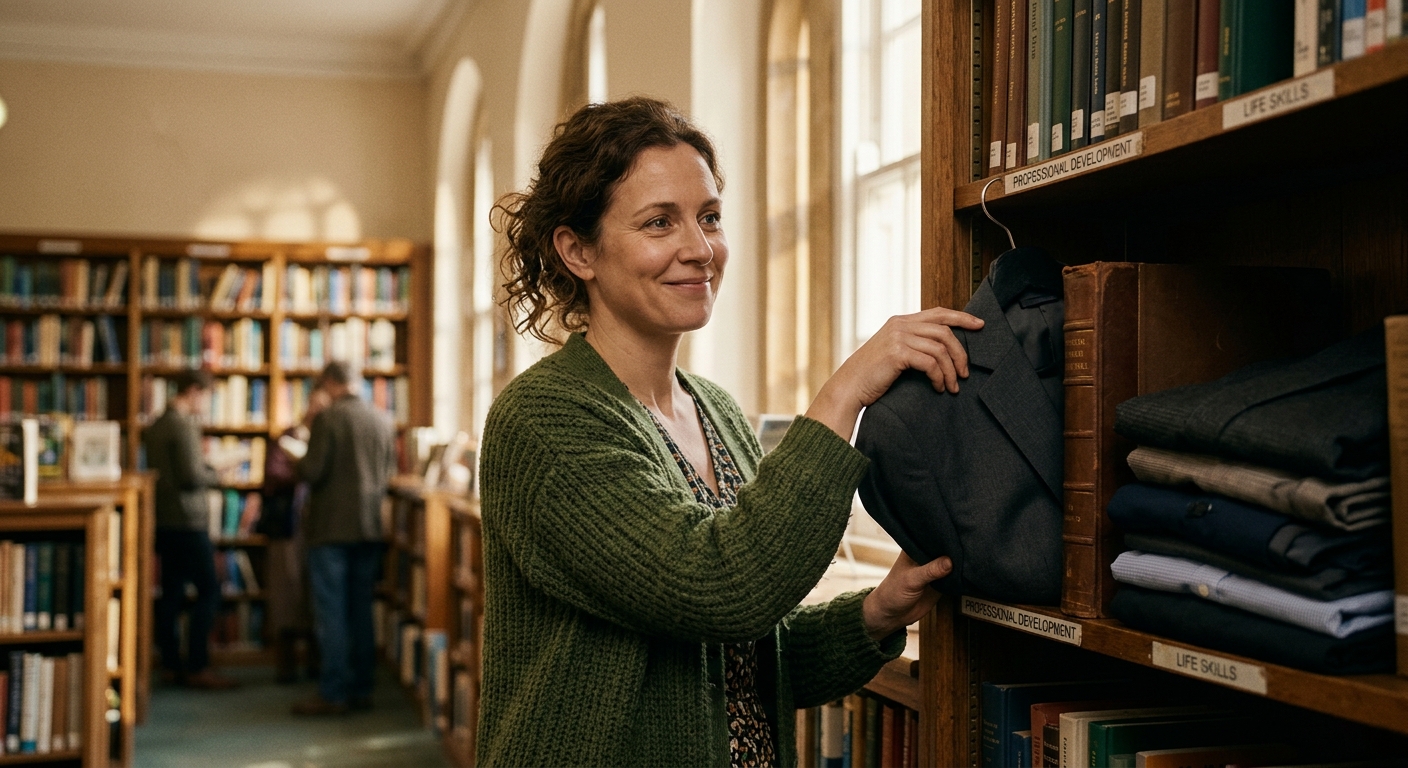
Behind it hang pressed blazers, polished flats, collared shirts, trousers with sharp creases, and neatly folded ties arranged by color. There are belts coiled on a shelf, a full-length mirror propped against the wall, and a small basket of safety pins and hem tape for last-minute adjustments. It looks, in every sense of the word, like a boutique. A boutique that costs nothing, asks nothing, and judges no one.
Donna has been running what students now quietly call “The Closet” for going on six years. She never advertised it. She never applied for a grant to start it. She simply noticed a problem, opened her wallet, and then opened a door.
How It Started: A Moment She Cannot Forget
The story begins the way many of the best stories do: with a single student on a bad day.
“It was a young man, maybe nineteen,” Donna recalls. “He came in asking if he could print something off our computers. He was nervous, fidgety. When I asked if he needed help, he sort of broke down a little. He had a job interview the next morning at a local accounting firm, and he had nothing to wear. Not just nothing appropriate. Nothing. He was going to go in a hoodie and hope for the best.”
Donna sent a quick text to her husband that evening. He is roughly the same build. By the next morning, she had a garment bag waiting for the young man at the circulation desk. He got the job. He returned the clothes washed and pressed with a handwritten thank-you note tucked into the pocket.
“I kept that note,” she says. “I still have it. That was the moment I thought, this cannot be a one-time thing.”
Building the Closet, One Donation at a Time
Donna started small. She put out a single box near the library entrance with a handwritten sign: Gently used professional clothing welcome. No questions asked. Within two weeks, the box was overflowing.
Faculty donated blazers they no longer wore. A local dry cleaner began offering free pressing for any items destined for the closet. A retired department store manager volunteered to sort and size everything. The college’s student services office, once they heard about it informally, quietly arranged for the storage room to be made permanently available.
Today the closet holds over two hundred individual pieces across a wide range of sizes, including plus sizes, petite fits, and gender-neutral options. There is even a small section for accessories: watches, scarves, simple jewelry, and a few pairs of professional-grade shoes.
How Students Access It
The process is deliberately low-friction. Students do not fill out forms. They do not prove financial need. They do not have to explain themselves at all. The only requirement is a conversation, and even that is kept light.
- Students approach Donna or any library staff member and simply say they need help finding something for an interview.
- They are brought to the closet privately, during a quiet moment in the library’s schedule.
- They can try on as many items as they need. There is no time pressure.
- Items are borrowed, not given, though Donna quietly notes that she has never once chased anyone for a return.
- If something fits perfectly and a student clearly needs it beyond the interview, she has been known to say, “You know what, just keep it.”
“The dignity piece matters more than anything,” she explains. “If I make someone feel like a charity case, I’ve already failed them. This is just a library service, as far as I’m concerned. We loan books. We loan professional clothes. Same idea.”
The Students: Stories Donna Carries With Her
She is careful not to share identifying details, but Donna lights up when she talks about the students who have come through that storage room door.
There was the single mother returning to the workforce after a decade away, who tried on three blazers and cried quietly in front of the mirror because, she said, she had forgotten what she looked like when she felt confident. There was the young man from a refugee family who had his first-ever corporate interview and did not know what a tie clip was until Donna showed him. There was the nursing student who had an unexpected clinical placement interview and needed something presentable within the hour. Donna had her sorted in fifteen minutes.
“Some of them come back just to say they got the job,” she says. “Those are my favorite days. I don’t need anything else. That look on their face is enough.”
What Other Schools Are Starting to Notice
Word spreads in academic circles, and Donna’s model has started attracting attention from librarians and student services professionals at other institutions. She has been invited to speak at two regional library conferences, something she finds equal parts flattering and baffling.
“I keep saying, I didn’t invent anything,” she laughs. “I just paid attention.”
But paying attention, it turns out, is exactly the skill in shortest supply. Several colleges have since launched their own versions of the closet model, citing Donna’s approach as a blueprint. The key elements they emphasize:
- Embed it in a trusted, neutral space. The library works because it carries no stigma. Students are already there.
- Remove all bureaucratic friction. The more forms you require, the fewer students will come.
- Prioritize privacy over process. A quiet moment matters more than a tracking spreadsheet.
- Let the community build it. Donation-driven models create buy-in and longevity.
- Train staff in empathy, not just logistics. How you hand someone a blazer matters as much as the blazer itself.
The Bigger Lesson Behind the Clothes
It would be easy to reduce this story to a feel-good moment about donated blazers, but the implications run deeper than fabric and thread. What Donna identified is a specific, painful, and largely invisible barrier that sits between talented young people and the opportunities they have worked hard to reach.
First-generation college students, students from low-income households, students who aged out of foster care, students who immigrated with very little: these are young people who have cleared enormous obstacles just to be in that library, just to have that interview lined up. And then, at the last mile, something as absurd and fixable as a missing blazer threatens to stop them.
“The interview is the opportunity,” Donna says simply. “I just want to make sure they get to show up for it. Literally show up, in a way that lets them be taken seriously. Everything after that is theirs.”
A Quiet Revolution Hiding in Plain Sight
There is something quietly radical about what Donna Hartwell has built, not because it is complicated or expensive or requires a committee, but because it required almost none of those things. It required one person choosing to see a problem as solvable, then solving it with whatever was in reach.
No grant application. No committee vote. No pilot program or assessment rubric. Just a door, some donated clothes, and a librarian who decided that her job description had more room in it than anyone had told her.
The next time you are clearing out your closet and wondering what to do with a blazer you no longer wear, consider this: somewhere, there is a nineteen-year-old with an interview tomorrow morning and nothing to put on. And somewhere, there might be a librarian in your community just waiting for someone to hand her the first donation.