🎧 Listen to this story
Narrated by Rasalgethi · 7,898 characters
A Different Kind of Retirement Plan
Most people picture retirement as a time of rest, travel, and leisurely mornings with a cup of coffee. For 67-year-old Patricia “Pat” Holloway of Decatur, Georgia, retirement looked a little different. It looked like folding tables, a blood pressure cuff, a donated refrigerator stocked with insulin, and a handwritten sign taped to a two-car garage that reads: “Everyone welcome. No insurance needed. No judgment here.”
Every Saturday and Sunday morning, Pat wakes up at 5:30 a.m., brews a thermos of coffee, and unlocks the side door of her garage by 7 a.m. By 7:15, there are already people waiting. Sometimes five. Sometimes thirty.
She has been doing this for six years now, and she has no plans to stop.
How It Started: A Neighbor, a Crisis, and a Decision
The story of Pat’s free clinic does not begin with a grand vision or a nonprofit grant. It begins with her next-door neighbor, a 54-year-old man named Darnell, who Pat noticed looking increasingly unwell over the course of a summer.
“He was losing weight, always tired, drinking water constantly,” Pat recalls. “I knew immediately. I pulled him aside and I said, ‘Darnell, when did you last see a doctor?’ He told me he hadn’t seen one in eleven years. He didn’t have insurance, and the copay at the urgent care was more than he made in a day.”
Pat drove Darnell to a clinic herself and paid out of pocket for his visit. He was diagnosed with Type 2 diabetes, severely unmanaged. With early intervention, he avoided what could have been a life-altering, or life-ending, complication.
But Pat kept thinking about all the other Darnells in her neighborhood. All the people quietly suffering, rationing medication, ignoring symptoms because the cost of care had become an impossible barrier.
So she did what nurses do. She assessed the problem, made a plan, and got to work.
Inside the Garage Clinic
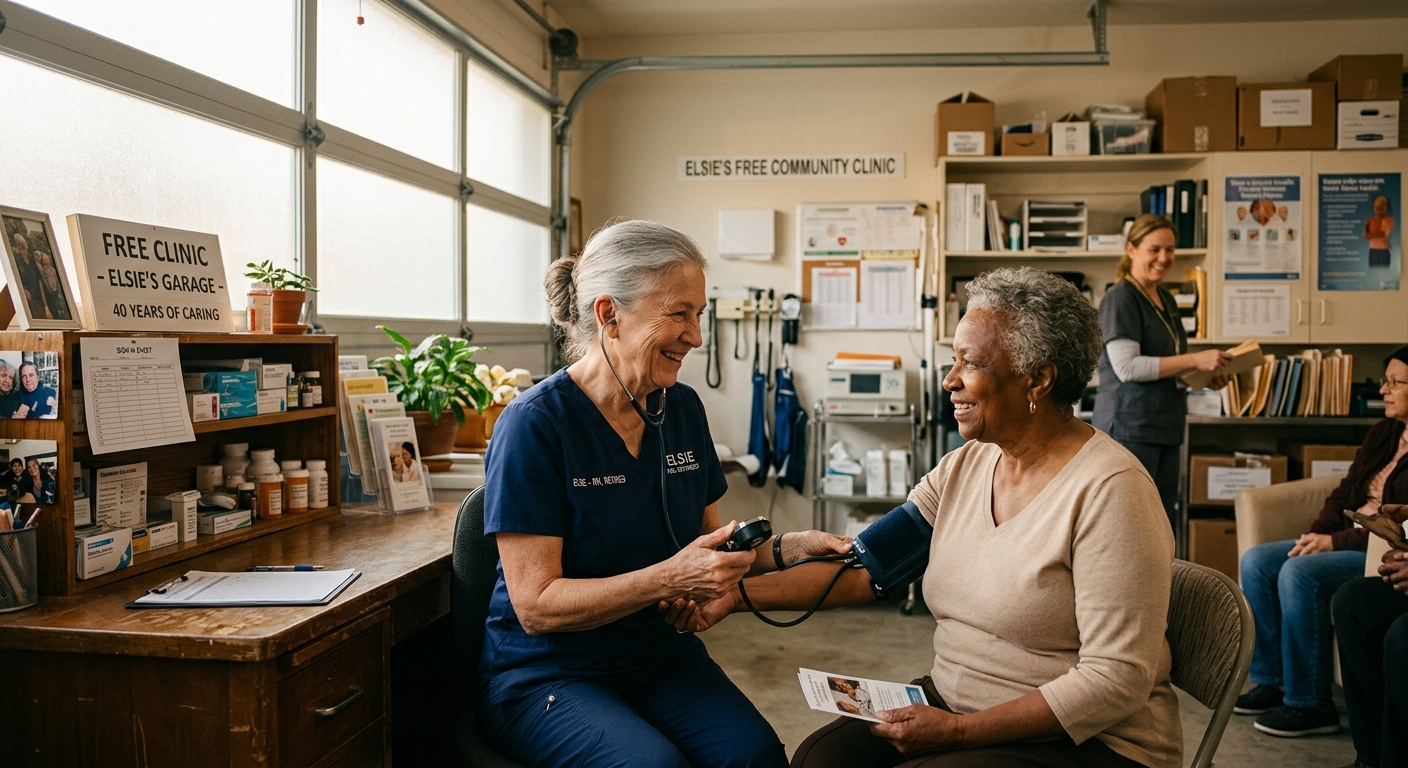
Walking into Pat’s garage clinic on a Saturday morning feels less like entering a medical facility and more like walking into a community living room. Mismatched chairs line the walls. A handmade quilt, donated by a local church group, hangs over a folding partition that creates a private examination area. Children’s books sit in a basket near the door.
The services Pat and her small team of volunteers offer are modest but meaningful:
- Blood pressure and blood sugar screenings
- Wound care and basic first aid
- Medication counseling and dosage guidance
- Referrals to low-cost or free specialists in the area
- Health education on managing chronic conditions like diabetes, hypertension, and asthma
- Prenatal guidance for uninsured expectant mothers
- Mental health check-ins and referrals to community counselors
What Pat cannot treat, she refers. She has spent years building a network of doctors, dentists, therapists, and pharmacists who offer reduced-rate or pro bono services to her patients. Her phone, she jokes, has more contacts in it than most people accumulate in a lifetime.
The Volunteers Who Showed Up
Pat started alone, but she did not stay that way for long. Word spread quietly through the neighborhood, then through the city. Within a year, she had been joined by a recently retired physician named Dr. Marcus Webb, two nursing students from a local university completing their community hours, and a pharmacist named Linda who drives forty minutes each way every Sunday.
“I heard about what Pat was doing and I thought, what am I doing with my weekends that’s more important than this?” Dr. Webb says. “Nothing. The answer was nothing.”
The team has grown to include roughly twelve rotating volunteers, each bringing different skills. One volunteer is a licensed social worker who helps patients navigate government assistance programs. Another is a bilingual college student who serves as a translator for the clinic’s Spanish-speaking visitors.
Nobody gets paid. Nobody asks to be thanked. Most of them say the work gives them something they didn’t expect: a sense of purpose that their paying jobs, somewhere along the way, had quietly stopped providing.
The Patients Who Keep Coming Back
Maria, 38, first came to Pat’s clinic two years ago with an infected wound on her foot she had been treating with dollar-store bandages for three weeks. She was undocumented, terrified, and convinced that seeking help would somehow make things worse.
“Pat opened the door and she just said, ‘Come in, honey. Let’s take a look at that.'” Maria says. “No forms. No questions about where I was from. She just looked at my foot and started helping me.”
The infection required proper wound care over several weeks. Pat treated it every Saturday. Today, Maria volunteers at the clinic herself, helping new patients feel less afraid to walk through the door.
Stories like Maria’s are not rare here. They are the rule.
The Challenges Pat Won’t Pretend Don’t Exist
Running a free health clinic out of a garage is not without its difficulties, and Pat is refreshingly honest about that.
Supplies cost money. Donated medications expire. The folding table that serves as her exam surface wobbles. She once ran out of glucose testing strips for three weeks and had to call in a favor from every contact in her phone to restock them.
There are also the harder moments: the patients she cannot help enough, the ones who come too late, the systemic barriers that no amount of Saturday morning goodwill can fully dismantle.
“I’m not fixing the healthcare system,” Pat says plainly. “I know that. But I’m not waiting for the system to fix itself either. People need help now. So we show up now.”
She has quietly funded much of the operation herself, supplemented by small community donations and an annual fundraiser organized by a local church. She does not have a website. She does not have a nonprofit status, though she is working on it. Most of her patients find her the same way Darnell did: through a neighbor, a friend, a whispered word of “there’s a woman on Clover Street, she’ll help you.”
What Other Communities Can Learn From Pat
Pat’s garage clinic is not just a feel-good story. It is a model, imperfect and scrappy and deeply human, of what community-based care can look like when someone decides that waiting for a perfect solution is a luxury the people around them cannot afford.
Here are a few principles that make her approach work:
1. Start with what you have
Pat did not wait for funding, a building, or official recognition. She used her skills, her garage, and her address book. That was enough to begin.
2. Build a network, not just a service
The clinic’s real power is not in what Pat can do herself, but in the web of referrals and relationships she has built over years. One person cannot provide everything, but one person can connect people to almost everything.
3. Remove every barrier you possibly can
No paperwork. No insurance requirement. No judgment. Every unnecessary barrier Pat removed was another person who felt safe enough to walk through the door.
4. Let people give back
Former patients who become volunteers, neighbors who donate supplies, local businesses that contribute, all of this creates a self-sustaining ecosystem of care and belonging.
Pat’s Simple Philosophy
When asked what drives her to keep going, Pat does not talk about legacy or impact metrics or community transformation. She talks about faces.
“I remember every single person who has come through that garage door,” she says. “Every one of them trusted me with something really vulnerable. Their health, their fear, their dignity. You don’t walk away from that. You just don’t.”
She pauses, then smiles.
“Besides, what else am I going to do on a Saturday morning?”
The coffee is always on. The door is always open. And every weekend, in a garage in Decatur, Georgia, a retired nurse reminds an entire community that care is not a system. It is a choice. And she keeps choosing it, every single week.