🎧 Listen to this story
Narrated by Sadachbia · 8,350 characters
The Starting Line Nobody Thought He’d Reach
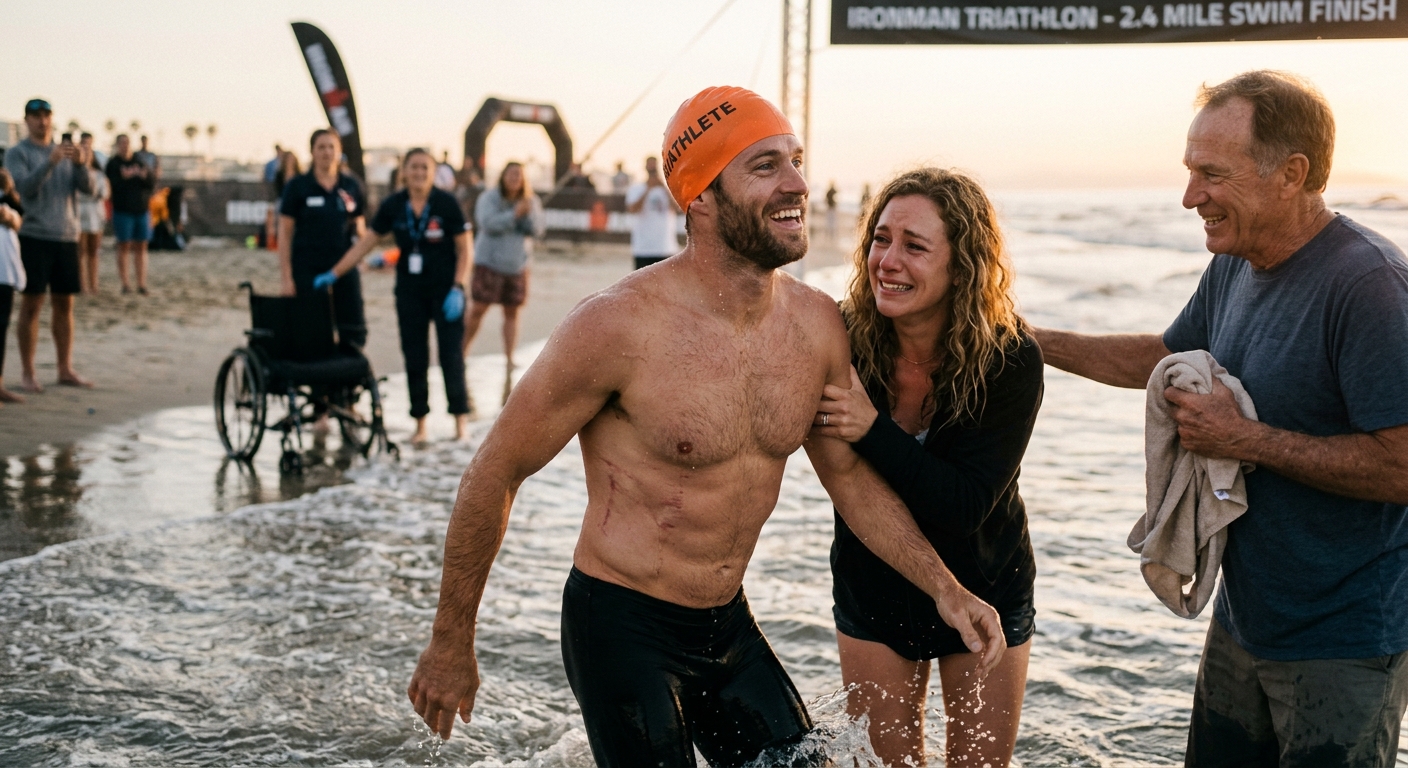
There is a photograph taken at the finish line of an Ironman Triathlon that has circulated quietly through veteran communities, physical therapy offices, and rehabilitation wards around the country. In it, a man raises both fists toward the sky, tears streaming down his face, standing on two prosthetic legs after completing one of the most grueling endurance events in the world: a 2.4-mile open-water swim, a 112-mile bike ride, and a full 26.2-mile marathon. Back to back. Without stopping.
His name is Marcus Tillman, a former Army Ranger who lost both legs below the knee in an IED explosion during his third deployment to Afghanistan. He was 27 years old when it happened. He is 34 now. And the story of how he got from a hospital bed in Landstuhl, Germany, to a finish line in Tempe, Arizona, is not a tidy, inspirational montage. It is something far more honest, far more difficult, and far more worth knowing.
The Aftermath: What Nobody Talks About
Most people, when they hear a story like this, want to skip to the triumph. But Marcus is the first to say that skipping the darkness does a disservice to everyone who is still living in it.
“The first six months, I didn’t want to do anything,” he said in an interview with a veterans’ rehabilitation nonprofit. “I didn’t want to talk to my family. I didn’t want to look at my legs, or what was left of them. I was angry at everything and everyone, and mostly at myself, which doesn’t make any logical sense, but grief isn’t logical.”
He was diagnosed with post-traumatic stress disorder and moderate depression within weeks of returning stateside. The physical rehabilitation was excruciating. Learning to walk on prosthetics is not simply a matter of strapping on a device and moving forward. It involves relearning the most basic motor patterns, enduring skin breakdown and socket fits that chafe raw, and falling down, repeatedly, in front of strangers and loved ones alike.
“Falling in front of my kids was the hardest part,” he admitted. “My daughter was five. She would cry every time I fell. And I had to decide: is this going to break me, or is it going to be the thing that keeps me going?”
The Moment Everything Shifted
The pivot point, Marcus says, was not a dramatic one. It was not a speech from a doctor or a moment of divine clarity. It was a Tuesday afternoon in a community pool, during a water therapy session, when his physical therapist offhandedly mentioned that she had once worked with an amputee who completed a sprint triathlon.
“I didn’t even know what a triathlon was,” he laughed. “She explained it and I thought she was insane. But I couldn’t stop thinking about it. That night I looked up Ironman on YouTube and I watched finish-line videos for three hours. I don’t know what happened to me watching those videos, but something clicked.”
He set his intention quietly at first, telling only his wife and his therapist. His prosthetist, a seasoned clinician named Dr. Rita Osei, said she was cautious when he first brought it up.
“Marcus came in and told me his goal and I said, great, let’s think about this systematically,” Dr. Osei recalled. “An Ironman on bilateral below-knee prosthetics requires not just one pair of legs. You need swim legs, cycling legs, and running blades. The fitting process alone took the better part of a year. But Marcus never missed an appointment. Ever. In three years, he never missed one.”
The Training: Numbers That Put It in Perspective
To appreciate what this accomplishment means physically, consider what an Ironman Triathlon demands of any athlete, let alone one navigating the additional variables of prosthetic use:
- 2.4-mile open-water swim: Completed without the use of legs for propulsion, relying almost entirely on upper-body strength
- 112-mile bike ride: Completed on a specially adapted handcycle after months of equipment modification and testing
- 26.2-mile marathon: Completed on carbon fiber running blades, requiring 8 prosthetic socket adjustments during training over 18 months due to residual limb changes
- Total training time: Approximately 2.5 years from first pool session to race day
- Training hours logged per week at peak: Between 18 and 22 hours
- Number of times he considered quitting: “Honestly? Hundreds.” his words, not an estimate.
His training partner, fellow veteran and above-knee amputee Derek Souza, trained alongside him for the final 14 months. “Marcus would show up when he was in pain. He would show up when the socket was rubbing him raw and he was bleeding. You could not keep that man out of the pool or off the bike,” Derek said.
Race Day: A Play-by-Play of the Impossible
The morning of the race, Marcus woke at 3:45 a.m. His wife, Elena, has described the scene simply: “He didn’t say much. He just ate his oatmeal, kissed me and the kids, and said, ‘Today’s the day.’ There was no fanfare. Just quiet, steady purpose.”
The swim went well. Without functioning legs to weigh him down, his upper body carried him efficiently through the water. He exited the swim in a strong competitive time for his division. The bike leg was harder. Around mile 70, a mechanical issue with his handcycle forced a 22-minute stop. Race officials and a support volunteer helped address it, and Marcus pressed on.
The marathon was where the real battle began. By mile 16, the skin on his left residual limb had broken down significantly. He stopped twice at medical tents for dressing changes. Race medical staff offered to pull him from the course. He declined both times.
“I thought about every person who had ever told me I was done,” he said later. “Not out of anger. More like, I wanted to finish for them too. I wanted them to see something different was possible.”
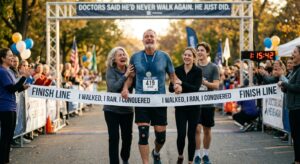
He crossed the finish line at 10:48 p.m., with 12 minutes to spare before the official cutoff. The announcer called his name. His daughter, now eight years old, ran onto the course and grabbed his hand for the final 100 meters.
What This Teaches the Rest of Us
It would be easy to look at Marcus Tillman’s story and feel inspired in the abstract. But he is insistent that the real lessons are practical and transferable, not just emotionally motivating.
Lesson 1: Goals Need Systems, Not Just Spirit
Marcus emphasizes repeatedly that emotion alone would never have gotten him to the finish line. “The passion gets you started. The calendar keeps you going,” he says. He and Dr. Osei broke his goal into specific, measurable milestones over a 30-month period. When he felt hopeless, he focused on the next milestone only.
Lesson 2: Community Is Not Optional
He credits his prosthetist, his training partner, his wife, and a veterans’ peer support group with his success. “I did not do this alone. Anyone who tells you they achieved something like this alone is leaving out most of the story.”
Lesson 3: Identity Has to Expand, Not Disappear
One of the most important shifts in his recovery, Marcus says, was refusing to let his injury become his entire identity, while also refusing to pretend it was not part of who he is. “I’m an amputee. I’m a veteran. I’m also an Ironman. Those things live together. None of them cancel out the others.”
Lesson 4: The Finish Line Is Not the Point
“People always ask how it felt to finish. And it felt incredible. But the real transformation happened somewhere around month 14 of training, on a Wednesday, when I realized I had become someone I actually liked again. That was the real finish line.”
Where Marcus Is Now
Marcus Tillman now works as a motivational speaker and consultant for veteran rehabilitation programs across the country. He has completed two more Ironman events since his first finish. He advocates for expanded prosthetic access for veterans, noting that many amputees do not have access to the specialized devices required for adaptive sports due to cost and insurance limitations.
He is also training his daughter to run her first 5K. He plans to run it with her.
“She has no idea yet that she’s the reason I got up some of those mornings,” he said, smiling. “Maybe someday I’ll tell her. Or maybe she’ll just figure it out.”
The photograph at the finish line, the one with the raised fists and the tears, now hangs in the waiting room of Dr. Osei’s prosthetics clinic. Beneath it, a small placard reads: “What is your next mile?”