🎧 Listen to this story
Narrated by Schedar · 7,766 characters
The Forest Has a Secret Language
Walk into any forest and you might feel it: a sense of calm, a quiet intelligence, something almost alive humming beneath your feet. For centuries, poets and indigenous cultures described forests as living, breathing communities. Scientists largely dismissed this as romantic thinking. Then came the research that changed everything.
It turns out the forest is not silent at all. Trees are communicating, warning, feeding, and protecting one another through systems so sophisticated they have earned the nickname “the Wood Wide Web.” What researchers have discovered over the past three decades is not just fascinating science. It is a complete reimagining of what it means to be a living thing on this planet.
The Underground Internet: Mycorrhizal Networks
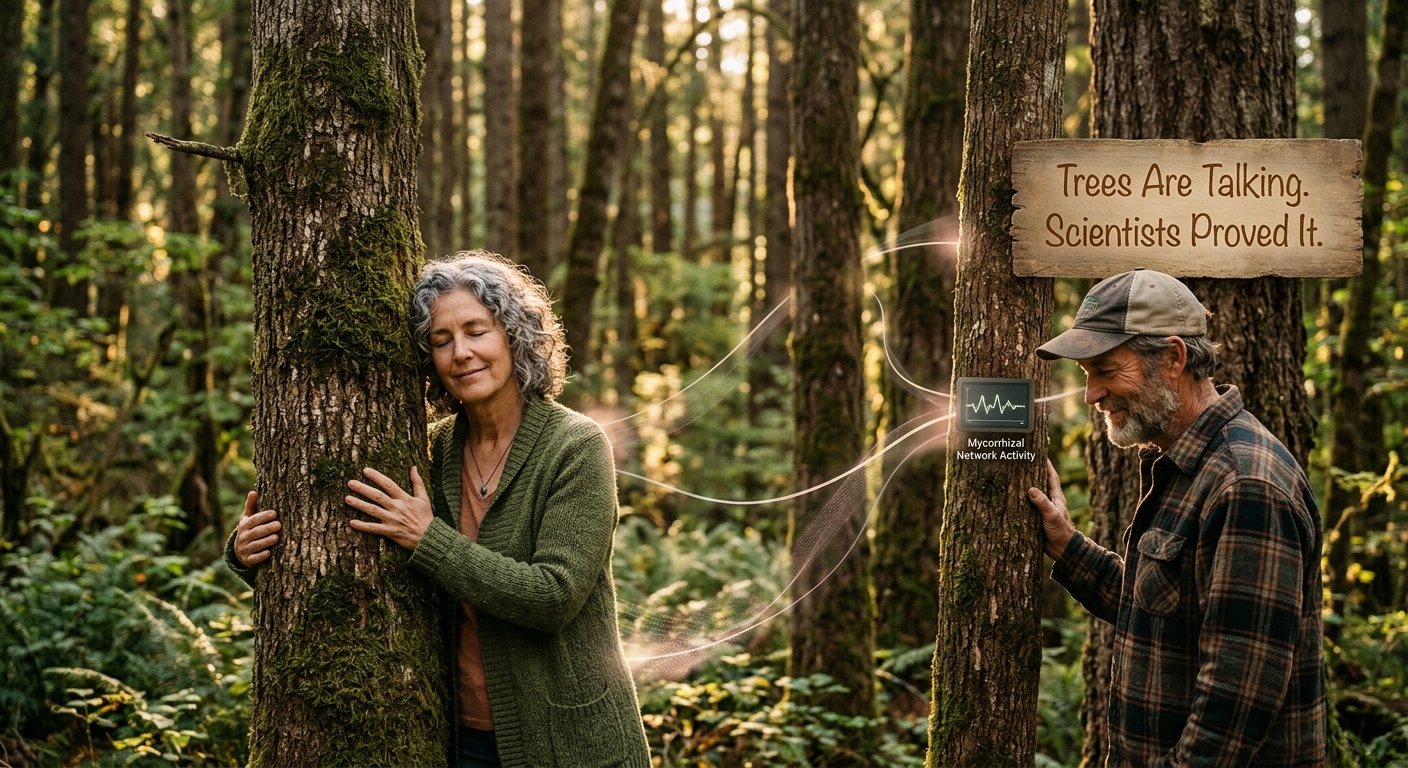
Beneath every healthy forest floor lies an extraordinary network of fungal threads called mycorrhizae. These microscopic filaments weave through soil, connecting the root systems of trees across vast distances. A single teaspoon of forest soil can contain miles of these fungal threads. Together, they form a biological internet that trees use to send chemical signals, share nutrients, and yes, warn each other about threats.
Dr. Suzanne Simard, a forest ecologist at the University of British Columbia, spent decades mapping these networks. Her landmark research revealed that trees are not competing loners fighting for sunlight and soil. They are cooperative members of a community, and the mycorrhizal network is their communication infrastructure.
Her most striking discovery: mother trees, the oldest and largest trees in a forest, actively recognize their own offspring and send them extra carbon and nutrients through the network. They essentially nurture their young, even in the dark of the soil.
Chemical Alarm Systems Above Ground
The underground network is only half the story. Above ground, trees communicate through the air using volatile organic compounds, essentially chemical messages carried on the wind.
Here is how it works:
- A tree is attacked by insects, caterpillars, or disease.
- The threatened tree releases chemical compounds into the air, including ethylene, terpenes, and other volatile signals.
- Neighboring trees detect these airborne chemicals through their leaves and bark.
- The neighboring trees respond by producing their own defensive chemicals, tannins, and bitter compounds that make their leaves less tasty and harder to digest for insects.
- The alarm spreads outward through the forest, tree by tree, like a slow-motion fire alarm going off across acres of land.
This process was first documented in the 1980s when researchers studying willows and poplars noticed that trees near damaged specimens started producing higher levels of phenolic compounds before any insects had actually reached them. The trees were preparing their defenses based on a chemical warning from their neighbors.
Warning Through Roots: Underground Signals
Beyond the fungal network, trees also send electrical signals through their own root systems. German forester Peter Wohlleben, author of the bestselling book The Hidden Life of Trees, described observing beech trees in the forests of the Eifel mountains sharing sugar through their roots with stumps of long-dead trees, keeping those stumps alive for centuries. He called it an act of communal memory.
Research published in journals including Science and Ecology Letters has further confirmed that root-to-root chemical signaling allows trees to communicate stress about drought conditions, soil toxicity, and physical damage. When one tree’s roots detect a pathogen, it can flood the surrounding soil with chemical signals that prime neighboring trees to produce antifungal compounds.
Sound: The Strangest Communication of All
Perhaps the most surprising discovery of recent years involves sound. Research teams have detected that plant roots emit and respond to specific sound frequencies in the range of 200 to 300 hertz. When exposed to these frequencies, roots appear to grow toward them, as though listening and orienting themselves.
Monica Gagliano, a plant biologist at the University of Sydney, conducted experiments showing that plant roots can detect and respond to the vibrations of running water through soil, choosing to grow in those directions even when no moisture was physically present. The plants were interpreting vibrations the way we might interpret a distant sound and using that information to make decisions.
Whether this constitutes “hearing” in any way we would recognize is debated. But it is clear that trees are sensing their environment in ways that go far beyond what we once believed possible.
What This Means for How We See Forests
The implications of this research ripple far beyond academia. If trees communicate, warn, and care for each other, it reshapes the ethics of how we treat forests entirely.
Consider these realities:
- Clear-cutting does not just remove trees. It destroys an entire communication network built over centuries.
- Isolated city trees planted in concrete medians are cut off from any network, effectively solitary and unable to communicate or receive support.
- Old-growth forests cannot simply be replanted. The fungal networks that support them take hundreds of years to develop.
- Monoculture forests, planted with a single species, lack the biodiversity that makes these communication networks function properly.
Suzanne Simard has said in interviews that when we lose the mother trees, we lose the elders of the forest, the ones holding the most connections in the network and the ones most capable of guiding the next generation. The loss is not just ecological. It is, in a very real sense, the loss of wisdom.
Indigenous Knowledge Got There First
It is worth pausing here to acknowledge something important. Many indigenous cultures around the world described forests as living communities with their own forms of intelligence and relationship long before Western science arrived at the same conclusion.
The Haudenosaunee, the Anishinaabe, the Māori, and countless other peoples embedded a relational view of trees and forests into their spiritual and cultural practices. Their land stewardship reflected an intuitive understanding that forests function as communities, not collections of individual resources to be extracted.
Modern forest science is, in many ways, catching up to what has always been known by those who lived closest to the land.
A Lesson in Connection
There is something profoundly moving about learning that trees warn each other about danger. That a forest, which appears to us as a collection of separate, silent, immovable individuals, is actually a humming, cooperative community sharing resources, sending alarms, and caring for its young.
It invites a question we might ask about ourselves: how often do we share what we know with those around us? How often do we send out the signal when we see danger coming, not just for our own sake, but so the whole community can prepare?
The trees have been doing it for millions of years. Perhaps there is a lesson in that for us after all.
How You Can Help Protect These Networks
If this science has sparked something in you, here are a few concrete ways to support forest communication networks:
- Support organizations working to preserve old-growth forests.
- When planting trees, choose native species suited to your region.
- Avoid using fungicides near tree roots, as these can destroy mycorrhizal networks.
- Advocate for forest management practices that retain old trees rather than removing them entirely.
- Spend time in old forests. The more people who experience them, the more people who will fight to protect them.
The forest is speaking. We just have to learn to listen.