🎧 Listen to this story
Narrated by Leda · 9,782 characters
A Different Kind of Time Off
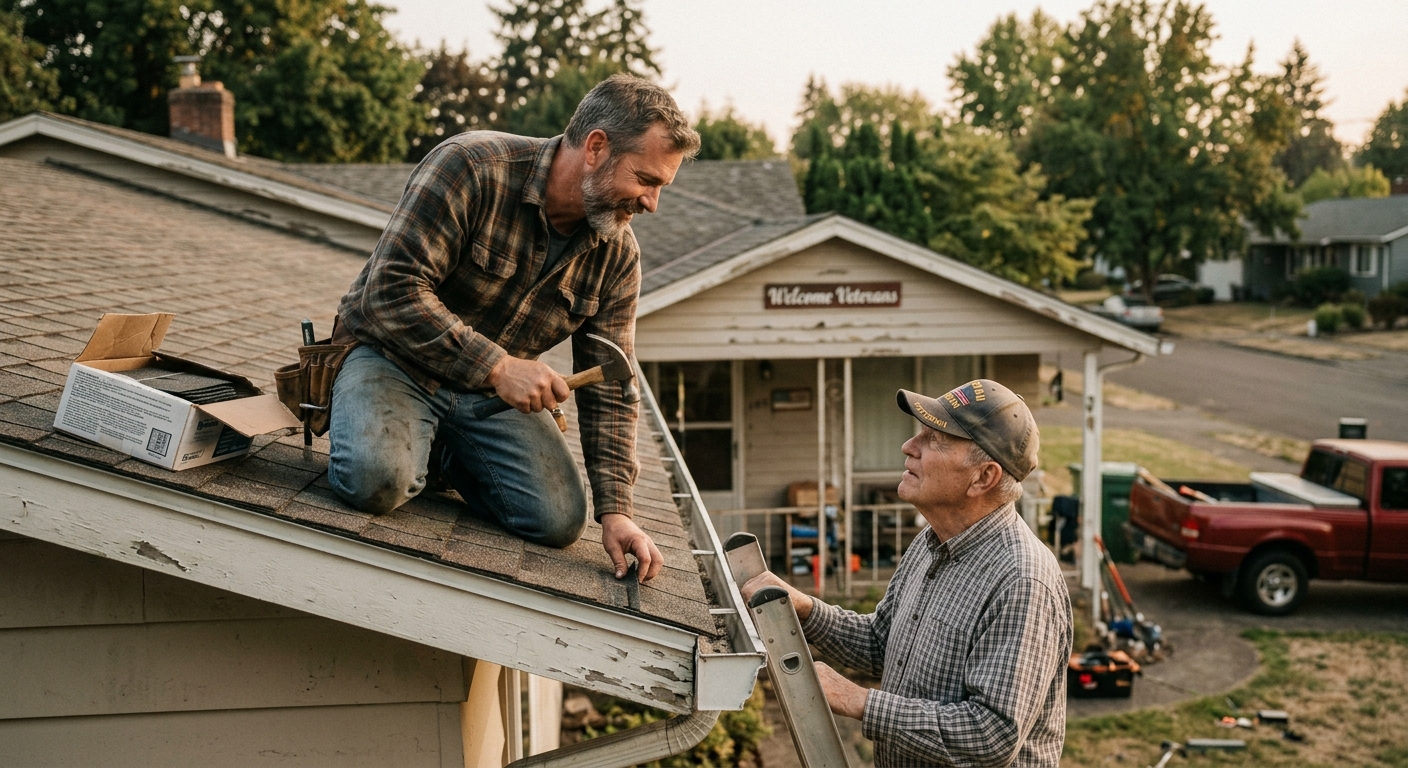
Most people count down the days to their vacation. They plan trips, book flights, scroll through travel photos, and dream about somewhere far away from the ordinary. Mike Callahan counts down too, but not for any of those reasons. When Mike’s paid time off rolls around each year, he loads his pickup truck with tools, lumber, paint, and caulk, and he drives to the home of a stranger who served this country and can no longer fix a leaking roof, a rotting porch, or a broken furnace on their own.
Mike is 47 years old. He works as a shift supervisor at a packaging plant in Akron, Ohio. He has a wife, two teenage kids, and a dog named Biscuit. By every conventional measure, he is an ordinary man living an ordinary life. But for the past eleven years, he has spent every single one of his vacation weeks doing something most people would never consider: free home repair for elderly veterans.
“People ask me if I ever want to go to the beach,” Mike says with a grin. “I tell them the beach will still be there. Some of these veterans, their houses won’t be. And they won’t be either.”
How It Started: A Neighbor, a Leaking Roof, and a Conversation That Changed Everything
The story begins, as many life-changing ones do, with a small moment that could have easily been ignored.
In 2013, Mike noticed that his elderly neighbor, a 79-year-old Korean War veteran named Harold, had a blue tarp draped across one section of his roof. It had been there through three rainstorms. One afternoon, Mike walked over and knocked on the door.
Harold answered. He was a thin man with a firm handshake and careful eyes. When Mike asked about the roof, Harold explained that he had called several contractors but could not afford the quotes he received. His fixed income left little room for anything beyond groceries and medication. His son lived in another state. His wife had passed two years prior. He was managing, he said, the way he always had, one day at a time.
Mike went home, told his wife, and came back the next morning with a ladder and a bag of roofing supplies he had purchased himself. It took him a full weekend. When he finished, Harold stood at the bottom of the ladder and looked up at the patched roof for a long time without saying anything. Then he looked at Mike and said, “I don’t know how to thank you for this.”
Mike says that moment rewired something in him. “He wasn’t asking for charity. He was just a man who had served his country, spent decades working hard, and ended up in a situation where something as basic as keeping the rain out of his house was beyond what he could handle. That didn’t sit right with me.”
Building Something Bigger Than One Roof
After helping Harold, Mike started asking around. He connected with a local Veterans of Foreign Wars post and discovered that Harold’s situation was far from unique. Across his county alone, dozens of elderly veterans were living in homes that were slowly deteriorating around them, unable to afford repairs, too proud to ask for help, and without family nearby to step in.
He reached out to friends who had construction skills. Two of them, a plumber named Derek and an electrician named Rosa, agreed to join him. They created an informal group they called Groundwork Vets, not a nonprofit, not a charity with a website and a board of directors, just a small crew of people who showed up with tools and did the work.
“We kept it simple on purpose,” Mike explains. “No bureaucracy. No application process that makes a 84-year-old man fill out twelve forms just to get a door rehung. You call the VFW, they call us, we show up.”
What the Work Actually Looks Like
Over eleven years, Mike and his rotating crew of volunteers have completed repairs for more than 90 veterans across four counties in northeastern Ohio. The projects range in size and scope, but all of them share one thing: they are things that matter deeply to the people who live in those homes.
- Roof repairs and replacements: The most common request, and often the most urgent. A compromised roof can make an entire home uninhabitable over time.
- Ramp and accessibility modifications: Many veterans have mobility challenges. Building a proper ramp or widening a doorway can mean the difference between independence and a care facility.
- Plumbing fixes: Leaking pipes, failing water heaters, and broken fixtures are frequent problems in older homes.
- Electrical safety updates: Outdated wiring is a fire hazard, and many veterans are living in homes that haven’t had an electrical inspection in decades.
- Insulation and weatherproofing: Heating costs on a fixed income can be devastating. Sealing drafts and improving insulation has a direct impact on quality of life and monthly expenses.
- General structural repairs: Rotting porches, sagging floors, broken steps. The kind of thing that is easy to ignore until it becomes dangerous.
Mike and his crew do not charge for labor. They cover the cost of materials themselves when they can, and they have a small network of local hardware stores and lumber yards that donate supplies on a regular basis. “It’s not glamorous,” Mike says. “Sometimes you’re in a crawl space in February. But when you come out and the veteran whose house you just worked on makes you a cup of coffee and sits down to talk, you realize you got the better end of the deal.”
The Veterans Behind the Work Orders
Each home visit comes with a story. Mike has learned to listen as much as he works.
There was Margaret, a 91-year-old World War II-era Navy nurse who needed her front steps rebuilt. She spent the entire two days of repairs telling Mike about her time stationed in the Pacific, stories she said she had not shared in years because she felt nobody her age was left who would understand them.
There was Calvin, an 82-year-old Vietnam veteran who had refused help three times before finally accepting when his ceiling started to cave in from a slow water leak. He told Mike on the last day of the project, quietly and without fanfare, that accepting help was the hardest thing he had done since coming home from the war. Mike says he thinks about that often.
There was Dorothy, 88 years old, a veteran of the Women’s Army Corps, who cried when the volunteers installed a grab bar in her bathroom. Not because of the grab bar itself, she explained, but because she had been afraid to shower for six months, scared she would fall, and now she wasn’t afraid anymore.
“These aren’t sob stories,” Mike is careful to say. “These are dignified people who built their lives, raised their families, and served their country. They just need a little help. We all do, eventually.”
What His Family Thinks
Mike’s wife, Karen, is supportive in the way that only someone who has truly thought it through can be. She volunteers on some projects herself, handling coordination, supply pickups, and the occasional painting job. Their kids have joined on school breaks.
“My son asked me once why we don’t just go somewhere fun for vacation,” Mike says. “I told him this is fun. He rolled his eyes, teenager-style. But then by the end of the week he was helping Calvin hang new drywall and Calvin was teaching him about tools, and my son came home and said that was actually the best week he’d ever had. That meant a lot.”
The Lesson Mike Keeps Learning
If you ask Mike what he gets out of this work, he takes a moment before answering. It’s clear he has thought about this a great deal.
“I think we tell ourselves that doing good is about sacrifice,” he says. “That you give something up. And sure, I could be at the beach. But I come home from these weeks feeling like I actually lived. Like I did something real. That’s not sacrifice. That’s the whole point.”
He pauses. “Harold passed away four years ago. I still drive by his house sometimes. The roof is still holding up. That matters to me more than I know how to explain.”
How You Can Do Something Similar
Mike is quick to point out that you don’t need a crew, a truck full of tools, or eleven years of experience to make a difference. He offers a few starting points for anyone who feels moved to help:
- Contact your local VFW post or American Legion chapter. They often know exactly which veterans in your community need help and have been too proud to ask.
- Organizations like Rebuilding Together and Habitat for Humanity have veteran-specific programs and welcome skilled volunteers.
- If you have a trade skill, offer it directly. Plumbers, electricians, carpenters, and painters are always needed.
- Even a single afternoon spent helping a veteran with yard work, grocery runs, or minor repairs can have an enormous impact on their daily life.
- Donate materials to local volunteer repair crews. Many groups like Mike’s operate on donated supplies and stretch every dollar as far as it will go.
“You don’t have to do what I do,” Mike says. “You just have to do something. Pick one person. Pick one problem you can solve. Start there. That’s all I did.”
One Nail at a Time
There is no dramatic finish line to Mike Callahan’s story, no moment where the work is done and everyone celebrates. Next year, he will load up his truck again. He will show up at another home where another veteran has been quietly struggling. He will climb another ladder, swing another hammer, and sit down at another kitchen table for another cup of coffee and another conversation that reminds him what this life is actually for.
Some people save up their vacation days for the trip of a lifetime. Mike spends his building something more lasting: the simple, sturdy assurance that the people who once protected this country will not spend their final years with the rain coming through the ceiling.
That, he will tell you without any hesitation, is exactly where he wants to be.