🎧 Listen to this story
Narrated by Gacrux · 8,278 characters
A Bond That Defied Easy Explanation
When longtime zookeeper Anton Hagenback passed away after a sudden illness in 2019, the staff at his European wildlife sanctuary expected a period of adjustment. Animals, after all, are sensitive to change. They notice when routines shift, when familiar voices go quiet, when a hand that used to offer food no longer appears at the enclosure gate.
What no one expected was Nana.
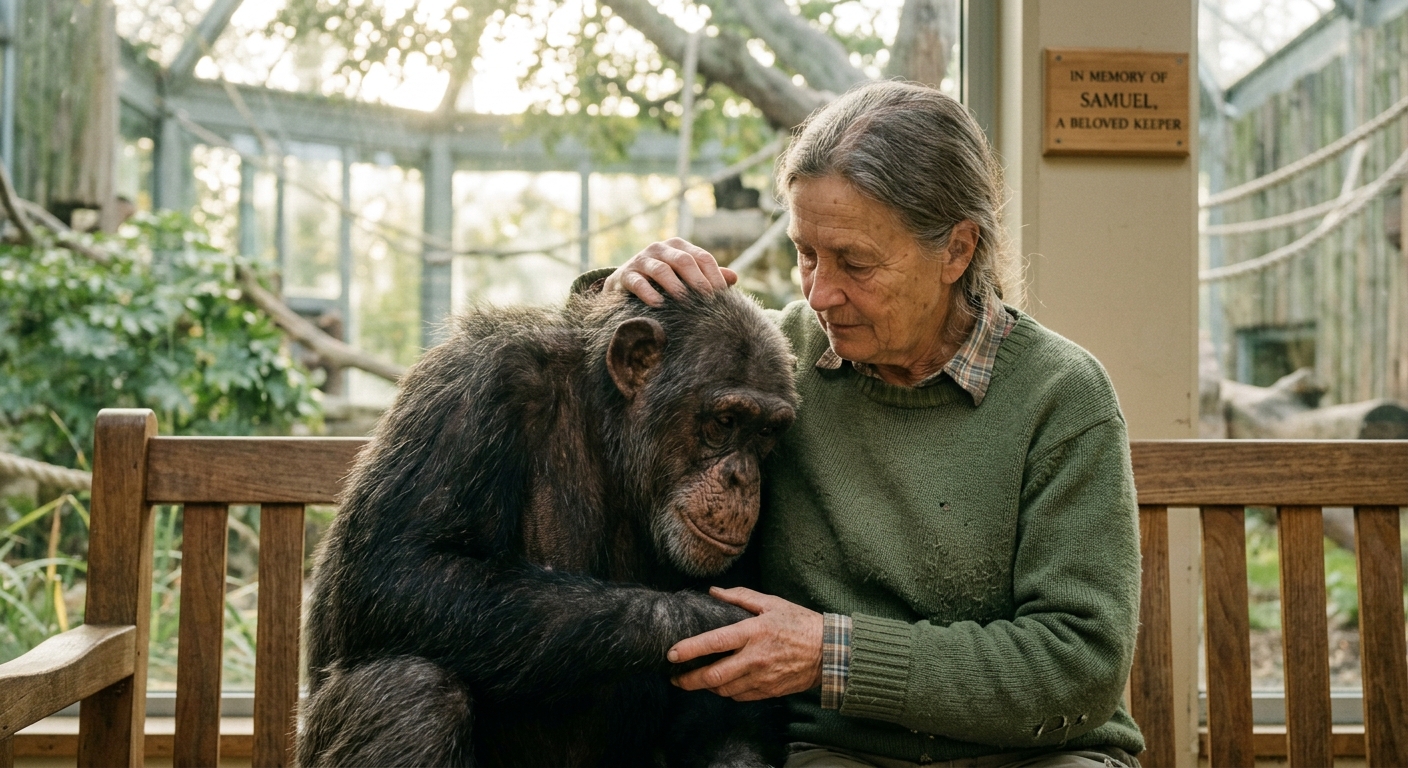
Nana, a 38-year-old female chimpanzee who had known Anton for nearly two decades, stopped eating for four days. She sat at the corner of her enclosure closest to the staff entrance, the same spot where Anton used to begin his morning rounds. She rocked. She watched the door. And for months afterward, according to sanctuary staff, she would grow visibly agitated whenever a male keeper in a blue uniform, the color Anton always wore, entered her sightline.
Her story is not unique. Across zoos, sanctuaries, and wildlife research stations around the world, scientists and caregivers have documented a growing body of evidence that great apes, and possibly other highly social animals, experience something that looks remarkably, uncomfortably close to grief.
What the Science Actually Says
Let’s be careful here, because the science demands it. Researchers are quick to caution against what they call anthropomorphism, the tendency to project human emotional frameworks onto animal behavior. And yet, those same researchers are increasingly reluctant to dismiss what they observe.
Dr. Jane Goodall, whose decades of fieldwork with chimpanzees in Gombe, Tanzania, remain some of the most detailed behavioral studies ever conducted, has described witnessing chimps fall into what she carefully terms “depression-like states” following the death of a companion. Her observations of Flint, a young male chimpanzee who died just weeks after the death of his mother Flo in 1972, became one of the earliest and most discussed cases of possible grief in non-human primates.
Flint stopped eating. He became withdrawn. He returned repeatedly to the place where his mother had died. He died at age eight from what researchers believe was a combination of immune suppression and despair.
More recently, a 2021 study published in Primates, the international journal of primatology, documented multiple instances of chimpanzees and gorillas carrying, grooming, and refusing to leave the bodies of deceased companions, including infants and long-term social partners. The researchers noted that these behaviors persisted for days and, in some cases, weeks.
The Neuroscience Underneath
Part of what makes this conversation so compelling is what we now understand about the primate brain. Great apes share between 95 and 99 percent of their DNA with humans. Their limbic systems, the emotional processing centers of the brain, are structurally similar to ours. They have spindle neurons, also known as Von Economo neurons, which are associated with social awareness, empathy, and the processing of complex emotions. For a long time, scientists believed only humans possessed these neurons. Then researchers found them in great apes. Then in elephants. Then in cetaceans like dolphins and whales.
This does not prove that animals grieve. But it does mean the biological hardware for something like grief may be far more widespread than we once assumed.
The Zookeepers Who Know It When They See It
For the people who work most closely with great apes, the academic debate can sometimes feel distant from what they witness every day.
“You spend fifteen years with an animal,” said one senior primate keeper at a accredited North American zoo who asked not to be named, “and you know her. You know when she is content and when she is uneasy and when something is genuinely wrong. When my colleague retired and stopped coming in, the female he had worked with most closely changed. Her vocalizations changed. Her appetite changed. It took almost six months before she seemed herself again.”
These are not isolated anecdotes. A 2017 survey of primate caregivers across 35 accredited facilities found that 78 percent reported observing behavioral changes in great apes following the loss of a human or animal companion that they could not attribute to environmental or health factors. Many described the changes as consistent with what grief looks like in human patients, including social withdrawal, appetite disruption, repetitive behavior, and a loss of interest in enrichment activities the animal had previously enjoyed.
Gorillas, Orangutans, and the Wider Picture
Chimpanzees tend to dominate this conversation, partly because they have been studied longest. But there is growing documentation of similar behaviors in other great apes.
- Gorillas: Multiple cases have been reported of silverbacks and adult females sitting with or returning to the bodies of deceased group members. In one widely reported 2018 case in Rwanda, a female gorilla was observed carrying her stillborn infant for more than two weeks before gradually moving on.
- Orangutans: Though more solitary by nature, orangutans in both wild and captive settings have shown signs of prolonged behavioral disruption following the loss of a bonded companion or caregiver.
- Bonobos: Perhaps the most socially sophisticated of the great apes, bonobos have been observed engaging in what researchers describe as consolation behaviors with group members who appear distressed, behaviors that parallel human comforting in striking ways.
What Nana’s Story Asks of Us
Back to Nana. Months after Anton’s death, a small memorial was held at the sanctuary. Staff gathered near the chimpanzee habitat to share stories about their colleague. Someone brought a framed photograph and placed it on a table outside the enclosure.
Nana approached the fence. She sat down. According to three staff members who were present, she was quiet for several minutes, looking at the photograph, before slowly walking away.
Was it recognition? Coincidence? The projection of grieving humans onto a watching animal? Possibly all three. Science cannot tell us, not yet, and perhaps not ever with certainty. The inner life of another species remains, by definition, beyond our full reach.
But here is what the growing body of research does suggest: the capacity for attachment, for social bonds that carry emotional weight, for something that functions like loss when those bonds are severed, may not be uniquely human. It may be something older, something we share with our closest evolutionary relatives in ways that should give us pause.
Five Things This Research Is Teaching Us
- Grief may be evolutionary: Some researchers theorize that grief-like responses in social animals may have evolved as a mechanism to reinforce the value of bonds, motivating individuals to protect their social partners more fiercely while they are alive.
- Relationships between humans and animals are real and complex: The bonds formed between skilled caregivers and the animals in their care are not simply transactional. They carry emotional resonance for both parties.
- Animal welfare science needs to catch up: If great apes can experience something like grief, then the deaths of companions, human or animal, deserve to be treated as welfare events requiring active support and monitoring.
- We are not as singular as we thought: Every decade of animal cognition research seems to erode another wall between human experience and animal experience. Grief may be the next wall to come down.
- Observation matters: The caregivers who spend years with these animals are generating important data, and the field needs better systems for capturing and sharing their observations alongside formal research.
A Closing Thought
There is something both humbling and oddly comforting about Nana’s story. Humbling, because it asks us to sit with the discomfort of not knowing exactly what she experienced. Comforting, because it suggests that the capacity to feel the absence of someone who mattered is not ours alone.
Anton spent nearly two decades showing up, in his blue uniform, at the same gate, at the same time, with the same steady presence. Nana noticed. And when he was gone, she noticed that too.
Whatever word we ultimately use for what she felt, it seems worth honoring.