🎧 Listen to this story
Narrated by Kore · 7,691 characters
The Day Everything Changed
In the spring of 2001, a twenty-three-year-old man named Samuel Osei stepped off a plane at JFK International Airport with a single duffel bag, a folded piece of paper with a cousin’s phone number on it, and exactly twenty dollars to his name. He did not speak fluent English. He had no job lined up. He had no savings waiting for him in a bank account, no safety net, no plan beyond the next forty-eight hours.
What he did have was a memory. A specific, stubborn, unshakeable memory of being eleven years old in rural Ghana, sitting outside a mud-brick building that passed for a classroom, learning arithmetic by scratching numbers into the dirt because there were no notebooks. He remembered the teacher, Mr. Amponsah, who showed up every single day despite earning almost nothing, who believed that education was the one thing no one could ever take from a child once they had it.
That memory, it turns out, was worth more than any amount of money Samuel could have carried through customs.
Starting From Zero, Literally
Samuel’s first years in New York were not the stuff of Hollywood movies. There was no magical mentor, no lucky break, no sudden windfall. He slept on his cousin’s couch in the Bronx for eight months. He washed dishes. He bused tables. He cleaned office buildings from midnight to six in the morning and then took English classes at a community center before heading back to work. On a good week, he made enough to cover his share of rent, buy groceries, and set aside a small amount that he kept in a tin box under the couch.
He called it his “school fund.” Even then, even when he had almost nothing, he was saving for something he could not yet fully imagine.
“People used to laugh at me,” Samuel recalled in a recent interview with a community nonprofit. “Not meanly, just confused. They would say, ‘Samuel, you don’t even have a bed. Why are you saving money for children in Ghana?’ And I would say, ‘Because someone has to start. It might as well be me.'”
Building a Life, One Shift at a Time
Over the next decade, Samuel’s circumstances slowly improved. His English became sharp. He earned a GED, then enrolled in a community college while continuing to work full time. He transitioned from restaurant work to construction, which paid better, and eventually got his contractor’s license. He started a small renovation business in the Bronx that grew steadily through word of mouth. He married a Ghanaian American woman named Abena, who understood the tin box and the dream inside it completely.
By 2015, Samuel’s business employed eleven people and was turning a modest but stable profit. The tin box had long since been replaced by a dedicated savings account, which had grown to just over sixty thousand dollars. He had not taken a vacation in four years. He drove a 2009 Honda Civic with two hundred thousand miles on it. Every financial decision he made was filtered through a single question: does this bring me closer to the school, or further away?
Returning Home With More Than Money
In 2016, Samuel flew back to Ghana for the first time in fifteen years. He visited the village of Aduamoa in the Eastern Region, the same village where he had scratched arithmetic into the dirt as a boy. What he found both broke his heart and hardened his resolve. The school building had partially collapsed. Classes were being held outside under a tarp. The nearest functioning school with solid infrastructure was more than twelve kilometers away, and many children simply did not go.
He met with village elders, local government officials, and a Ghanaian nonprofit organization called EduBridge that specialized in building and staffing rural schools. He laid out his savings, his plan, and his timeline. Within six months, construction had begun.
What the School Looks Like Today
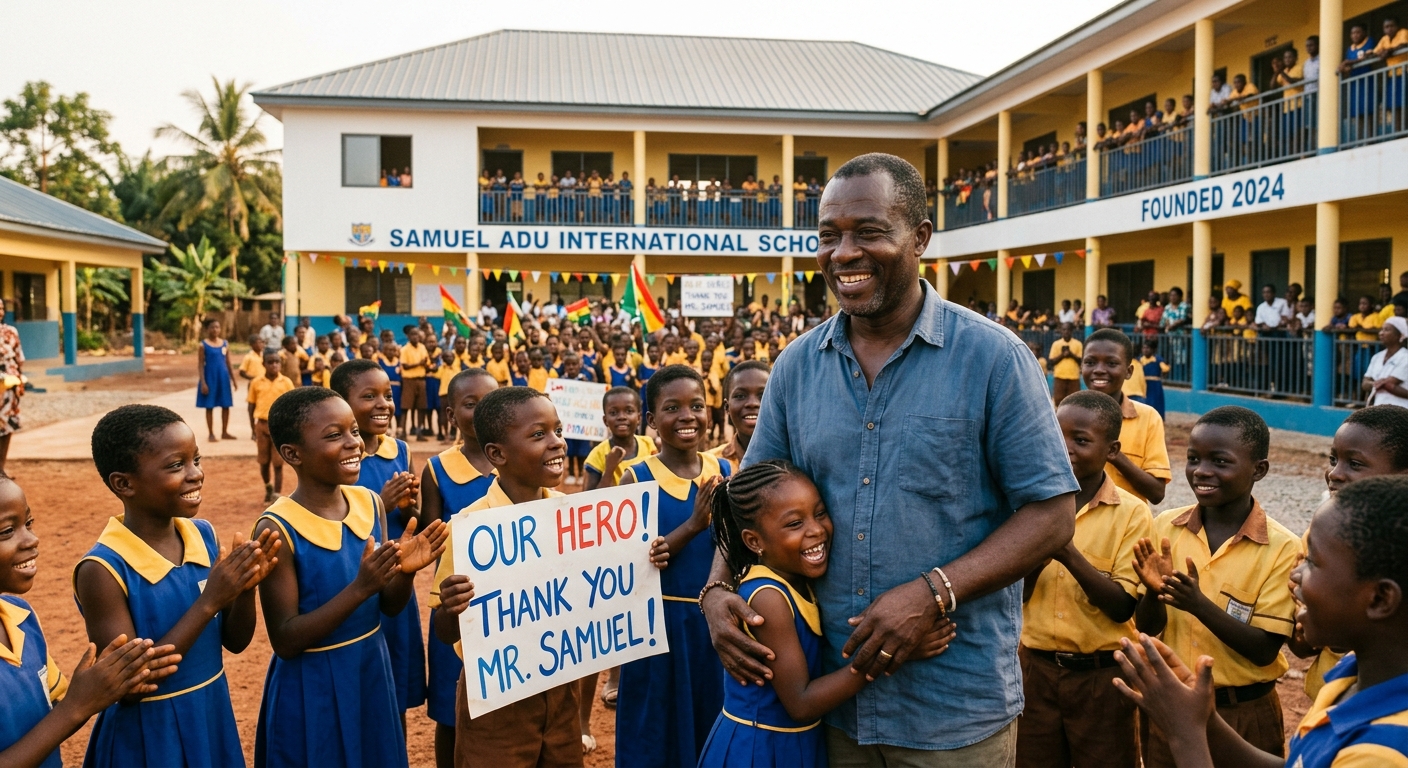
The Aduamoa Community Learning Centre officially opened its doors in January 2020, just weeks before the world shut down for a pandemic. It stands as a six-classroom building with concrete walls, proper roofing, clean water access, and a small library. It serves 500 children from Aduamoa and seven surrounding villages. It has twelve trained teachers, a feeding program funded through ongoing donations, and a growing relationship with a teacher training college in Accra that sends student educators for hands-on experience.
The school also has a room that Samuel insisted on including in the original blueprints: a small, quiet study hall stocked with notebooks. Stacks and stacks of notebooks. Because Samuel never forgot what it felt like to not have one.
Seven Things Samuel’s Story Teaches Us About Purpose
- Start before you are ready. Samuel began saving when he could barely afford food. Waiting for the “right time” to pursue a meaningful goal is often just another word for never.
- A clear why is more powerful than a large bank account. His motivation was not abstract. It was rooted in a specific childhood experience that gave his sacrifices real meaning.
- Community is not optional. Samuel did not build the school alone. EduBridge, village elders, local contractors, and dozens of donors made it real. He simply started the conversation.
- Small, consistent actions compound over time. Twenty dollars a week for ten years becomes something extraordinary. Discipline over time defeats circumstance.
- Return matters. Samuel could have kept his success in New York and felt good about sending occasional donations. Instead, he went back. He looked people in the eye. That changed everything about how the project was received and sustained.
- Your story is your most valuable fundraising tool. When Samuel shared his background, people gave. Not because they felt sorry for him, but because they believed in him. Authenticity opens doors that pitch decks cannot.
- Legacy is built in ordinary moments. The school did not happen because of one dramatic gesture. It happened because of thousands of small, unglamorous choices made over two decades.
What Samuel Says to Young Immigrants Today
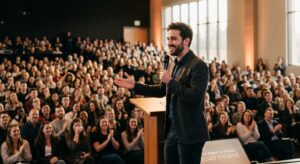
Samuel now speaks regularly at community centers and churches in the Bronx, often to recently arrived immigrants who are exactly where he was in 2001, scared, broke, and unsure if their dreams have any room to breathe in a new country. His message is consistent and direct.
“I tell them: do not abandon the place you came from just because you are trying to build something here. Your roots are not a burden. They are the reason. The thing that broke your heart back home, that is the thing you are supposed to fix. You did not come here just to survive. You came here to go back with something.”
He pauses at that point in his talks, always. And then he adds, quietly: “You do not need more than twenty dollars to start. You just need to decide what the twenty dollars is for.”
The Ripple That Keeps Spreading
In 2023, Samuel launched a small scholarship fund through the school that will send three graduating students each year to secondary school with full tuition covered. His oldest daughter, who was born in the Bronx and is now sixteen, has begun learning to speak Twi so she can one day communicate directly with the students her father built a school for. His wife Abena runs the social media presence for the school’s fundraising page on evenings and weekends.
The tin box is gone. The 2009 Honda Civic is gone. But the thing that lived inside that tin box for all those years, the stubborn, specific, unshakeable belief that one person doing one consistent thing over a long period of time can change hundreds of lives, that is very much still there.
It is made of concrete now. It has a roof. And five hundred children sit inside it every single day.