🎧 Listen to this story
Narrated by Kore · 6,502 characters
There is a moment in every parent’s evening that has no official name, but anyone who has lived it knows it instantly. The bath is done. The last song has been sung. The small chest rises and falls in the steady rhythm of sleep, and the house, at long last, goes still.
For most parents, that moment is a reward. For Maya Delgado, it was a doorway.
This is the story, told in the reported style of a neighbor who watched it unfold, of how a seventeen-year-old new mother turned the quietest hour of her day into a diploma, a scholarship, and a future that once seemed to belong to someone else.
The Night Everything Changed
Maya was a junior when she found out she was pregnant. She was a good student, the kind teachers describe as quietly capable, with a habit of sitting in the second row and turning in neatly organized notes. She had talked, vaguely, about becoming a nurse.
Then came the positive test, the long silence at the kitchen table, and the whispered conversations she was certain everyone was having about her.
"I remember thinking my life was a movie that had just been cut off in the middle," Maya says now. "Like the part where I was supposed to become somebody had been deleted."
Her daughter, Lucia, arrived in the spring. Maya was sixteen days past her seventeenth birthday and eleven credits short of graduating.
The Math of a Tired Day
Anyone who has cared for a newborn knows how time stops belonging to you. Maya’s days were measured in feedings and diaper changes, in doctor visits and the endless low hum of worry. School felt impossible. Her counselor mentioned an alternative program, but the classes met during hours when Maya had no childcare and no ride.
So she did the arithmetic that so many young parents do. She looked at the hours she actually controlled and found almost none.
Except for one.
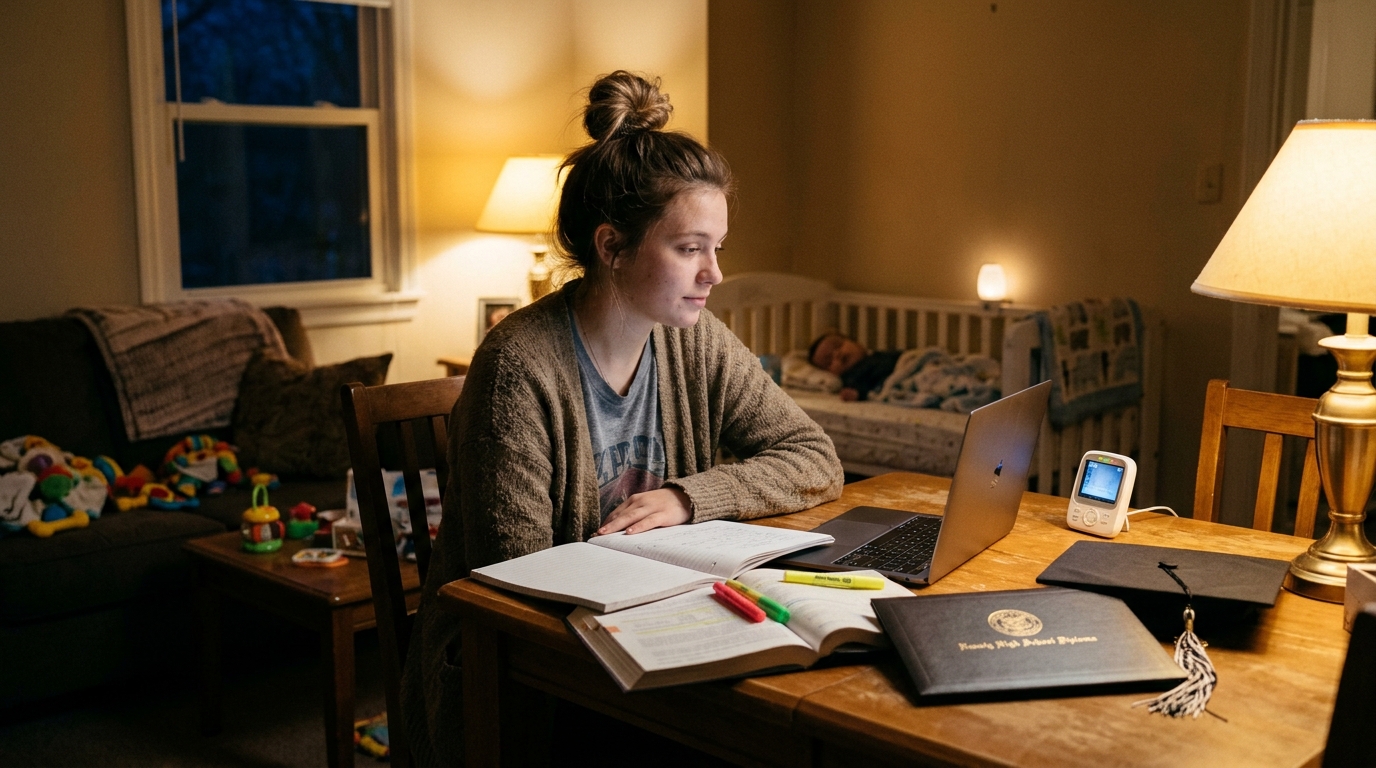
Every night, somewhere between eight-thirty and nine-thirty, Lucia would finally surrender to sleep. For the first few weeks, Maya used that time to collapse beside her. But one evening, listening to her daughter breathe, she did something small. She opened her laptop instead.
What the Quiet Hour Looked Like
It was not glamorous. Maya studied at the kitchen counter under a single lamp, the baby monitor humming softly beside her textbook. She kept the volume low so she could hear every sigh from the next room.
Her routine, which she refined over many months, went something like this:
- 8:45 p.m.: Lucia asleep. Maya warms a cup of tea she often forgets to drink.
- 9:00 p.m.: One online course module, usually math, because it required the most focus.
- 10:00 p.m.: Reading or writing assignments, in short bursts between checks on the monitor.
- 11:00 p.m.: A quick review of the next day’s goals, written on an index card taped to the cabinet.
- 11:30 p.m.: Lights out, because the 3 a.m. feeding was never negotiable.
Some nights she got through two hours of work. Some nights Lucia woke up after twenty minutes and the whole plan collapsed. Maya learned to forgive those nights and to be ready for the next one.
The Kindness That Arrived Quietly
Maya will tell you she did not do this alone, and she is quick to say so. Her grandmother moved in that first year and took over the afternoon shift, which meant Maya could nap before her night classes. A retired teacher two doors down, Mr. Okafor, noticed the light on in the kitchen window late at night and started leaving a folder of practice problems on the porch with a sticky note that read only, "When you’re ready."
"He never made it a big deal," Maya recalls. "He never asked me why I was studying so late or told me how brave I was. He just made sure I had what I needed. That meant more than any speech could have."
Small kindnesses, she has come to believe, are often the ones that hold a person up. Not rescue, exactly. Just a steady hand placed beneath you at the right moment.
The Lesson That Settles In After Dark
Ask Maya what she learned from those long evenings and she thinks for a moment before answering.
"I used to think big change came from big moments," she says. "A huge decision, a dramatic turning point. But mine came from one ordinary hour, repeated six hundred times."
There is something about the evening that makes this lesson easier to believe. The day’s noise fades. The phone stops buzzing. What remains is a quiet room and a choice: rest, or reach a little further. Neither is wrong. But the nights Maya chose to reach, even when she was exhausted, added up in a way she could not feel while she was living them.
Graduation Day
Eighteen months after Lucia was born, Maya walked across a stage in a borrowed gown, her daughter on her grandmother’s lap in the third row. Lucia, by then a curious toddler, clapped at the wrong moments and waved at everyone.
Maya earned her diploma with honors. She also earned a community scholarship, funded by local donors who had heard her story, that covers the first two years of a nursing program.
"I looked out at the audience," she says, "and I realized the person I was afraid I’d never become was already standing there in that gown."
What We Can Carry Into Our Own Evenings
You do not have to be a student or a parent to find something useful in Maya’s story. Most of us have a quiet hour somewhere in our day, even if it is short and imperfect. Here are a few gentle takeaways worth sitting with tonight:
- Protect one small pocket of time. It does not have to be long. Consistency beats intensity.
- Forgive the broken nights. Progress is not a straight line, and a missed evening is not a failed one.
- Let people help. Maya’s grandmother and Mr. Okafor were not signs of weakness in her story. They were the foundation of it.
- Be the porch-folder person. Somewhere nearby, someone is studying under a lamp. A quiet, unannounced kindness might be exactly what they need.
One Last Look at the Lamp
These days, Maya still keeps that kitchen lamp on some evenings. Lucia, now in preschool, sleeps down the hall. Maya is a few semesters into her nursing coursework, working on anatomy flashcards as the house settles into stillness.
She says she no longer thinks of those late hours as sacrifice. She thinks of them as the place where her life quietly turned around, one soft, tired, determined evening at a time.
So tonight, when the dishes are done and the world goes quiet, consider what your own stillness might be holding. It may be rest, and rest is holy. Or it may be a small door, waiting for you to open it.
Either way, the lamp is on. You are allowed to begin.