🎧 Listen to this story
Narrated by Kore · 6,869 characters
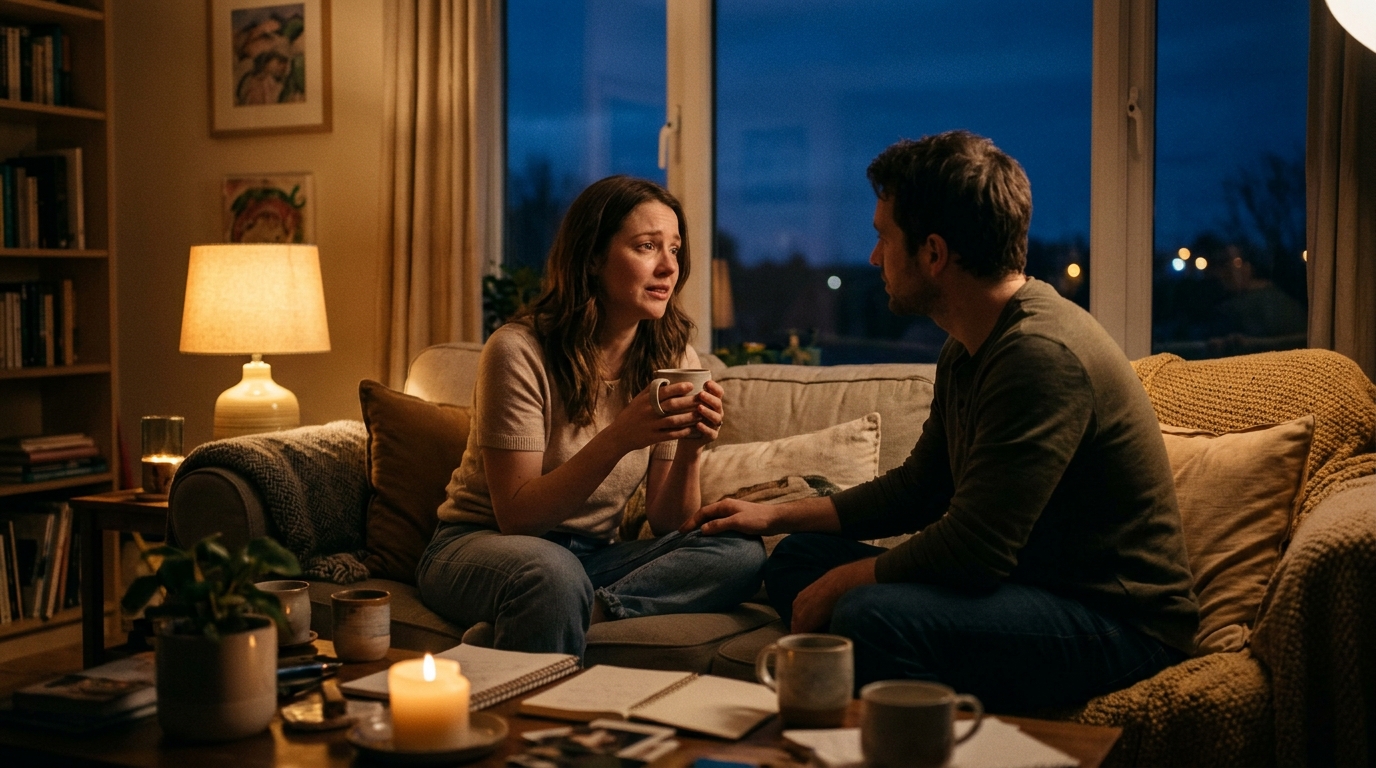
There is a small office at the end of a quiet hallway where the lamps come on before the sun has fully gone. The couch has a soft blanket folded over one arm. A box of tissues sits within reach but not too obviously. And on the windowsill, a single candle-style lamp glows amber, because real flames are against the building’s rules.
This is where a grief counselor, whom we will call Marguerite, holds her most difficult sessions. Not in the bright flatness of a morning appointment. Not in the busy middle of the day. She holds them after dark, and she does it on purpose.
When I asked her why, she did not answer right away. She looked out at the fading light and said, “Because that’s when grief actually shows up for most people. I just decided to meet it there.”
The Hour Grief Arrives
Anyone who has lost someone knows the pattern. The day is manageable. You answer emails. You make dinner. You tell people you are doing okay, and you mostly mean it. Then the house goes quiet, the lights dim, and the loss sits down beside you as if it had been waiting all along.
Marguerite noticed this years ago, long before she built her practice around it. Her early clients would arrive for their afternoon sessions composed and articulate, offering tidy summaries of their sorrow. Then they would mention, almost in passing, that the nights were the unbearable part. The 3 a.m. wakefulness. The dinner table with an empty chair. The sound of a house with one fewer person in it.
“They were describing the real wound to me in the daylight, but they could only describe it,” she told me. “They couldn’t reach it. Not in that bright, busy, performing-okay part of the day.”
Why Evening Changes Everything
Marguerite’s reasoning is part psychology and part simple human observation. By evening, the defenses we build all day long begin to loosen. We are tired. The small armor of productivity comes off. The mind slows down enough to feel what it has been outrunning.
She described a few things she has come to rely on in her evening sessions:
- Dimmer light lowers the performance. People stop managing how they appear. There is less pressure to look fine when the room itself is soft and shadowed.
- Tiredness makes honesty easier. A weary person has less energy to maintain a polite story. The truth tends to slip out more gently.
- The quiet matches the feeling. A silent building at dusk does not compete with grief. It keeps it company.
- There is a natural ending. After the session, her clients go home to rest, not back into a loud workday. They carry the tenderness into sleep rather than into a meeting.
That last point matters most to her. “Healing work stirs things up,” she said. “I don’t want to send someone back to a spreadsheet in that state. I want them to be able to go home, let the evening hold them, and sleep.”
A Session, Told Gently
She shared one story, with details altered to protect the person involved. A man in his sixties came to her after his wife of forty years died. For months he had been the capable one, handling the paperwork, thanking the casserole-bringers, reassuring his grown children.
In his daytime appointment, he talked about logistics. The estate. The accounts. The practical tasks he was proud of finishing.
Then Marguerite moved his sessions to the last slot of the day. The first evening, he arrived as the sky turned that deep blue that comes right after sunset. He sat down, looked at the lamp, and said nothing for a long while.
Finally he said, “She used to turn on the porch light for me every night. I never thought about it. I just came home and it was on.”
And then he cried, really cried, for the first time since the funeral. Not at noon, not in a parking lot, not in front of his children. In a dim, quiet room, at the hour when a porch light used to be switched on for him.
“That was the session,” Marguerite said softly. “Everything before it was preparation for that one sentence.”
What Sits Underneath the Method
It would be easy to treat this as a clever scheduling trick, but Marguerite insists it comes from something deeper: respect. Respect for the rhythm of the human heart, and for the fact that grief keeps its own hours.
She does not believe sorrow should be fit into a nine-to-five container. If anything, she thinks our culture asks mourners to grieve efficiently, between obligations, on a convenient schedule. The people she works with are often relieved to be told, simply, that it is okay to fall apart at night.
“I tell them, you are not broken because the evenings are hard,” she said. “You are loving someone who is gone. Of course the evenings are hard. That’s when you used to be together.”
Small Evening Practices She Shares With Clients
Marguerite does not leave her clients to face the nights alone. She offers a few gentle habits for the hours after dark, none of them complicated:
- Name the hardest hour. Knowing when the ache peaks helps you prepare for it rather than be ambushed by it.
- Keep one ritual. A cup of tea, a lit lamp, a favorite song. A small, repeatable comfort gives the evening a shape.
- Say the name aloud. Speaking the person’s name in a quiet room can feel like keeping them in the house a little longer.
- Let the tears come without a schedule. Crying at dusk is not a setback. It is often the body finally exhaling.
- Reach out before bed. A short call or message to someone who knows your loss can soften the loneliest stretch of the night.
The Quiet Reward of the Work
By the time Marguerite locks her office, the hallway is empty and the windows are dark. She told me she walks to her car slowly, usually past a stretch of trees where the birds have gone silent for the night. It is her own small ritual, a way to set down what she has carried.
“People think this work must be unbearably heavy,” she said. “And it is, sometimes. But there’s also a kind of grace in it. I get to sit with someone in the exact hour they’ve been dreading, and show them they don’t have to face it alone. That’s not heavy. That’s a privilege.”
A Thought to Carry Into Tonight
If the evenings are hard for you right now, you are in good company. The hush after the day ends is when many of us feel our losses most sharply, and there is nothing wrong with that. It does not mean you are failing to heal. It means you loved someone, and love does not clock out when the sun does.
Tonight, when the light goes soft and the house grows quiet, consider doing what Marguerite’s clients learn to do: let the evening be what it is. Turn on a lamp. Say a name. Let the feeling come. And know that somewhere, in a dim office at the end of a hallway, someone has arranged her entire working life around the belief that you should not have to be okay by nightfall.
Sometimes the kindest thing we can do for a hurting heart is simply meet it where it already is, in the soft blue hour after the day lets go.