🎧 Listen to this story
Narrated by Kore · 7,845 characters
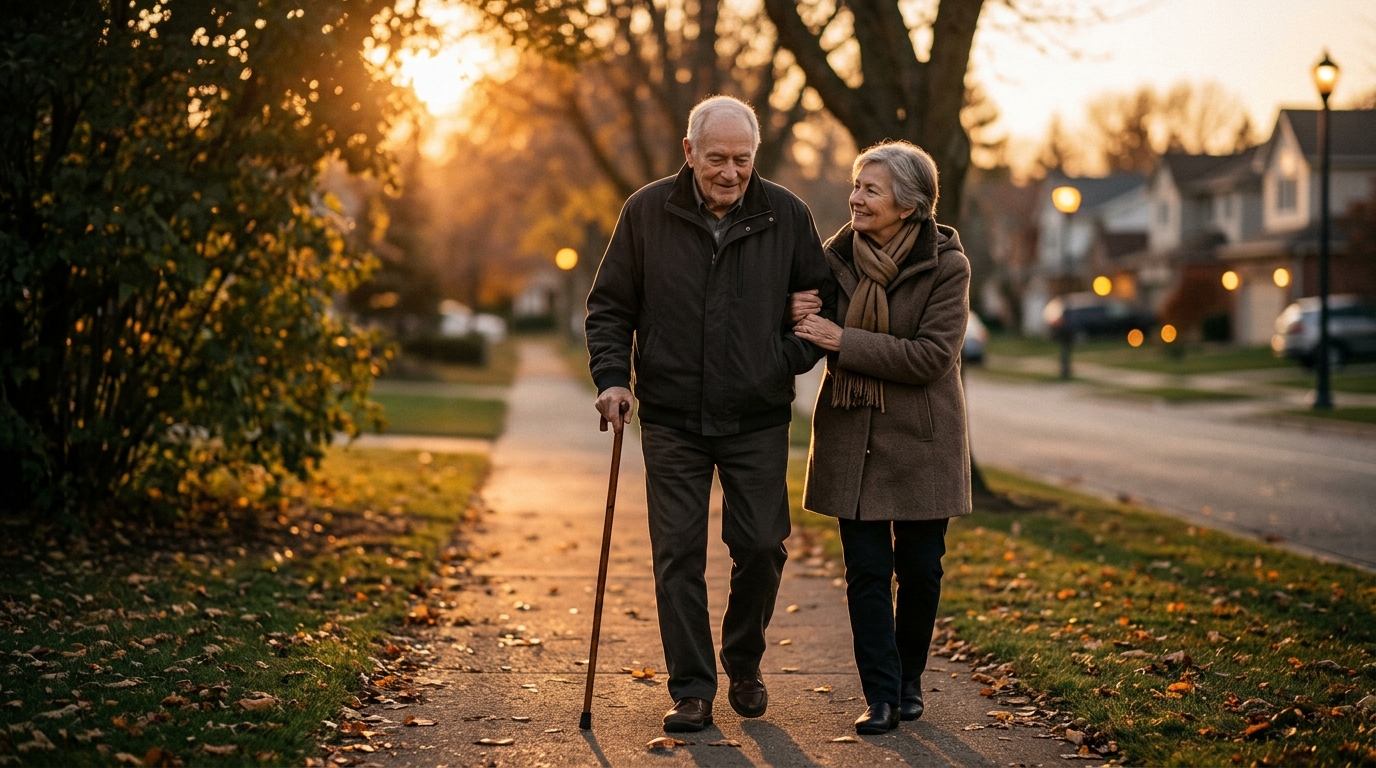
There is a particular kind of light that settles over Marguerite’s street around six-thirty in the evening this time of year. It comes in low and amber, stretching the shadows of the maple trees across the pavement, and it makes the whole block look like a photograph someone has taken extra care with. For most people, it is just the end of a long day. For Marguerite, a retired schoolteacher from Ohio, it has become something closer to a ruler. A way of measuring how far she has come.
Eleven months ago, she could not walk to her own mailbox.
The Morning Everything Changed
Marguerite was sixty-eight when the stroke came. She was in her kitchen, buttering toast, when the knife slipped from her right hand and clattered to the floor. She remembers thinking it was strange, almost funny, that her fingers simply would not close. Then the words in her head stopped lining up with the words in her mouth.
Her neighbor, who happened to be watering her garden, heard the crash of a dropped plate and came running. That small, ordinary accident, a plate hitting tile, is the reason Marguerite is alive to tell this story. The doctors later told her that the speed of her care made all the difference.
What followed were weeks in a hospital and then a rehabilitation center, a blur of therapists, charts, and the quiet humiliation of relearning things she had known for six decades. How to hold a spoon. How to say her daughter’s name without it breaking apart on the way out.
Why Evenings Became Her Anchor
Here is something Marguerite says people rarely understand about recovery: mornings belong to the therapists, but evenings belong to you.
During the day, healing is a job. There are exercises with colorful resistance bands, speech drills with flash cards, and a physical therapist named Dev who greets every wobbling step with a cheerful, “Again!” It is exhausting and necessary and relentlessly measured against goals on a clipboard.
But in the evening, once the appointments ended and the house went quiet, something different happened. The pressure lifted. Without anyone watching, she could try things at her own pace, fail without an audience, and sit in the stillness afterward.
“The day was about progress,” she told me. “The evening was about peace. And I needed both to get better.”
The Ritual That Slowly Took Shape
It began with something almost laughably small. Each night, once dinner was cleared, Marguerite would stand at her front door and look out at the street. That was the whole exercise. Just standing. Her therapist had suggested she practice balance in a safe, familiar place, and the doorway gave her something to hold.
Over the following months, the ritual grew, step by tiny step:
- Week 2: Standing at the door for one full minute without gripping the frame.
- Week 6: Stepping onto the porch and back, with her daughter nearby.
- Month 3: Walking to the end of the driveway, using a cane.
- Month 5: Reaching the mailbox and returning, unassisted, as the streetlights flickered on.
- Month 8: Walking to the corner and resting on a neighbor’s low stone wall.
- Month 11: Completing the full loop around the block.
Each of those milestones happened in the evening, in that soft gold hour, with the day’s noise fading behind her. She kept a small notebook by her bed and wrote down each one before she slept, not with fanfare, just a line or two. “Mailbox. No cane on the way back.”
The Kindness of the Street
One of the things that surprised Marguerite most was how her neighbors quietly adapted around her routine. Nobody made a fuss. Nobody applauded, which she says would have mortified her. Instead, small kindnesses appeared like lamps being lit one at a time.
The man across the street began leaving his porch light on a little earlier. A teenager who lived two doors down took to raking leaves out of her path without ever mentioning it. A woman walking her terrier started timing her own evening stroll to pass Marguerite’s house, then slowing down to match her pace, chatting about nothing in particular so that the walk felt like company rather than rehabilitation.
“They never once said, ‘You’re doing so well,'” Marguerite remembers. “They just made it easier to keep going. That’s a different kind of love. It doesn’t ask you to perform.”
What Healing Actually Feels Like
Marguerite is honest that recovery was not a tidy upward line. There were nights she sat on the edge of her bed and cried because a word would not come, or because her right hand still refused to do what her mind commanded. There were weeks when it felt like nothing was changing at all.
What helped, she says, was learning to judge progress by a gentler standard. Instead of asking, “How far am I from who I used to be?” she began asking, “Am I further than I was last month?” The answer, when she checked her notebook, was almost always yes, even if it was only by a few feet of sidewalk.
Doctors and rehabilitation specialists often echo this idea. Recovery after a stroke tends to be gradual and uneven, and consistent, patient practice over many months matters far more than dramatic leaps. Small, repeated efforts rewire the brain in ways that are invisible day to day but remarkable over time.
The Night She Finished the Loop
The eleventh month arrived quietly. It was a mild evening in early autumn, and the air smelled faintly of cut grass and someone’s wood smoke. Marguerite set out as she always did, past the mailbox, past the stone wall, and this time, she kept going.
She walked past the corner, past the house with the blue shutters, past the dog who barked once and then thought better of it. The streetlights blinked on one by one, as if the neighborhood were quietly cheering her along. When she turned the final corner and saw her own porch light glowing, her eyes blurred.
She did not shout or call anyone. She simply climbed the steps, sat down in her wicker chair, and breathed. Her daughter, watching from the window, understood not to interrupt.
That night, in her notebook, Marguerite wrote just three words: “Whole block. Home.”
Gentle Lessons From the Quiet Hours
If there is wisdom to be gathered from Marguerite’s story, it is less about the stroke than about the way she met the recovery. A few things she hopes others might carry with them:
- Let evenings be a place to rest, not just to try. Healing needs both effort and stillness.
- Measure yourself against yesterday, not against who you were. The smaller the unit, the kinder the math.
- Write it down. A notebook full of tiny wins is proof on the days you cannot feel your own progress.
- Accept the quiet kindness around you. Let people hold the door, leave the light on, walk beside you without asking for anything in return.
- Be patient with the slow parts. The slowest chapters are often where the deepest repair is happening.
Where She Is Now
These days, Marguerite walks the block most evenings, sometimes twice. She still carries her cane, though more out of habit than need. Her speech has returned almost entirely, and she has started volunteering at a local reading program, helping children sound out words, a gentle irony she appreciates deeply.
When the golden light begins to slant across her street, she sets down whatever she is doing and steps outside. Not because she has to, but because the evening has become hers, a time when the world slows enough for her to notice how far she has come.
“People think healing is a mountain you climb,” she told me as the sun dipped behind the maples. “For me, it was a street I learned to walk, one quiet evening at a time. And I wouldn’t trade a single step.”
So tonight, if you are in the middle of your own slow mending, whatever it may be, consider the hour when the day finally exhales. You may not be where you want to be. But if you are a little further than yesterday, that is worth writing down.