🎧 Listen to this story
Narrated by Kore · 6,837 characters
My father was not a man who gave away words easily. He gave away other things: rides to the airport at five in the morning, a spare tire in the trunk of every car I ever owned, a quiet nod when I fixed something around the house. But the words I wanted most, the ones I carried around like a stone in my coat pocket for two decades, he kept locked away. This is the story of the evening he finally set them down in front of me.
The Silence I Grew Up Inside
I was the kid who brought home report cards with straight A’s and heard, “Good. Keep it up.” I was the teenager who won a regional writing prize and watched my father read the certificate, fold it in thirds, and tuck it into the kitchen drawer with the takeout menus. I told myself he was proud in his own way. I told myself that so many times it almost became true.
Almost.
When I left for college, I decided I would earn the sentence. I would become so undeniably accomplished that he would have no choice but to say it out loud. I chased promotions, published essays, moved to a bigger city. Every achievement was a quiet letter addressed to him, and every time the reply was a handshake, a nod, or a gruff, “That’s nice, kid.”
Somewhere in my thirties, I stopped chasing it and started resenting it. That resentment is a heavy thing to carry through a life. It followed me into my marriage, my friendships, and the way I spoke to my own daughter, whom I over-praised out of fear of repeating the pattern.
The Evening Everything Slowed Down
Two autumns ago, my father had a minor stroke. It was not the dramatic kind. He recovered most of his speech and strength within weeks, but the doctors said he needed someone nearby, so I started driving out to his house on Friday afternoons and staying through the weekend.
There is something about evening in a quiet house that loosens a person. By the time the sun slid behind the maple trees in his backyard, the day’s busyness had drained away, and the two of us were left with nothing to do but sit. He would settle into the old green armchair. I would take the couch. We would not talk much, and for the first time in my life, the not-talking did not feel like a wall.
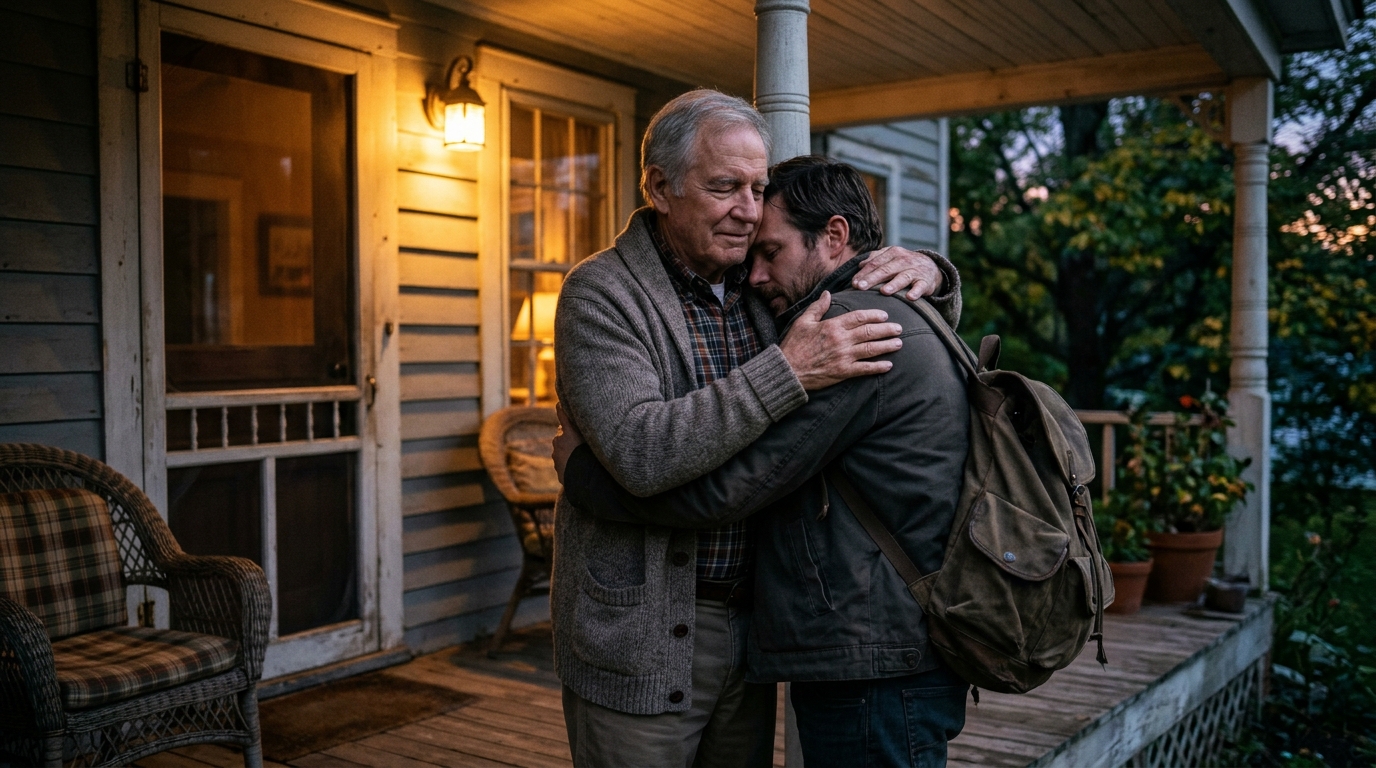
On the fourth Friday, he asked me to turn on the porch light, even though it was not fully dark yet. “I like to see it come on,” he said. “Your mother always did that.”
We sat there as the sky went from gold to amber to a deep, soft blue. And in that hush, he said it.
What He Actually Said
He did not make a speech. He did not look at me. He looked out the window at the porch light and said, “I’m proud of you. I should have said it a long time ago. I was a coward about it.”
I did not move. I was afraid that if I breathed wrong, the sentence would evaporate.
“My father never said it to me,” he continued, his voice slower than it used to be, the stroke still leaving small gaps between his words. “I thought if I said it, you’d stop trying. I thought pride made people soft. It was stupid. I was stupid.”
Twenty years. Twenty years of earning, striving, and quietly aching, and the answer had been that he was just afraid.
Too Late, and Somehow Still on Time
People tell you that some things come too late to matter. I understand the instinct. For a few seconds, I felt the old anger flare up. Where were these words when I was seventeen? When I was twenty-five and sleeping on a friend’s floor, wondering if any of it was worth it?
But then the anger did something unexpected: it softened and let go. Because I looked at him, small in that green armchair, a man who had spent his whole life believing love was a thing you proved through provision and not through language, and I saw that he had finally broken a lifelong habit with the little time and strength he had.
It was twenty years late for the boy I used to be. But it was exactly on time for the man I had become, the one who finally had the room to hear it without needing it to survive.
The Quiet Lessons That Settled In
I have thought a lot about that evening since. Here is what has stayed with me, the way a few stars stay visible after the sky has gone fully dark:
- People love in the language they were taught. My father’s love was practical and silent because that was the only dialect he ever heard. It was not an absence of love. It was a different alphabet.
- Waiting for approval keeps you small. I spent two decades building a life aimed at a single sentence. The life was good, but it was never fully mine until I stopped needing the applause.
- Late is not the same as never. We treat unsaid things as if they expire. Often they do not. Sometimes they are simply waiting for a quiet enough evening.
- The people who hurt us in silence are often afraid, not unfeeling. That does not excuse the hurt, but it changes what we do with it.
- Say it now. The most practical lesson of all. If there is a sentence you are holding back from someone, the cost of keeping it is higher than the cost of saying it clumsily.
What I Did With It
I did not cry right away. I told him, “Thank you, Dad,” and then we sat in silence for a long while, but it was a different silence, full instead of empty. Eventually I got up, made us both a cup of tea, and brought it back to the living room. He took his cup with both hands, and the tremor in them made the tea ripple.
“Your daughter,” he said after a while. “You tell her?”
“Every day,” I said. “Maybe too much.”
He almost smiled. “There’s no such thing as too much.”
That night, driving home beneath a sky full of early stars, I called my daughter even though it was past her bedtime. I told her I was proud of her, not for any grade or trophy, but just because. She laughed sleepily and said, “Okay, Mom. You’re weird.” I have never been happier to be called weird.
A Gentle Invitation for Your Own Evening
If you are carrying a stone like mine, waiting for a sentence from someone who may never be able to say it, I will not tell you to forgive on a schedule. Healing is not tidy. But I will offer this: sometime this week, when the day’s noise has faded and the house has gone quiet, sit with the question of who in your life is waiting to hear something from you.
Then say it. Say it to your child, your parent, your friend, the colleague who never gets thanked. Say it plainly, even if your voice shakes. Do not wait for the perfect moment, because the perfect moment looks suspiciously like an ordinary evening with the porch light coming on.
My father is still here, still in his green armchair, still asking me to flip on the light before the sun is fully gone. We do not talk about that night often. We do not need to. Some words, once finally spoken, do their work quietly, the way the evening does, settling over everything until the whole world feels a little softer than it did before.
Twenty years too late, and still on time. I will take it.