🎧 Listen to this story
Narrated by Kore · 7,517 characters
There is a particular hour in the evening when the house exhales. The dishes are done, the phone has gone quiet, and the light through the window turns the color of weak tea. I have come to think of that hour as the time when the truth gets a chance to speak, because it is the only time the noise of the day is not loud enough to drown it out.
It was in that hour, on a damp Tuesday in October, that I finally read the letter. I had carried it for twelve years without opening it. This is the story of why, and of what happened when I did.
The Envelope I Could Not Open
My brother Daniel and I had not spoken in the last eight months of his life. It was a stupid argument, the kind that begins with one small thing and grows roots. It was about money, then about our father’s care, then about who had shown up and who had not. By the end we were both saying things we did not mean, and then, worse, things we did.
I told myself I would call him when things cooled down. Pride is a patient liar. It whispers that there is plenty of time.
There was not. Daniel died on a Thursday in March, suddenly, of something no one saw coming. I got the call while standing in a grocery store, holding a bag of oranges, and I remember that I did not put them down for a long time.
Three weeks after the funeral, a letter arrived in the mail. My name was written across the front in his familiar, slanting handwriting. He must have mailed it just before he died. I held it in my hands, and I knew in my bones that I could not read it. If it was angry, I could not bear it. If it was kind, I could not bear that either, because I would not deserve it.
So I put it in a drawer. And for twelve years, that drawer became the heaviest place in my home.
How Guilt Learns to Live With You
Here is something nobody tells you about unresolved guilt: it does not stay dramatic. It does not keep you weeping on the floor. It becomes quiet and domestic. It moves in like a houseguest who never leaves, and over time you stop noticing the space it takes up.
Mine showed up in small ways:
- I flinched whenever someone mentioned their siblings.
- I never answered when people asked how Daniel had died, only that he had.
- I overcompensated with everyone else, saying yes to every request, as though I could earn back what I had lost.
- I avoided the drawer. Entirely. I bought a new dresser rather than open it.
That last one still makes me laugh a little. I spent real money to avoid a piece of paper. But that is how powerful the fear was. It was not really about the letter. It was about what the letter might confirm: that I was the kind of person who let her brother die angry at her.
The Evening Everything Went Still
The night I finally opened it, nothing dramatic had happened. That is the part I find most remarkable. There was no anniversary, no crisis, no sign from the universe. It was simply a quiet evening in October, and a storm had knocked out the power on our street.
I was rummaging for a flashlight when I found myself, almost without deciding to, kneeling in front of the old dresser I had kept in the spare room. The drawer stuck, the way old drawers do. I pulled harder than I needed to. And there it was, the envelope gone soft at the corners, the ink slightly faded.
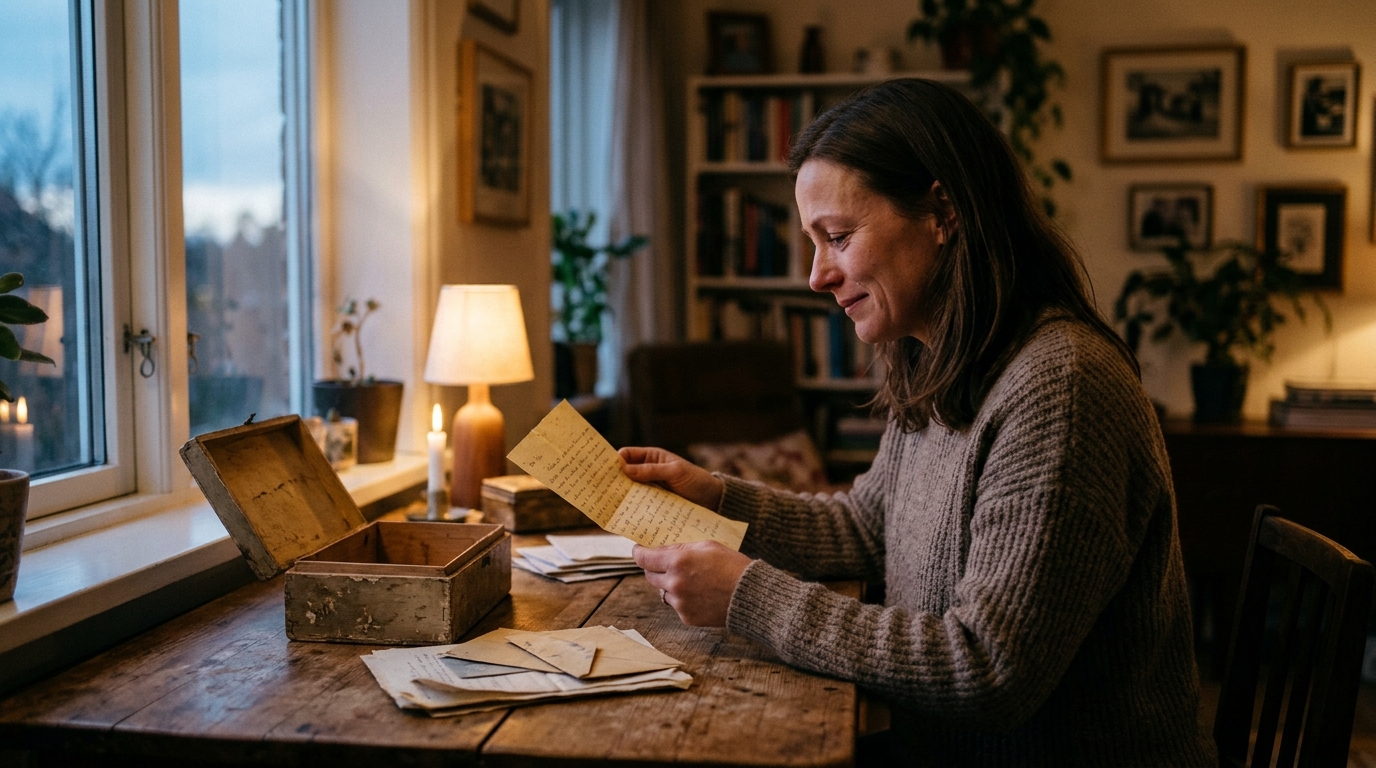
I lit a candle. I do not know why exactly. Perhaps because the dark seemed to ask for it. I sat on the floor with my back against the bed, the small flame throwing a warm circle onto the carpet, and I slid my thumb under the flap.
The candlelight made the room feel smaller and kinder, as if the walls had leaned in to listen. Outside, the rain had softened to a murmur. I took a breath that felt like the first real one in years.
What the Letter Said
I will not share every word, because some of it belongs only to the two of us. But I can tell you the shape of it.
Daniel did not write in anger. He did not write to win the argument. The letter began with a memory: a summer when we were children and I had pushed him on a rope swing until he laughed so hard he fell off, and then I had fallen off too, laughing at him. He wrote that he thought about that day a lot lately.
Then he wrote the sentence that undid me. He said: I am sorry I made it so hard for you to love me. I know you did anyway.
He had spent his last months not nursing a grudge, but carrying the same ache I carried. We had been two people standing on opposite sides of a river, each waiting for the other to cross first, each too proud to take the first step. And now the river was permanent.
I read the letter once, and then I read it again. Then I put my face in my hands and cried the kind of tears that had been waiting twelve years for a door to open.
The Part That Surprised Me
I had always assumed that forgiveness would feel like a lightness, a lifting. And it did, eventually. But in the first hour, it felt more like grief finally being allowed to finish. All those years, I had been grieving only half of it, the half I was permitted. The guilt had stood guard over the rest.
Reading his words gave me permission to mourn him fully, not just the version of him that I had punished myself over.
What I Learned, Sitting on That Floor
I have thought a great deal about that evening since. Here is what settled into me, slowly, the way sediment settles when water finally stops moving:
- Guilt is often a disguised form of love. I had been so hard on myself precisely because I had loved him so much. The pain was the proof.
- The person we fear we have wronged is often carrying the same regret. I had imagined Daniel’s anger for twelve years. The truth was far gentler than anything I had invented.
- We cannot forgive ourselves while we avoid the thing that hurts. The drawer held more power closed than it ever did open.
- Some endings cannot be tidy, and that is allowed. I will never get to say my part to him aloud. But I can say it anyway, and I have.
The Letter I Wrote Back
The following evening, once the power had returned and the world had resumed its usual hum, I sat at the kitchen table with a pen. I wrote Daniel a reply. I did not expect it to be delivered. I only knew that a conversation left half-finished for twelve years deserved to be completed.
I told him about the rope swing, and how I remembered it too. I told him I was sorry, and that I forgave him, and that I hoped he had forgiven me. I told him about his niece, who has his crooked smile, and about the oranges I never ate that day.
I read it aloud, quietly, to the empty kitchen. And somewhere in the saying of it, I felt the last knot loosen.
For Anyone With a Drawer of Their Own
If you are reading this and you have a letter, a voicemail, a photograph, or a conversation you have been avoiding, I will not tell you to rush. Some things need years before they can be faced. Mine did.
But I will tell you this. The evening is a good time for hard things. The day has taken its toll, your defenses are lower, and the world has quieted enough to let you hear yourself. Light a candle if it helps. Sit on the floor if that feels right. Let the dark be gentle with you.
You may find, as I did, that the thing you feared is not a verdict at all. It may be an open hand, held out across the river, that was there all along.
I keep Daniel’s letter in a small wooden box on my nightstand now. Some evenings, when the house exhales and the light turns amber, I read a line or two before bed. It no longer feels like a weight. It feels like a goodnight from someone who, in the end, never stopped loving me either.