🎧 Listen to this story
Narrated by Kore · 8,284 characters
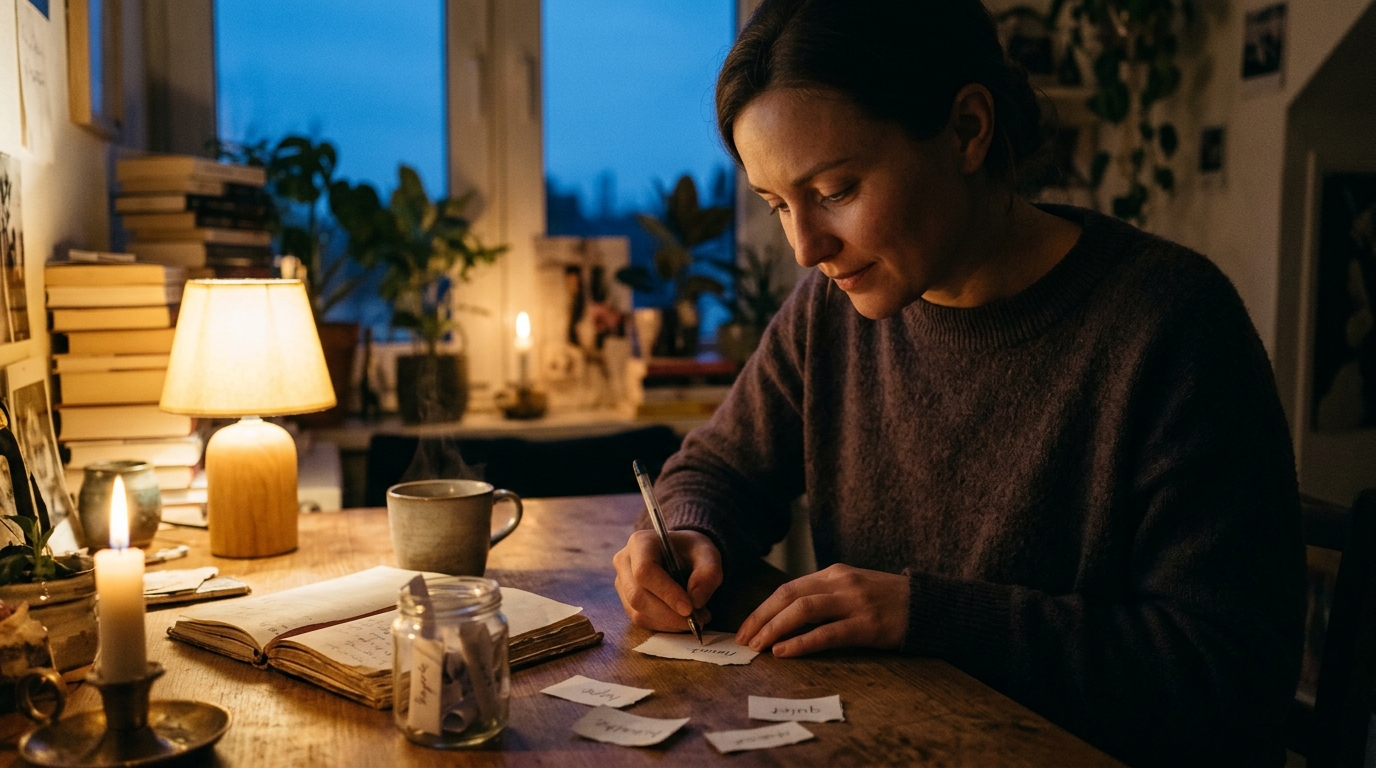
The kitchen light was still on when Marguerite Dalloway sat down at her table on the first night she decided to try. It was a little past nine in the evening. The dishes were done. The house had gone quiet in the way houses do when the day has finally let go of everyone inside it. In front of her sat a stack of index cards, a small mirror, and a cup of tea that she would let go cold, as she did most nights that winter.
Eleven weeks earlier, a stroke had taken her words.
The Afternoon Everything Went Silent
Marguerite was sixty-one, a retired school librarian who had spent her career reading aloud to children. Her voice had been her instrument. She could make a room of restless seven-year-olds fall silent with the first line of a story. Then one Tuesday afternoon, while she was telling her daughter about a recipe, the sentence in her mouth simply stopped making sense. The words arrived scrambled, or not at all. Her right hand went numb. Her daughter, Odile, called an ambulance within a minute.
The diagnosis was an ischemic stroke affecting the left side of her brain, the region that governs language. The medical term for what she was left with was aphasia, specifically a type called Broca’s aphasia. People with it often understand what is said to them perfectly well. They know exactly what they want to say. But the bridge between the thought and the spoken word has been damaged, and the words will not cross.
In the hospital, Marguerite could follow every conversation around her. She could not answer any of them. Nurses spoke to her slowly and loudly, as though the stroke had affected her hearing rather than her speech. She understood everything and could say almost nothing, and that, she later wrote in her notebook, was the loneliest place she had ever been.
The Gap Between Knowing and Saying
There is a particular cruelty in aphasia that is easy to miss from the outside. The person is still fully present. Their intelligence, humor, and memories are intact. What has gone missing is the delivery system. Imagine standing on one side of a river, holding a letter, with the bridge washed away.
Her speech therapist, a patient woman named Teodora Ashgrove, explained it to the family in plain terms during the first week of rehabilitation. The brain, she said, is remarkably willing to build new routes when old ones close. But it needs repetition. It needs patience. And it needs the person to keep showing up, even on days when nothing seems to move.
“The brain does not heal in leaps,” Teodora told them. “It heals in small, boring, faithful steps. The people who recover best are not the ones who try hardest in a single day. They are the ones who return the next day.”
Marguerite held onto the word faithful. She could not say it yet. But she wrote it on an index card and propped it against the sugar bowl.
Why Evenings Became Her Classroom
The daytime sessions with Teodora were structured and tiring. By the time Marguerite got home, her mind felt wrung out, like a cloth twisted too tightly. Mornings were for appointments. Afternoons were for rest, because fatigue after a stroke is its own relentless adversary.
But evenings were different. Odile had gone home to her own family. The television was off. The house settled into stillness. And Marguerite discovered that in that quiet, with no one watching and no one waiting for her to finish a sentence, her mind loosened. There was no audience to disappoint. There was no pressure to perform. There was only her, a mirror, and the slow work of coaxing a sound into shape.
So she made a rule. Every night, after the dishes, she would sit at the kitchen table and practice for twenty minutes. Not longer. Twenty minutes, every night, no exceptions except illness. She called it her evening lesson, and she treated it with the seriousness she once gave to a school day.
What a Nightly Lesson Actually Looked Like
She kept it humble and consistent. Her routine, refined over weeks, went something like this:
- Warm the mouth first. She stretched her lips, tongue, and jaw in front of the mirror, the way Teodora had shown her, because the muscles had gone slack along with the words.
- One sound at a time. She began with single syllables: ba, da, ma. She watched her mouth in the mirror to see how the shape matched the sound.
- One word per card. Each index card held a single everyday word with a small drawing beside it. Cup. Door. Window. Bread. She said each one aloud until it came out clean.
- Name the room. Before turning off the light, she walked through the kitchen and named every object she could, touching each one as she spoke.
- End with one true sentence. She finished every session by saying a single complete sentence, however small. “I am here.” “The tea is cold.” “Tomorrow is Thursday.”
Some nights a word came out whole. Many nights it did not. There were evenings when she managed nothing but a tangle of sounds, and she sat with her hands flat on the table, tears sliding down, until the twenty minutes ended. She did not skip a single session because of it.
The Night the First Sentence Came
For weeks, the progress was nearly invisible. A word here. A syllable that landed correctly after thirty failed attempts. Odile would call in the evenings and Marguerite would hold the phone and say, carefully, “Hello. Good.” That was all. But Odile began to hear the difference, the way a mother hears the difference in a child’s first steps.
It was in the fourteenth week, on a gray February evening, that something shifted. Marguerite was finishing her lesson, saying her closing sentence, when she heard herself say more than she had planned. She had meant to say, “The tea is cold.” Instead, out of her own mouth, came a sentence she had never practiced:
“I missed my own voice.”
She sat very still. The words hung in the quiet kitchen. She said them again, to be sure they were real. Then she laughed, and then she cried, and then she sat there under the single warm lamp until the tea had gone entirely cold, grateful for the stillness that had held her while it happened.
What the Evening Taught Her
Months later, when she could speak in full, if slower, sentences, Marguerite was asked to share her story with a stroke survivors’ support group. She stood before a circle of folding chairs and read from a page she had prepared, pausing when she needed to. She told them she had learned three things from the nights at that kitchen table.
- Small and daily beats large and rare. Twenty quiet minutes every evening did more than any heroic effort she could have mustered once a week.
- Gentleness is not weakness. The nights she forgave herself for failing were the nights she was able to return the next day.
- The end of the day is a good place to begin again. Evening asks nothing of you. It simply offers room, and room is what healing needs.
A Note for Anyone Rebuilding Something
You do not have to have had a stroke to understand Marguerite’s lesson. Many of us are rebuilding something: a trust, a habit, a sense of self after a loss. We often imagine that recovery requires a dramatic turning point. More often it is a modest ritual, repeated faithfully, in the soft hour when the world has gone quiet enough to hear ourselves try.
If you are in the middle of your own slow rebuilding, consider giving it an evening. Pick a small action. Set a gentle limit, twenty minutes or even ten. Do it when the day’s noise has faded. Then do it again tomorrow.
The Voice She Reads With Now
Marguerite still practices most nights, though the sessions have grown shorter and the sentences longer. Last spring she did something she had once thought impossible. She volunteered at her old elementary school, sat down in a small chair among a circle of children, and read them a story aloud. Her pace was slower than it used to be. Now and then she paused to find a word. The children did not mind at all. They leaned in, listening harder than they ever had.
That evening, back at her kitchen table, she set out a fresh index card. On it, in careful handwriting, she wrote the word she had practiced the longest and loved the most. She propped it against the sugar bowl, where the first card had once stood, and turned off the light.
The word was faithful. And now, at last, she could say it.