🎧 Listen to this story
Narrated by Kore · 9,965 characters
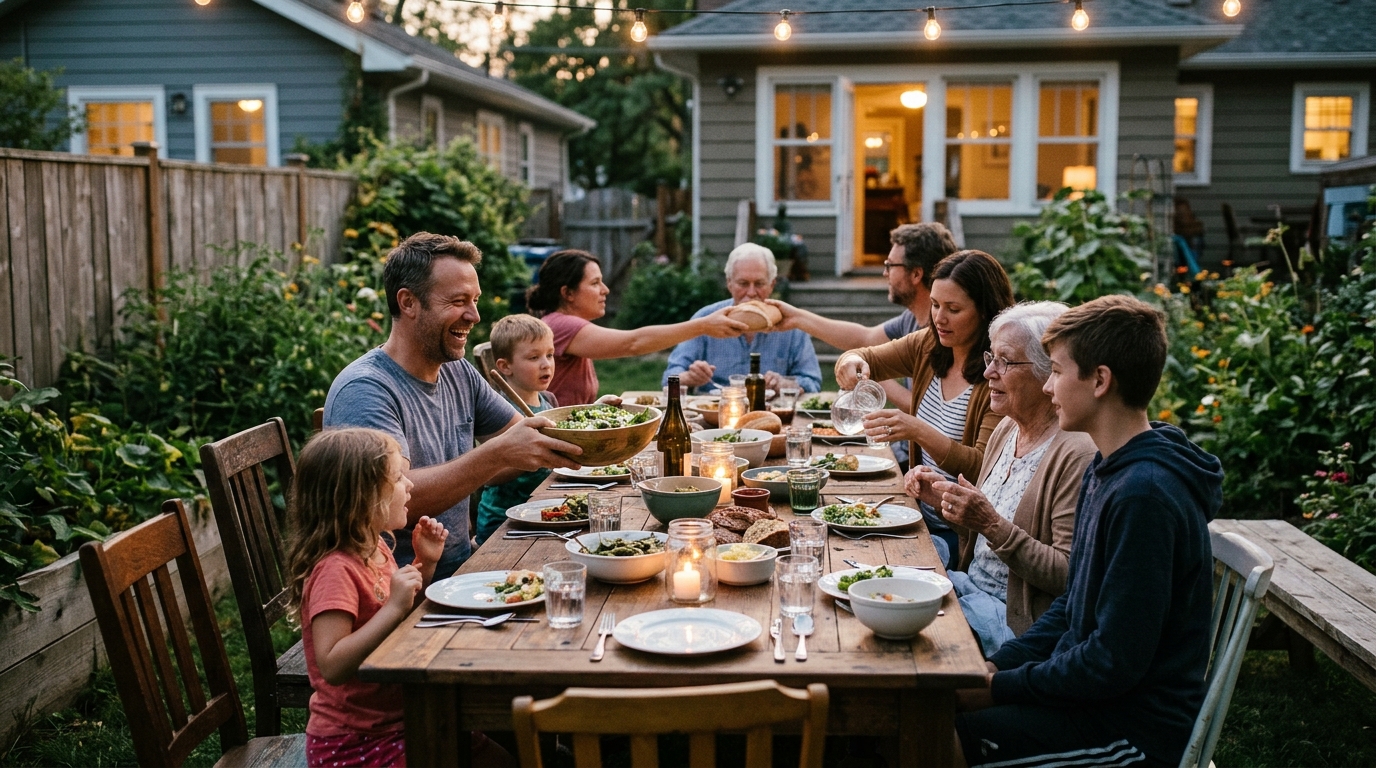
The light in the Haddad family’s kitchen goes soft and amber around six in the evening, the hour when the rest of the street is pulling into driveways and closing car doors. It is also the hour when the table gets set. Not for four, or six, but for as many as show up. Some nights that number is nine. Some nights it is fourteen.
This is a story about what happens when a family that lost nearly everything decides that the one thing they will not lose is the habit of sitting down together at the end of the day.
The Evening Before Everything Changed
Nadia Haddad remembers the last dinner in her old home with startling clarity. She was thirty-eight, a school librarian. Her husband Samir, a pharmacist, had come home early. Their three children, then eleven, eight, and four, were arguing over who got the last piece of flatbread. Her mother-in-law, Layla, was complaining, lovingly, that the rice needed more salt.
“We did not know it was the last one,” Nadia says. “If you know it is the last one, you pay attention differently. We just ate. We just complained about salt.”
Within three weeks, the family had left. Within five months, after a long stretch in a transit facility and a cascade of paperwork that Samir describes as “a second full-time job with no salary,” they arrived in a mid-sized American town in late autumn, carrying four suitcases, a pot with a dented lid, and a small cloth bag of spices Layla had refused to leave behind.
The Silence of the First Evenings
Resettlement agencies do remarkable work, and the Haddads speak of their caseworker with something close to reverence. But no agency can fix the particular loneliness of an evening in a new country.
The days were busy. There were appointments, enrollment forms, bus routes to memorize, English classes to attend. Daylight is forgiving that way. It gives you tasks.
Then dusk would arrive, and the tasks would run out.
“The apartment was so quiet,” Samir recalls. “Back home, our evenings were loud. Cousins would knock. Neighbors would send a plate over. Someone was always arguing about football or politics or whose turn it was to bring dessert. Here, in the evening, we could hear the refrigerator humming.”
The youngest child, Rami, stopped eating well. The oldest, Dania, spent evenings with her face turned toward the window. Layla, who had cooked for crowds her whole life, found herself making a single pot of lentils for a family of five and then standing at the stove, unsure what to do with the empty space where the rest of her life used to be.
The Pot with the Dented Lid
It was Layla who first broke the silence, and she did it without a word of English.
One cold evening in December, she made far too much food. She did it on purpose. She filled the dented pot with a slow-cooked chicken and rice dish fragrant with cardamom and cinnamon, the kind of meal that in her village signaled a celebration or a welcome. Then she told Nadia to carry a bowl across the hall to the neighbor in 2B, an older man named Walter whom they had seen only in passing.
Nadia was mortified. “I said, Mama, he does not know us. He will think this is strange.” Layla waved her off. “Hunger is not strange. Go.”
What Walter Said
Walter, seventy-four, a retired machinist and a widower, opened his door expecting a salesperson. Instead he found a nervous woman holding a steaming bowl and a phrase she had practiced on the stairs: “For you. Please. Eat.”
He later told his daughter that he stood in the doorway for a full minute after Nadia left, just holding the warm bowl. He had been eating microwave dinners alone since his wife died two years earlier. He ate the whole thing standing at the counter, then washed the bowl twice, then wrote a note in careful block letters: “BEST MEAL I HAVE HAD IN TWO YEARS. THANK YOU.”
The next evening, the empty bowl came back with the note tucked inside and a small box of shortbread cookies. The evening after that, Layla sent over another portion. By the end of January, Walter was eating dinner at the Haddads’ table twice a week, teaching the children card games and being taught, in return, how to say thank you in Arabic with the right throat sound.
How a Dinner Becomes a Door
What happened next was not planned. The Haddads will tell you this firmly, almost apologetically, as though they worry people will think they set out to build something.
They did not. They simply kept setting the table.
- The upstairs neighbor, a night-shift nurse named Priya, started stopping by on her way to work for a plate she could eat in the car.
- Dania’s classmate, a quiet boy whose parents worked evenings, began doing his homework at the kitchen table and, inevitably, staying to eat.
- A young couple from down the block showed up with a bottle of juice and a hesitant smile after smelling the cardamom from the stairwell.
- Walter began bringing a folding chair when the table filled up, and eventually brought a second chair, and then a card table.
No one was invited in the formal sense. The invitation was the smell, the lit window, the open door. By spring, the Haddads’ small apartment held a rotating cast of guests who came for the food and stayed for the feeling of being expected.
The Rules of the Table
When asked what makes these evenings work, Samir laughs and says there are no rules. Then Nadia gently corrects him, because there are, in fact, a few. They are unwritten, but everyone who comes seems to absorb them.
Nobody Eats Alone
If you show up, you eat. There is no negotiation. Layla will simply place a plate in front of you and watch until you take a bite.
Everyone Brings Something, Even If It Is Small
Not food necessarily. A story, a joke, a question, a borrowed phone charger. The point is that no one is only a guest. Everyone is also a contributor.
Phones Go in the Basket
A wicker basket by the door collects them. The first twenty minutes of the evening belong to the table.
Everyone Says One Thing About Their Day
It can be big or tiny. “I got the job.” “I saw a cardinal.” “I did not get the job, and I am sad.” All of it is welcome, and none of it is graded.
The Healing Nobody Announced
It is difficult to explain what these evenings did for the family without sounding sentimental, but the changes were concrete. Rami began eating again, then asking for seconds. Dania, who had barely spoken at school, started practicing her English at the table with Priya, who corrected her gently and cheered when she got a tricky word right. Samir, who had been mourning his lost profession and the dignity of his old title, found that he was needed at the table in a way that had nothing to do with credentials.
Nadia describes a night in the spring that she keeps returning to. The table was full, laughter was rolling, and someone knocked over a glass of water, and everyone groaned and then howled with laughter. She looked around at the faces, the borrowed chairs, the steam rising off the rice, and she realized she had not thought about the suitcase or the transit facility or the last dinner in her old kitchen for nearly an hour.
“That is what the table did,” she says. “It did not erase the grief. It made room for it to sit down with us, and then it gave us something else to hold at the same time.”
An Evening Practice Worth Borrowing
There is something quietly radical about the Haddads’ approach. They did not wait until they felt settled to open their door. They did not wait for fluent English, a better apartment, or a steadier income. They opened it when they were at their most vulnerable, and that vulnerability became the thing people responded to.
The evening, it turns out, is when many of us are most exposed. The day’s armor comes off. The performance ends. What is left is the plain human need to be fed, noticed, and gathered in. A meal at that hour is not just nutrition. It is a small, repeated promise: you are not alone tonight.
If you want to try a version of this in your own life, you do not need a big home or a big budget. The Haddads started with one bowl carried across a hallway.
- Make a little extra. Cook one more portion than you need and think of someone who might welcome it.
- Knock on one door. It is awkward for about thirty seconds, and then it is not.
- Keep it simple. The warmth is in the invitation, not the menu.
- Repeat it. One dinner is a kindness. A habit is a community.
Where They Are Now
Samir is currently completing the licensing process to practice pharmacy again, a long road he walks in the early mornings and late evenings. Dania is applying to college. Rami, now seven, has declared himself the official table-setter and takes the job with tremendous seriousness, counting out forks like a tiny general. Layla has taught at least a dozen neighbors to make her rice, and she still insists, with great confidence, that every one of them uses too little salt.
Walter still comes on Tuesdays and Fridays. Last winter, when he had a fall and spent a week in the hospital, the table moved to him: someone showed up with soup every evening until he was back on his feet. Nobody organized it. Nobody had to.
The Last Light of the Day
When the dishes are finally stacked and the guests have drifted home, Nadia sometimes stands at the kitchen window while the last of the amber light fades off the rooftops across the street. The apartment smells of cardamom and coffee. Somewhere down the hall, a door closes softly, and a neighbor who ate with them tonight is walking home a little fuller than when he arrived.
She says she thinks about that first dinner back home, the one she did not know was the last. She does not feel only sadness anymore when she remembers it. She feels something closer to gratitude, because she understands now that the dinner was never really about the place. It was about the people, the passing of bread, the arguing over salt.
And that, she has learned, can be carried anywhere. All it needs is a pot, a table, and an open door at the end of the day.