🎧 Listen to this story
Narrated by Kore · 7,533 characters
For most people, dusk is a soft landing. The light goes amber, the street noise thins out, and the day finally lets go. For Daniel Reyes, a 38-year-old Army veteran, those same hours used to feel like the opening bell of a fight he couldn’t win.
This is the story of how that changed. It did not happen overnight, and it did not happen through a single breakthrough. It happened one slow lap around the block at a time, with a gray-muzzled Labrador named Biscuit setting the pace.
When the Sun Goes Down, the Memories Come Up
Daniel served two deployments overseas before coming home to a quiet suburban neighborhood and a life that looked, from the outside, perfectly fine. He had a steady job in logistics, a small house, and a sister who called every Sunday. What nobody saw was what happened after sunset.
‘Daytime, I could stay busy,’ Daniel says. ‘Work, errands, the gym. But the second it got dark, everything got loud inside my head. I would sit in my kitchen with all the lights on and the TV blaring, just trying to outrun my own thoughts.’
Post-traumatic stress disorder does not follow a tidy schedule, but for many veterans, evening is the hardest stretch. The distractions of the day fall away. The body, still wired for danger, starts scanning. Sounds sharpen. Sleep feels like a door that might open onto something worse.
Daniel went three years sleeping an average of four fragmented hours a night. He stopped seeing friends. He started declining invitations before they were even fully offered.
The Dog Who Didn’t Ask Questions
It was a counselor at the local veterans’ center who first suggested a service dog. Daniel resisted. He didn’t like the idea of needing something, or someone, to get through an ordinary evening.
But after a long waitlist and months of paperwork, a trainer introduced him to Biscuit, a four-year-old yellow Lab with a graying chin and a calm that seemed almost unnatural. Biscuit had been trained to do a few specific things: interrupt anxious spirals by pressing against Daniel’s legs, wake him gently from nightmares, and create a buffer of space in crowded places.
‘The first night, he just lay down on the kitchen floor and sighed,’ Daniel remembers. ‘Like he’d been waiting for me. He didn’t need me to explain anything. He didn’t need me to be okay.’
The Walk That Started as a Dare to Himself
The nightly walks began almost by accident. About two weeks in, Daniel was pacing the house at 7:30 in the evening, jaw tight, hands restless. Biscuit stood by the front door and stared at him.
‘He wasn’t begging. He was just waiting. So I clipped on the leash and told myself I’d make it to the end of the driveway.’
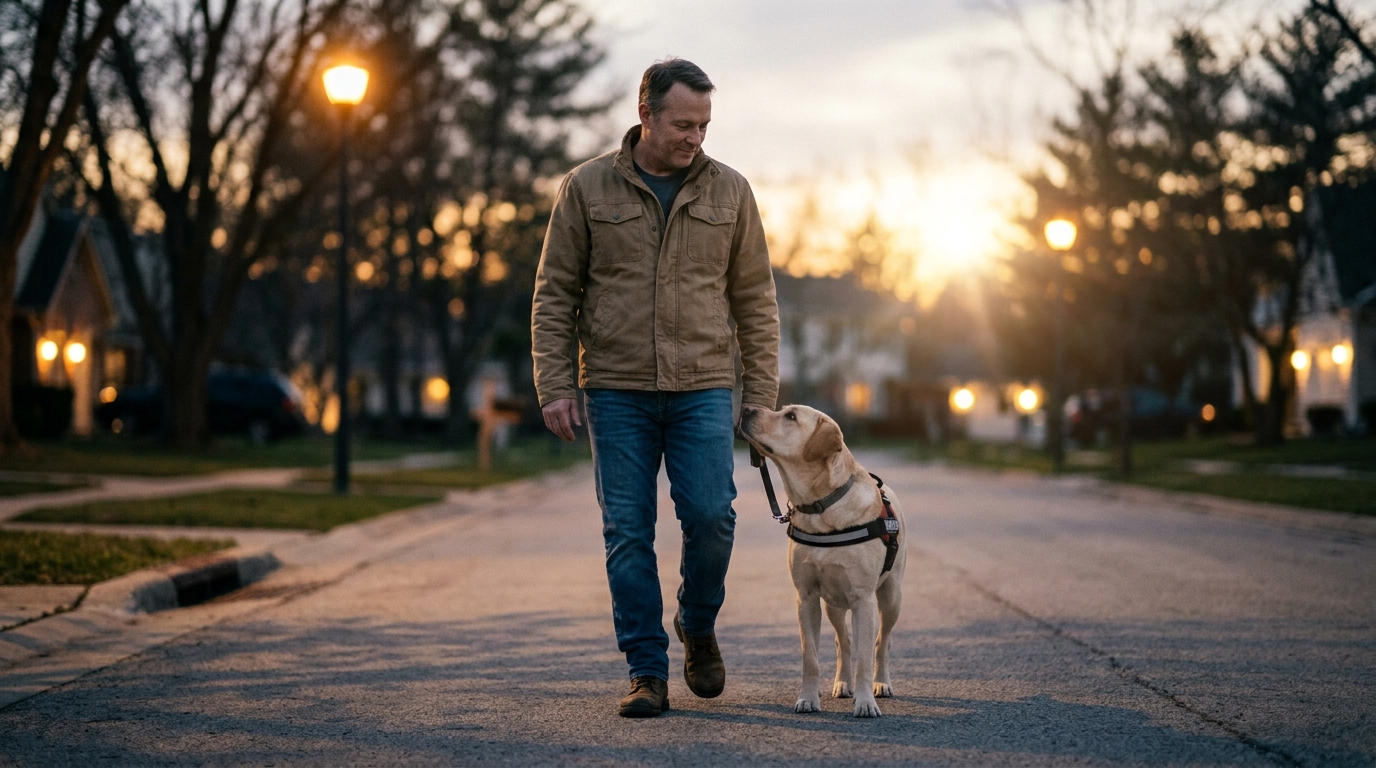
He made it to the end of the street. The next night, to the corner. By the end of the first month, they were walking a full loop through the neighborhood every evening as the streetlights flickered on.
What surprised Daniel was how the walk reorganized his relationship with the hour he feared. Instead of waiting for the dark to arrive, he was moving through it, with a steady, warm, four-legged anchor at his side.
What the Evening Walk Gave Him
- A ritual to replace the dread. The same time, the same route, the same rhythm. Predictability is a powerful comfort for a nervous system that has learned to expect threat.
- Gentle exposure, on his own terms. Dusk sounds, passing cars, distant voices: all the things that once triggered him became manageable when Biscuit stayed calm beside him.
- Real physical tiredness. For the first time in years, his body was winding down naturally, not just crashing from exhaustion.
- Small human moments. Neighbors began waving. A child asked if they could pet the dog. Conversations, tiny ones, started to happen again.
The Evening Light Does Something Quiet to You
There is a particular stretch of Daniel’s route, a slight rise near a community garden, where the whole western sky opens up around six-forty-five in the fall. He started timing the walk to reach that spot as the sun slipped down.
‘I used to hate the dark coming,’ he says. ‘Now I look forward to watching it arrive. Biscuit sits down right there at the top of the hill every time, like he knows. And for a minute, I’m not bracing for anything. I’m just a guy and his dog watching the sky change colors.’
Therapists who work with veterans often talk about the power of grounding: anchoring the mind in the present moment through the senses. The cool air, the crunch of leaves, the weight of a leash, the warmth of a dog leaning against your knee. These are not small things. For a brain trained to live in the past or brace for the future, the present can be a hard-won place to stand.
The Nights Began to Change Too
The walks did not erase the nightmares. Daniel is clear about that, and it matters. Healing from PTSD is rarely a straight line, and he still has hard nights.
But something shifted in how the evenings ended. After the walk, Daniel would make tea, sit on the porch for a few minutes, and let the day close. Biscuit would settle at his feet. Falling asleep, once a battle, became something closer to a negotiation he could sometimes win.
Within six months, he was sleeping an average of six hours a night. When a nightmare did come, Biscuit would nudge his hand awake before it could take hold, and Daniel would lie there, breathing, feeling the steady thump of a tail against the mattress.
Rising Up, One Evening at a Time
The most meaningful change, Daniel says, is not about sleep or even calm. It’s about trust.
‘I stopped believing the night was something that happened to me,’ he says. ‘Now it’s just a time of day. A time I get to walk through with my best friend.’
He has since started volunteering with the same veterans’ center that connected him with Biscuit, sharing his story with others who are on the waitlist, still skeptical, still bracing. He doesn’t promise them a cure. He tells them about the first lap around the block, and how small it felt, and how much it turned out to hold.
Gentle Takeaways for Your Own Evenings
You do not have to be a veteran, or to have a service dog, to borrow something from Daniel’s story. Many of us carry something heavy into the evening hours, whether it’s worry, grief, loneliness, or simple exhaustion. A few quiet ideas worth considering:
- Build a small ritual around the hour you dread. Even ten minutes of the same gentle routine can teach your body that evening is safe.
- Move through the hard part instead of waiting it out. A slow walk can turn restlessness into something steadier.
- Let a companion carry some of the weight. A pet, a friend, or a neighbor can offer presence without needing to fix anything.
- Notice one beautiful thing before bed. The sky, a lit window, a quiet street. Let it be enough.
- Ask for help sooner than you think you should. Counselors, support groups, and veterans’ organizations exist because no one is meant to carry this alone.
As the Porch Light Clicks On
Last week, Daniel tells me, he and Biscuit reached the top of the hill just as the clouds turned the color of embers. A neighbor jogging past slowed down and said it was a beautiful evening. Daniel, who once couldn’t stand to be outside after dark, smiled and said, ‘It really is.’
Then he and Biscuit turned for home, the porch light waiting, the night no longer something to outrun.
If you are struggling with PTSD or know someone who is, you are not alone. In the United States, veterans can reach the Veterans Crisis Line by dialing 988 and pressing 1, or by texting 838255, any hour of the day or night.