🎧 Listen to this story
Narrated by Callirrhoe · 6,990 characters
A Quiet Kitchen, a Stack of Envelopes, and a Mission That Never Ends
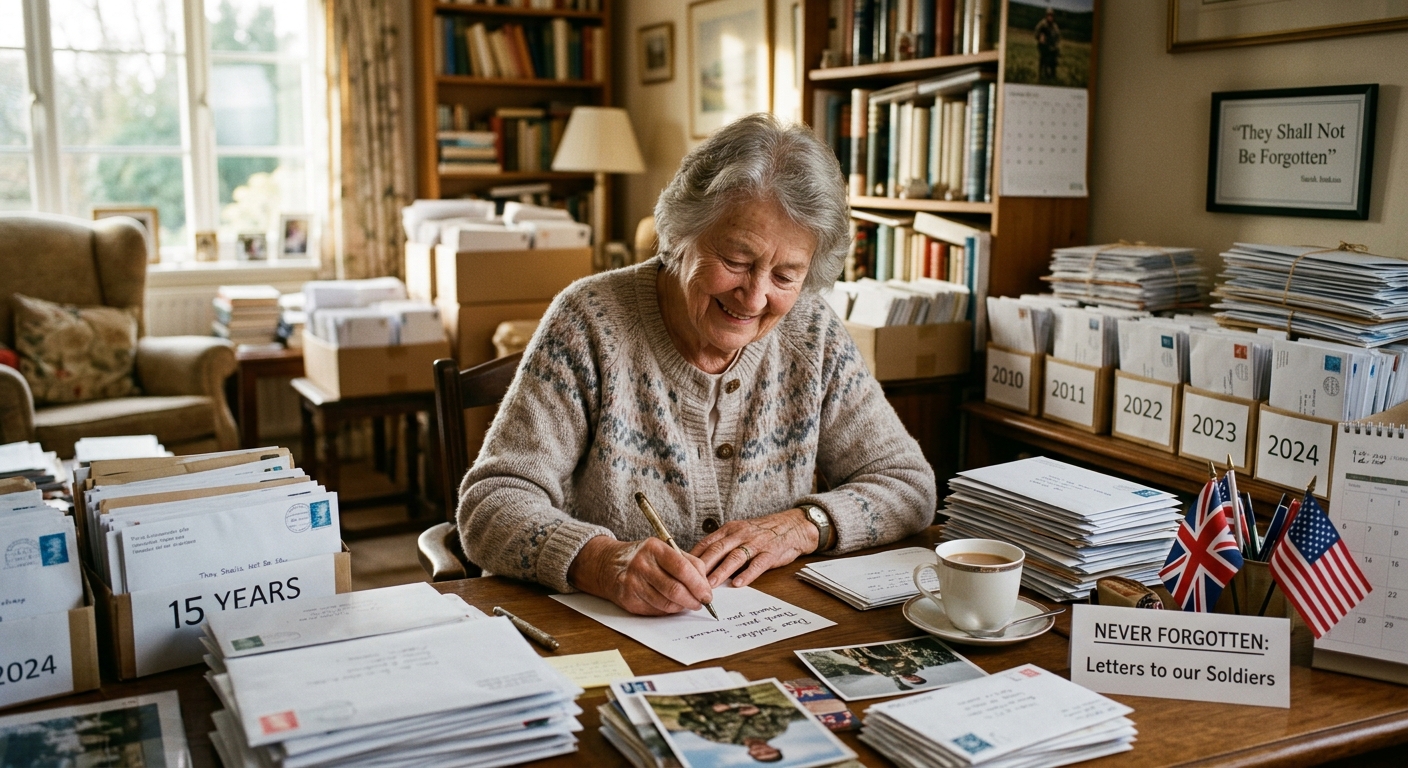
Every Tuesday morning, before the rest of her neighborhood stirs, 71-year-old Eleanor Marsh sits down at her kitchen table in Harlan County, Kentucky, brews a pot of coffee, and begins to write. Not emails. Not texts. Letters, written by hand, in her careful cursive, addressed to men and women she has never met, thousands of miles away.
She has been doing this for fifteen years. She does not plan to stop.
“I just kept thinking about what it must feel like to be so far from home and wonder if anyone back here even knows your name,” Eleanor says, straightening a fresh stack of cream-colored envelopes. “I know their names. Every single one of them.”
How It Started: A Gold Star and a Promise
The story begins, as so many acts of extraordinary kindness do, with a moment of ordinary grief. In 2009, Eleanor’s neighbor lost her son, Army Specialist David Calloway, to an IED in Afghanistan. He was 23 years old. At the funeral, Eleanor overheard someone mention that David had once told his mother he felt homesick in a way that went beyond missing people. He missed feeling seen.
That sentence lodged itself deep in Eleanor’s chest. She went home, pulled out a legal pad, and wrote her first letter that same night. It was addressed to a young man from her county who was stationed in Kandahar. She introduced herself. She told him about the county fair, the way the hills looked in October, the gossip from the diner on Main Street. She told him people were proud of him.
He wrote back six weeks later. His letter was two pages long.
“That was it,” Eleanor says with a soft laugh. “I was done for.”
The System She Built From Scratch
What began as one letter to one soldier has grown into a carefully organized operation that Eleanor runs almost entirely on her own, with occasional help from her daughter and a rotating cast of volunteers from her church.
Here is how she does it:
- She contacts the county clerk’s office and the local National Guard unit to get the names and deployment information of every active-duty service member from Harlan County.
- She writes a personal letter to each soldier at the beginning of every deployment, then follows up monthly for the duration of their service.
- Each letter is handwritten, never photocopied, never a form letter. She researches each person before writing, reaching out to their families to learn details: their hobbies, their pets’ names, their favorite local restaurant.
- She includes small items when postage allows: crossword puzzles, pressed wildflowers from her backyard, local newspaper clippings, packets of instant coffee, and handwritten recipes.
- She maintains a logbook with every name, address, and date, ensuring no one is missed and no letter goes unsent.
Over fifteen years, she estimates she has written more than 4,200 letters.
What the Soldiers Say
The responses Eleanor has received could fill a library. Many soldiers write back once. Some write back every week for the duration of their deployment. A handful have driven to Harlan County after returning home just to meet her in person.
One veteran, Marine Corporal James Tate, who was deployed to Iraq in 2014, described receiving Eleanor’s first letter as one of the most disorienting experiences of his deployment, in the best possible way.
“We were in a rough stretch. Morale was low. And I got this letter from this woman I had never met, and she knew my dog’s name was Biscuit,” James recalls. “She asked me how Biscuit was doing. I just sat there and laughed for about two minutes straight. It was the first time I had laughed like that in weeks.”
Another veteran, Army Staff Sergeant Monica Reyes, who served two tours in Afghanistan, says Eleanor’s letters gave her something she did not know she needed: continuity.
“When you’re deployed, your world shrinks to your unit, your mission, the day in front of you. Eleanor’s letters reminded me there was a whole life waiting. She made home feel real again.”
The Cost, the Sacrifice, and the Stubbornness
Eleanor is not a wealthy woman. She lives on Social Security and a modest pension from her late husband, a coal miner who passed away in 2015. She spends roughly $80 to $120 per month on postage, paper, envelopes, and the small items she tucks inside each letter. That money comes from her own budget, carved out of grocery savings and what she calls her “luxuries fund,” which she laughs and clarifies was never very large to begin with.
Her daughter, Patricia, has tried more than once to set up a donation fund or a nonprofit to help cover costs. Eleanor has resisted, though she is warming to the idea.
“I don’t want it to feel like a program,” she explains. “I want it to feel like a neighbor who cares. The minute it starts feeling like an organization, I worry the letters will stop feeling personal.”
That instinct for intimacy is at the core of everything Eleanor does. She does not write about politics. She does not write about the wars. She writes about the county. She writes about people. She writes about life the way it feels when you belong somewhere.
7 Things Eleanor’s Story Teaches Us About Kindness
- Consistency matters more than grand gestures. One letter a month for fifteen years outweighs any single dramatic act.
- Specificity is love. Knowing someone’s dog’s name is an act of care. Generic kindness lands differently than personal kindness.
- You do not need resources. You need resolve. Eleanor is not rich, well-connected, or running a foundation. She has stamps, paper, and stubbornness.
- Grief can be the seed of something beautiful. Her mission grew directly from loss, from David Calloway’s funeral and one overheard sentence.
- The people who feel forgotten often feel it most quietly. Soldiers rarely ask to feel seen. Eleanor assumed they needed it anyway, and she was right.
- A handwritten letter carries weight that a digital message cannot. There is something about ink on paper that signals permanence and intention.
- One person truly can make a sweeping difference. Eleanor is one woman at one table with one pot of coffee. She has touched over four thousand lives.
A Letter Still Waiting to Be Written
On the morning we spoke with Eleanor, she was midway through a letter to a 19-year-old private from the eastern edge of the county, currently stationed at a base in Germany. His mother had told Eleanor he was nervous, a little homesick, not quite sure he had made the right choice in enlisting.
Eleanor dipped her pen and kept writing. She told him about the way the fog sits in the valleys in the morning. She told him the high school football team had a good season this year. She told him his mother bragged about him at church every Sunday without fail.
She signed it the way she signs every letter: “Thinking of you from home. You are not forgotten.”
She sealed the envelope, added a stamp, and set it on the pile by the door.
Then she picked up the next blank sheet of paper and started again.