🎧 Listen to this story
Narrated by Vindemiatrix · 8,005 characters
The Driveway Workshop That Became a Lifeline
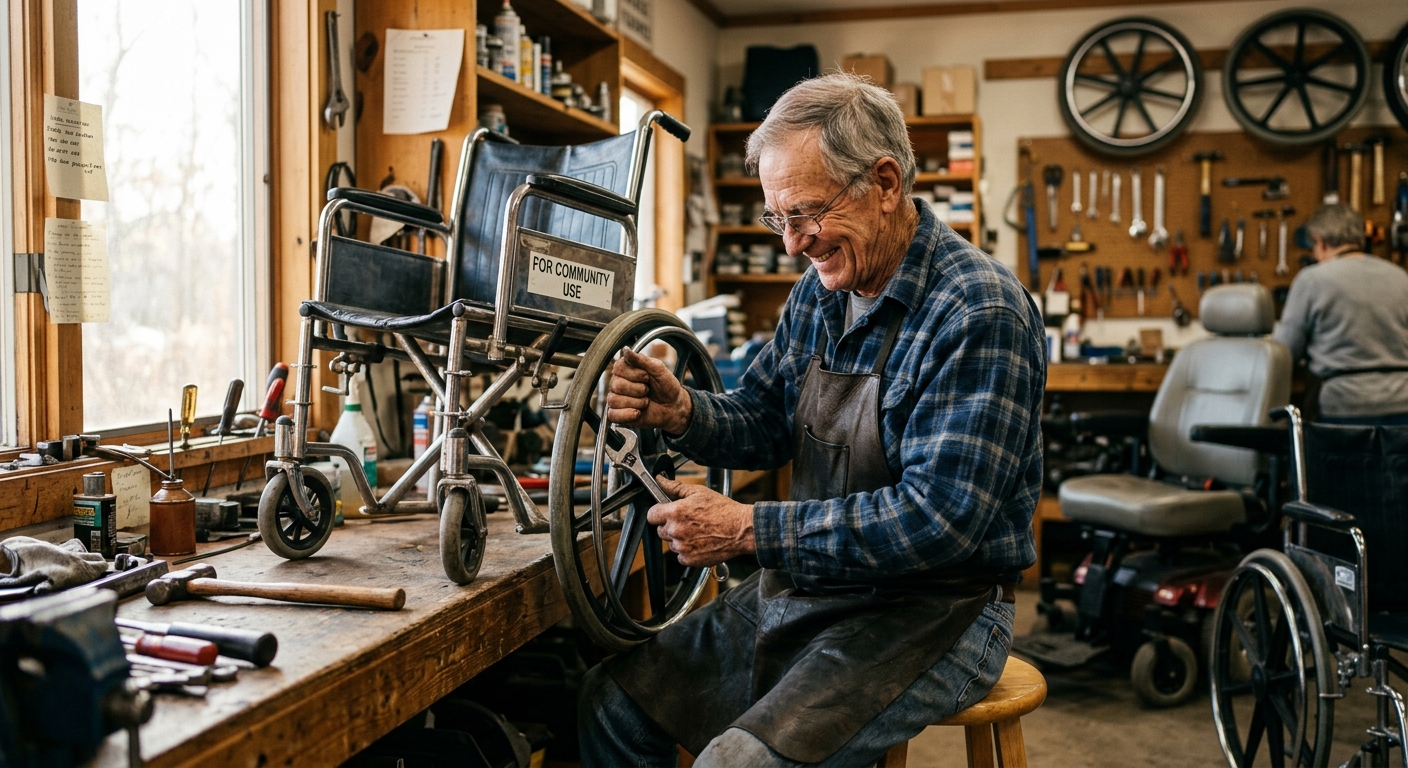
On any given Tuesday morning in a quiet suburb of Columbus, Ohio, you might hear the faint whir of a power drill and the clinking of metal coming from a modest two-car garage on Elmwood Drive. The garage doors are thrown wide open, a portable radio murmurs classic rock, and 71-year-old Gerald ‘Jerry’ Kowalski is already elbow-deep in a disassembled power wheelchair that belongs to a 16-year-old named Marcus.
Marcus has cerebral palsy. His chair broke down three weeks ago. His family’s insurance denied the repair claim. The medical supply company quoted them $1,400 just to look at it. And then someone at Marcus’s school mentioned Jerry’s name.
Within 48 hours of calling, Marcus’s mother drove him forty minutes across town to that driveway. Within two days, Marcus was rolling again. The bill: zero dollars.
‘People ask me what I charge,’ Jerry says, wiping grease from his hands with a red shop rag. ‘I tell them the same thing every time. I charge nothing, and I take coffee. Black.’
From Steel Beams to Steel Frames
Jerry Kowalski spent four decades as a structural engineer. He worked on highway overpasses, commercial buildings, and water treatment facilities across the Midwest. He was good at his job, methodical and patient, the kind of man who could look at a failing structure and immediately understand what it needed.
When he retired in 2018, he expected to fill his time with woodworking and fishing. That lasted about four months.
‘I went insane,’ he admits with a laugh. ‘I’m not built for sitting still. My wife will tell you. I repainted every room in the house twice. I reorganized the garage three times. She finally said, Jerry, you need a project or I’m going to lose my mind.’
The project found him through a neighbor. A woman down the street had a daughter who used a manual wheelchair. One of the wheels had cracked. The family couldn’t afford the replacement part and was on a two-month waiting list through their insurance provider. Jerry, who had watched the girl roll past his house for years, offered to take a look.
‘It took me an afternoon to figure it out and another morning to fix it,’ he says. ‘Cost me maybe twelve dollars in parts I ordered online. When that little girl came back and rode down my driveway for the first time after weeks of being stuck, I just…’ He pauses, looks down at his workbench. ‘That was it for me. That was the thing I was supposed to be doing.’
How the Operation Works
Jerry does not run a nonprofit. He has no website, no social media presence, and no official business registration. What he has is a reputation, and in the disability community, that reputation travels fast.
Word of mouth has brought him clients from as far as 90 miles away. He has fixed:
- Power wheelchairs with failing motor controllers
- Manual chairs with bent frames and broken footrests
- Pediatric strollers modified for children with mobility conditions
- Scooters and rollators belonging to elderly veterans
- Custom chairs that were abandoned by suppliers who went out of business
He teaches himself what he does not already know. YouTube videos, manufacturer service manuals he requests directly from companies, online forums for mobility device technicians. He has a binder, two inches thick, filled with printed diagrams and handwritten notes.
‘Engineering is engineering,’ he says simply. ‘The principles don’t change whether you’re looking at a bridge or a wheelchair. You find where the stress is, you figure out why it failed, and you fix it so it doesn’t fail again.’
What the Families Say
For the families who find their way to Jerry’s driveway, the experience is often about more than just a repaired chair. It is about being seen.
Linda Torres, whose 34-year-old son Roberto has muscular dystrophy, drove to Jerry’s house last spring after Roberto’s power chair stopped functioning entirely. She had spent six weeks navigating insurance calls, prior authorizations, and supplier backlogs. She was exhausted before she even arrived.
‘He just looked at Roberto and said, let’s see what’s going on with your wheels, buddy,’ Linda recalls. ‘Not at me, not at the paperwork. At Roberto. Like he was a person and not a case number. I almost cried right there in the driveway.’
The repair took Jerry three sessions over two days. A faulty joystick module and a wiring harness that had corroded. Parts cost about sixty dollars, which Jerry covered himself. He does not ask families to reimburse him for parts, though some insist on leaving something behind. He keeps a mason jar on his workbench where he puts whatever people give him, and at the end of each year he donates its contents to a local adaptive sports program.
The Real Problem Jerry Is Solving
What Jerry is doing in his driveway is not just generous. It is filling a gap that, by most accounts, should not exist at all.
In the United States, the average wait time for a wheelchair repair through insurance can range from six weeks to six months, according to advocacy groups focused on disability rights. During that time, users are often left without their primary means of mobility. They miss school. They miss work. They miss life.
The system relies on a small network of certified repair technicians and approved suppliers, and demand consistently outpaces availability. Independent repair is often discouraged or technically voided by manufacturer warranties. Families with financial means can sometimes pay out of pocket for faster service. Those without that means wait, or they go without.
Jerry represents an informal but growing movement of retired tradespeople, engineers, and mechanics who are stepping into this gap on a volunteer basis. Organizations like Whirlwind Wheelchair and local repair cafes focused on mobility devices have begun formalizing similar efforts, but most of the work still happens exactly the way Jerry does it: quietly, in a driveway, person by person.
What Jerry Wants You to Know
Jerry is uncomfortable being called a hero. When a local community Facebook group posted about him last year, he asked them to take it down. He is not doing this for recognition, he says. He is doing it because he can, and because it matters.
But there are a few things he does want people to understand:
- The need is massive and largely invisible. Most people have no idea how broken the wheelchair repair system is until they or someone they love is stuck in it.
- Skills don’t expire. Jerry believes too many retired tradespeople underestimate the value of what they know. ‘You spent thirty years learning how things work,’ he says. ‘That doesn’t go away when you get a gold watch.’
- Small acts compound. He estimates he has repaired over 200 chairs in six years. Each one represents a person who got their mobility back. ‘You do the math on what that means for 200 lives,’ he says, ‘and it stops feeling small.’
- Community is built in driveways, not boardrooms. Some of Jerry’s most meaningful conversations have happened while he works, with parents, with wheelchair users themselves, with siblings who come along. ‘People talk when their hands are busy,’ he observes.
A Morning in the Driveway
Before Marcus leaves that Tuesday, Jerry walks him through exactly what he fixed and why it failed, the same way he might explain a bridge repair to a junior engineer. Marcus, who his mother quietly mentions rarely engages with adults he doesn’t know, asks three follow-up questions. Jerry answers all of them directly, technically, without condescension.
As Marcus wheels back toward the car, he does a small, tight circle in the driveway, testing the turning radius. The chair responds cleanly. He does it again.
Jerry watches from his garage door, arms crossed, the red shop rag hanging from his back pocket.
He is already thinking about the chair coming in Thursday. A woman in her fifties. A broken anti-tip mechanism. He has already ordered the part.
‘Next,’ he says quietly, and goes back inside to make another cup of coffee.