
🎧 Listen to this story
Narrated by Orus · 8,353 characters
It Started as a Box to Check
I will be honest with you. The first time I walked through the doors of the City Light Community Kitchen on a Tuesday morning in January, I was not there out of the goodness of my heart. I was there because my therapist had suggested I “get out of my head” and “do something for someone else.” I had been circling a drain of low-grade anxiety and self-absorption for the better part of a year, and volunteering at the local soup kitchen felt like a reasonable prescription. Cheap, accessible, and probably something I could quietly quit after a week if it felt weird.
I did not quit after a week. And by the time thirty days had passed, something in my brain had genuinely shifted. Not in a dramatic, cinematic way. More like how a long overdue conversation with an old friend rearranges your priorities without you noticing until you are driving home and realize you feel different.
This is what those thirty days actually looked like, and what they quietly did to me.
Week One: The Discomfort Was Louder Than I Expected
Nobody tells you how uncomfortable it feels at first. I had assumed I would show up, ladle soup, feel warm and purposeful, and drive home changed. Instead, I spent the first three days fighting an overwhelming awareness of my own awkwardness. I did not know the regulars. I did not know the rhythms of the kitchen. I burned a massive tray of corn bread on my second morning and stood there in the fluorescent light feeling genuinely embarrassed.
More than that, I did not know how to look at people. Not the other volunteers, but the guests. There was a part of me, a part I am not proud of, that had walked in with an unconscious script about who these people would be and what they would need from me. That script was wrong in almost every detail. The guests were not a monolith. They were a retired schoolteacher who had lost her home after a medical bankruptcy. They were a twenty-three-year-old college student working two jobs who still could not afford consistent meals. They were a man named Gerald who arrived every Wednesday in a suit jacket because, as he told me on my fourth day, “showing up with dignity is the only thing nobody can take from you.”
Gerald said that casually, over a tray of mashed potatoes, and I thought about it for the rest of the week.
Week Two: I Started Listening Instead of Performing
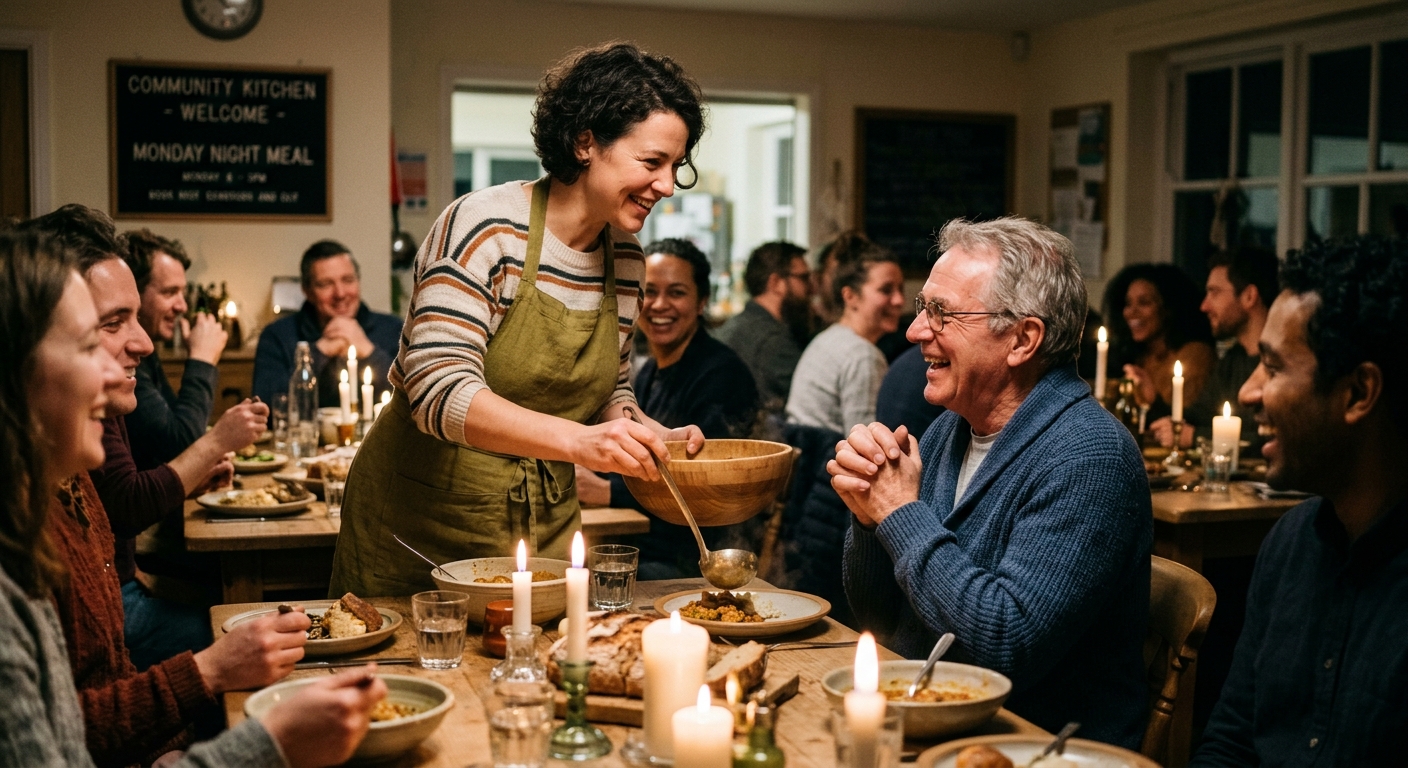
The shift in week two was subtle but important. I stopped trying to be visibly helpful and started just being present. The kitchen coordinator, a woman named Darnelle who had been running volunteers for eleven years, pulled me aside one afternoon and said something I wrote down that night: “The food is the door. The conversation is the house. Do not just stand in the doorway.”
I started actually talking to people. Not asking probing questions or offering unsolicited encouragement, but just talking the way you talk to anyone. About the weather turning. About whether the coffee was better this week than last. About the basketball game. Small talk, the kind I had always dismissed as meaningless, turned out to be one of the most humanizing things I had ever participated in.
There is something profound about being treated as an ordinary person when your circumstances are anything but ordinary. I watched guests visibly relax when the volunteers engaged them without pity or performance. I watched people laugh. A lot, actually. More than I had expected.
What the Research Actually Says About Volunteering and Mental Health
My experience was not an anomaly. A growing body of research supports what I stumbled into over the course of thirty mornings.
- A 2020 study published in BMC Public Health found that regular volunteering was associated with significantly lower rates of depression and higher life satisfaction across all age groups.
- Neuroscientists at the National Institutes of Health have identified that acts of generosity activate the same reward pathways in the brain as receiving gifts or money, a phenomenon sometimes called the “helper’s high.”
- Research from Carnegie Mellon University found that adults over fifty who volunteered regularly were significantly less likely to develop high blood pressure than non-volunteers.
- A study from the London School of Economics found a direct correlation between frequency of volunteering and reported happiness, with weekly volunteers reporting the highest wellbeing scores.
None of this surprised me after the fact. But it might have helped to know it going in, on the morning I burned the corn bread and wanted to disappear.
Week Three: The Thing That Actually Rewired Me
By the third week, something had changed in how I processed my own daily life. The most accurate way I can describe it: my problems started to feel like problems again instead of catastrophes.
This is not the same as toxic positivity. I did not start dismissing my difficulties by comparing myself to people who had less. That kind of thinking is reductive and ultimately unhelpful. What actually happened was more nuanced. I began to understand, in a cellular, not just intellectual way, that resilience is not rare. It is everywhere. It is Gerald in his suit jacket. It is the woman who walked three miles in January sleet to make sure her kids had a hot meal. It is Darnelle, who had lost her own sister to addiction and channeled that grief into eleven years of showing up every single week.
Witnessing resilience up close does not minimize your pain. It expands your sense of what is survivable.
I also noticed that my phone had become far less interesting. Not because I made a conscious decision to reduce my screen time, but because real, complex, three-dimensional human interaction had recalibrated my sense of what was worth paying attention to.
Week Four: Gratitude Without the Cliche
I want to be careful here, because “I volunteered and now I am grateful” is the most predictable ending to a story like this, and it also happens to be true, which is awkward.
But the gratitude I came home with at the end of the month was not the Instagram-caption kind. It was not a list of things I had and others did not. It was something quieter and stranger. It was gratitude for friction. For the discomfort of the first week. For being wrong about people. For burning the corn bread and having to ask for help cleaning it up. For Gerald, who gave me more than I could ever have given him with a ladle of soup.
On my last day, Darnelle handed me a small card that the kitchen gave to all volunteers who completed their first month. It read: “Thank you for seeing us.” I had to sit in my car for a few minutes before I could drive home.
What I Would Tell Anyone Considering It
If you are on the fence about volunteering, or about this specific kind of volunteering, here is what I wish someone had told me before I walked through those doors:
- Go in without an agenda. The moment you arrive needing to feel like a good person, you have made it about you. Let the work make it about them, and the rest will follow.
- Commit to at least four sessions before you decide it is not for you. The discomfort of the first few visits is part of the process, not a sign that the experience is wrong for you.
- Small talk is a skill worth practicing. It is not shallow. In the right context, it is one of the most dignified things you can offer another person.
- You will receive more than you give. This is not a warning. It is just the truth, and it will probably catch you off guard the same way it caught me.
- The kitchen is not the only place this works. A food pantry, a literacy program, an animal shelter, a hospital visiting program. The specific venue matters less than the consistency and the presence you bring to it.
A Month Later
I am still volunteering, twice a month now. Gerald is still there on Wednesdays. Darnelle still runs the place with the calm authority of someone who has seen every kind of person walk through a door and decided they are all worth feeding.
My anxiety has not disappeared. My problems are still my problems. But somewhere between the burned corn bread and the card I still keep in my car, something in my brain was quietly, permanently rearranged. I am not sure there is a cleaner word for it than gratitude, awkward as that is to admit.
Sometimes the prescription your therapist writes turns out to be exactly right.