
🎧 Listen to this story
Narrated by Orus · 6,700 characters
The Morning Everything Fell Apart
It started with a broken crayon. A bright red one, snapped clean in half by my daughter Lily’s best friend, Maya, during what was supposed to be a peaceful Saturday morning playdate. Lily, five years old and fiercely protective of her art supplies, burst into tears. Maya, equally five and equally dramatic, burst into tears too. Within sixty seconds, the living room had transformed into a scene of complete emotional chaos, and I was standing in the middle of it holding a cup of coffee that had long gone cold.
I separated the girls. I sent Maya to one corner with a juice box and Lily to another with a tissue. I sat down on the floor between them, fully prepared to deliver what I considered a masterclass in conflict resolution. I had a whole speech ready. Something about being careful with other people’s things, about saying sorry, about how friends have to be gentle with each other’s feelings. I was ready. I was the adult in the room.
What I was not ready for was what happened next.
Thirty Seconds That Changed How I See Everything
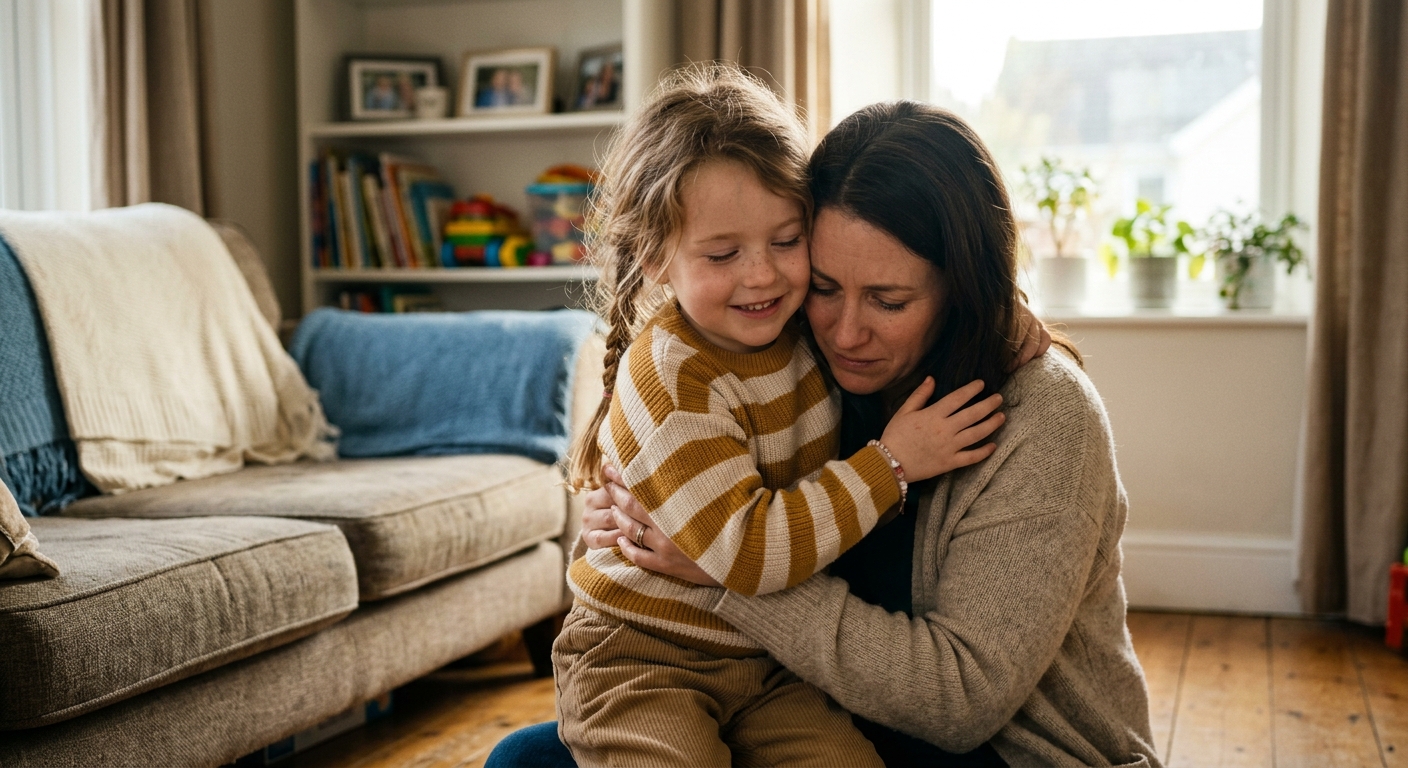
Before I could say a single word, Lily looked up from her tissues. She looked across the room at Maya, who was staring at the floor, her little shoulders hunched with guilt. And then Lily said, very quietly, “It’s okay, Maya. I’m not mad anymore. Do you want to color with me?”
That was it. No lecture. No conditions. No “I’ll forgive you, but you have to promise never to do it again.” No negotiation, no score-keeping, no drawn-out silence meant to let the other person feel the full weight of their wrongdoing. Just: I’m not mad anymore. Do you want to color with me?
Maya’s face transformed instantly. She crossed the room in three quick steps and the two of them were side by side again, heads bent over a coloring book, sharing the crayons that remained. Within two minutes, they were laughing.
I sat on the floor alone with my cold coffee and felt something shift inside my chest.
What Adults Do Instead
I started thinking about how I handle forgiveness. Really thinking about it, not just in theory but in practice. And I did not love what I found.
When someone wrongs me, there is a process. A long, complicated, exhausting process. First comes the hurt. Then the rehearsal of the hurt, where I replay the moment over and over to make sure I have fully understood how wronged I was. Then comes the telling of it, sharing the story with people I trust so they can confirm that yes, I had every right to be upset. Then, maybe eventually, the slow thaw. The cautious reopening. The forgiveness that comes with invisible asterisks attached.
I hold grudges like they are heirlooms. I pass them from one week to the next, polishing them, keeping them safe. I have ended friendships over things I cannot fully remember anymore. I have let relationships quietly dissolve because asking for a repair felt like admitting weakness.
And here was my five-year-old, teaching me that none of that is actually necessary.
What the Research Actually Says About Forgiveness
It turns out that Lily was not just being sweet. She was being neurologically efficient. Studies on forgiveness have found that holding onto resentment keeps the body in a prolonged stress response, elevating cortisol levels, disrupting sleep, and even contributing to cardiovascular issues over time. According to researchers at Johns Hopkins Medicine, people who practice forgiveness report lower rates of depression, anxiety, and chronic pain.
Forgiveness, the science tells us, is not primarily a gift we give to the person who hurt us. It is a gift we give to ourselves. It is the decision to stop carrying something heavy.
Children seem to understand this instinctively. They have not yet learned to weaponize pain. They have not yet discovered that withholding forgiveness can feel like power. They simply feel the hurt, release it, and return to the business of living, which in Lily’s case was coloring a picture of a horse.
Three Things a Five-Year-Old Knows That We Have Forgotten
1. Forgiveness Does Not Require a Perfect Apology
Maya did not deliver a heartfelt, carefully worded apology. She cried and stared at the floor. That was enough for Lily. Many of us wait for the apology that matches the size of the hurt, a full acknowledgment, a demonstration of true remorse, a guarantee it will never happen again. Sometimes that apology never comes. Lily did not wait for perfect. She just let go.
2. The Relationship Matters More Than the Scoreboard
Lily wanted to keep coloring with her friend. That desire was bigger than the broken crayon. When we hold onto resentment, we often tell ourselves we are protecting ourselves, but what we are frequently doing is choosing the wound over the connection. Lily chose the connection without even hesitating.
3. Moving On Is Not the Same as Saying It Did Not Hurt
“I’m not mad anymore” does not mean “it didn’t matter.” It means: I felt it, and now I am choosing something different. That distinction is important. Forgiveness is not the erasure of pain. It is the decision to stop letting the pain write the next chapter.
The Practice I Started After That Saturday
I will not pretend that watching my daughter color with her friend turned me into a person who forgives easily and instantly. That would be a tidy ending, and life rarely gives us those. But it did make me start asking a different question.
Before, when I felt wronged, my instinct was always: How do I protect myself from this? Now I try to also ask: What am I choosing to carry, and how long do I want to carry it?
I have been reaching out to people I let drift away. I have been saying “it’s okay” and meaning it rather than saying it while keeping a quiet tally somewhere in the back of my mind. I have been trying, imperfectly and with a lot of backsliding, to forgive faster. Not because the things that hurt me did not matter, but because I want more time coloring and less time in my corners.
The Ongoing Lesson
Lily is six now. She has already forgotten the broken crayon entirely. When I mentioned it to her recently, she looked at me blankly and then went back to what she was doing, which was teaching her stuffed rabbit the correct way to hold a pencil.
She is not carrying it. She never was. And I think about that more than she will ever know.
The best teachers do not always come with credentials. Sometimes they come with juice boxes and broken crayons and a completely effortless capacity to choose love over ledger-keeping. Sometimes they are five years old and they are already wiser than you have managed to become in four decades of trying.
I am still learning. But at least now I know what I am learning toward.