🎧 Listen to this story
Narrated by Gacrux · 7,975 characters
A Brush Stroke Away From Giving Up
Margaret Osei had been painting since she was seven years old. Growing up in Accra, Ghana, before immigrating to the United States at nineteen, she had filled dozens of sketchbooks with color, shape, and life. By the time she was in her late forties, she had built a modest but deeply respected career as a watercolor artist in Portland, Oregon, selling work at local galleries and teaching weekend workshops to aspiring painters of all ages.
Then, on a Tuesday morning in March 2021, Margaret reached for her coffee mug and felt nothing on her right side. By the time the ambulance arrived, she had lost consciousness. She was having a massive ischemic stroke.
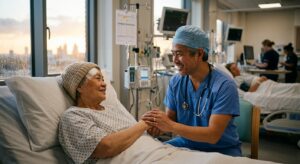
She survived. But when she woke up three days later in the ICU, her right arm lay still beside her. The dominant hand that had held a brush for four decades was, for now, completely unresponsive. Her doctors were cautiously optimistic about partial recovery, but honest about what that meant: she might regain some function, but fine motor control, the delicate, precise movement that painting demands, was unlikely to fully return.
Margaret was fifty-one years old, and the tool she had used to make sense of the world had been taken from her overnight.
The Weeks Nobody Talks About
What followed was not an immediate montage of triumphant comeback moments. Margaret is candid about this when she speaks to groups or gives interviews today.
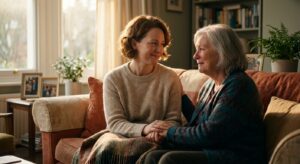
‘People want the story to jump from the hospital bed to the gallery opening,’ she has said. ‘But there were weeks in between where I didn’t want to look at a paintbrush. I didn’t want to look at the walls in my house where my old paintings were hanging. I asked my daughter to take them down.’
Her rehabilitation team at OHSU included occupational therapists, neurologists, and speech therapists, as the stroke had also affected some of her language processing. Progress was slow and nonlinear. Some days she gained ground. Other days she felt like she was back at the beginning.
Her occupational therapist, a woman named Dana Cho, noticed that Margaret’s eyes would drift toward the art supply corner of the rehab room where they kept colored pencils and simple craft materials for patients. Dana made a small but significant decision: she started incorporating drawing exercises into Margaret’s left-hand therapy sessions, disguising art as occupational work.
‘She didn’t think of it as painting,’ Dana later told a local newspaper. ‘She thought of it as grip strengthening and coordination practice. But I could see something shift in her when she had a pencil in her hand, even the wrong hand.’
The Left Hand Begins to Learn
Six weeks after her stroke, Margaret drew a mango. It was wobbly, asymmetrical, and nothing like the precise, luminous still-life work she had produced for decades. She cried when she saw it. Then she drew another one.
The human brain, particularly after injury, holds a remarkable capacity for what neurologists call neuroplasticity, the ability to reroute, rewire, and rebuild pathways through repetition and intention. Margaret’s recovery became, in part, a real-time lesson in this process. The left side of her brain, which controls the right side of the body, had been damaged. But the right hemisphere stepped in, slowly, stubbornly, to pick up some of the slack.
This did not mean her left hand became her right hand. It never would. The left hand thinks differently, moves differently, sees differently. Margaret had to accept that she was not relearning to paint. She was learning to paint for the first time, in a new body, with a new instrument.
What Changed in Her Work
Here is where the story takes a turn that surprises people. Margaret’s left-handed paintings are, by most accounts including her own, more emotionally powerful than anything she made before the stroke. This is not simply a feel-good narrative trick. Critics and collectors have noted it plainly.
- The lines became looser. Where her previous work was technically polished, her new pieces carry an immediacy and rawness that feel alive in a different way.
- The color choices grew bolder. Without the habit and muscle memory of the right hand guiding her toward familiar palettes, she experimented more freely.
- The subjects shifted. She began painting people more, particularly hands, faces in transition, bodies caught between one moment and the next.
- The scale expanded. Working larger canvases helped her left hand move more naturally, and her compositions became more sweeping and ambitious.
- The vulnerability became visible. Viewers often describe her new work as feeling like it was painted by someone who knows exactly how fragile everything is.
Returning to the Studio
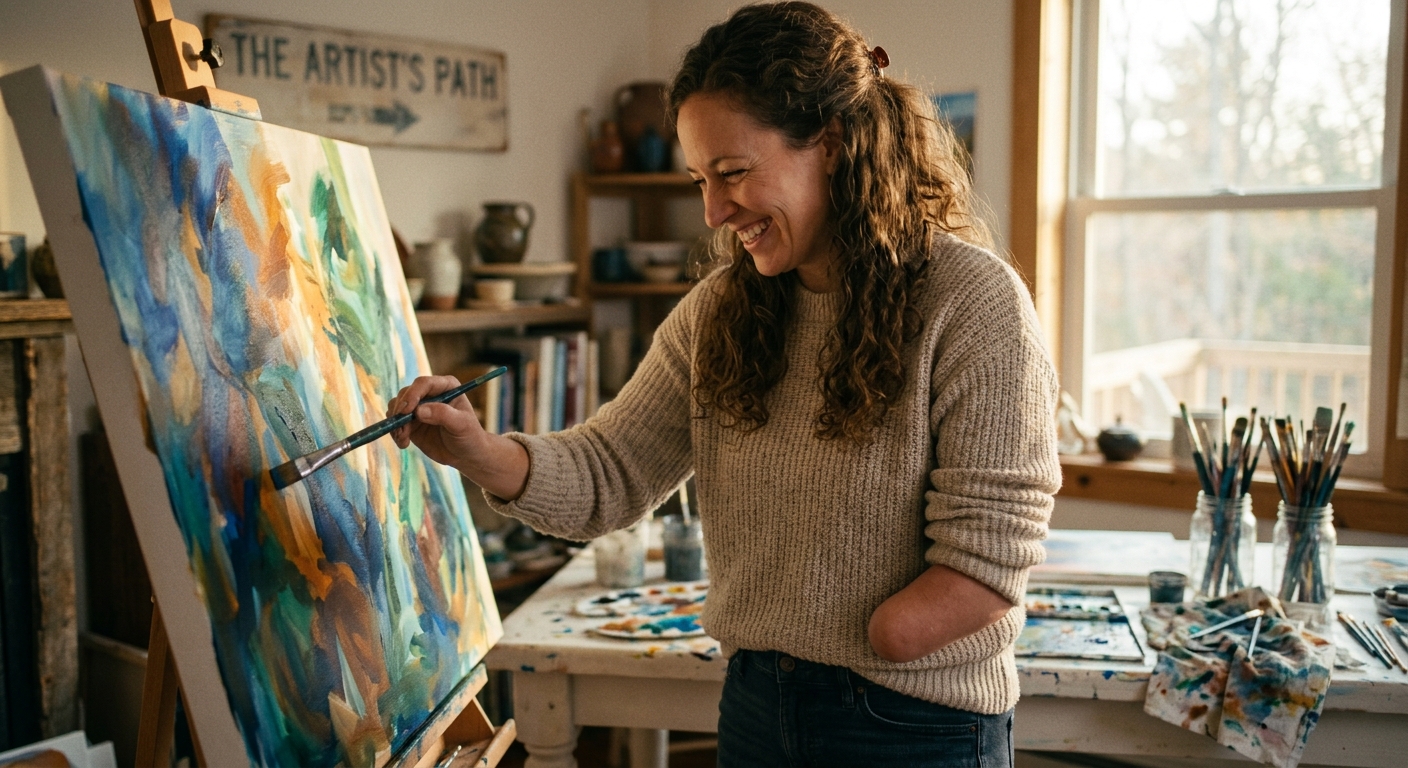
Eight months after her stroke, Margaret returned to her home studio for the first time. Her daughter had rehung some of the old paintings, but left wall space open. Margaret sat in front of a blank canvas for forty-five minutes without touching it. Then she picked up a brush with her left hand and began.
The painting she finished that day, a loose, luminous portrait of her mother that she titled Still Here, sold within a week of being posted to her social media account. The response was immediate and emotional. Strangers sent messages from around the world. Other stroke survivors, people living with Parkinson’s disease, artists who had lost limbs, wrote to say that the image had cracked something open in them.
Margaret donated the proceeds of that first sale to the stroke rehabilitation unit at OHSU.
Teaching Again, Differently
By the second year of her recovery, Margaret had restarted her weekend workshops. They look different now. She no longer teaches technique as a primary goal. Instead, she teaches presence, the art of paying attention to what your body can do in this moment rather than grieving what it could do before.
She works alongside her students using her left hand, making no effort to hide the difficulty or the imperfection. Students who come expecting a masterclass in watercolor technique often leave having learned something larger about persistence, adaptation, and what it means to begin again.
‘I tell them that the best painting you’ll ever make might be the one where everything goes wrong,’ she says. ‘Because that’s the one where you stopped trying to control it and just let it be what it needed to be.’
What We Can All Learn From Margaret’s Story
You don’t have to be a stroke survivor or an artist for Margaret’s journey to land somewhere true inside you. Her experience speaks to something most people quietly understand: that identity can become a trap when it’s too tightly wound around ability.
She was a painter. That was her identity, her livelihood, her emotional language. When the stroke threatened to take that away, it also threatened to take her sense of self. What she found on the other side of that loss was not the same self, restored. It was a broader, more flexible self that had room for imperfection, for slowness, for beginning again without a guarantee.
That, perhaps, is the real painting she made during her recovery. Not the canvases on the wall, but the person she became while learning to fill them.
Where Margaret Is Today
Margaret Osei continues to paint, teach, and speak publicly about stroke recovery and creative resilience. She has partial function in her right hand now, though she continues to paint primarily with her left. She has said she has no plans to switch back, even if full function were to return.
Her work is currently on display at two galleries in the Pacific Northwest, and she is finishing a short memoir about the eighteen months following her stroke, which she plans to self-publish in late 2025.
When asked what she would say to someone who has just lost the thing they built their life around, she doesn’t hesitate.
‘Grieve it. Fully. Don’t rush past that part. And then, when you’re ready, pick up whatever you have left. It’s more than you think.’