🎧 Listen to this story
Narrated by Orus · 8,166 characters
A Shovel, a Dream, and a Muddy Saturday Afternoon
In the spring of 2003, retired engineer Gerald Hutchins did something his neighbors found mildly eccentric. He rented an excavator, tore up a quarter-acre of his overgrown backyard in rural Somerset, England, and started digging. His wife, Patricia, brought him sandwiches and shook her head. His neighbor Dave called it “Gerald’s midlife crisis, just twenty years too late.”
Gerald didn’t have a grand conservation plan. He didn’t have a biology degree or a grant from an environmental agency. He had a book about British wildlife he’d borrowed from the local library, a stubborn streak, and a vague, persistent feeling that the land behind his house could be something more than a patch of compacted clay and bindweed.
What he built that weekend was a modest pond, roughly the size of a tennis court, edged with native reeds and filled by a natural spring that had been quietly bubbling beneath his property for decades. He scattered some native aquatic plant seeds he’d ordered from a catalog. He added a small log pile along the bank for amphibians to shelter in. Then he waited.
He had no idea he was about to accidentally save a species.
The Unexpected Arrival
Within the first season, the pond attracted frogs, dragonflies, and a pair of moorhens who nested in the reeds with the confidence of squatters who know the landlord is friendly. Gerald kept a journal, noting every new arrival with the careful handwriting of a man who once drafted engineering blueprints. Bats appeared at dusk. A heron began visiting every Thursday morning with such clockwork regularity that Gerald named him Arthur.
But in the summer of 2005, something remarkable happened. Gerald noticed a cluster of distinctive spotted eggs attached to the underside of a submerged reed stem. He photographed them, cross-referenced his library book, and felt his pulse quicken. He drove to the library the next morning and asked the librarian to help him access a university zoology database online.
The eggs belonged to the great crested newt, Triturus cristatus. A protected species under UK and European law. A species that had lost more than 97% of its pond habitat across Britain since the 1940s due to agricultural drainage, urban development, and pollution. A species that was, in the polite language of conservation reports, in serious trouble.
Gerald called the local wildlife trust that afternoon. A researcher named Dr. Anita Patel drove out the following week, rubber boots and survey net in hand, expecting to confirm a small colony and offer some encouragement to a well-meaning retiree. Instead, she stood at the edge of Gerald’s pond with her clipboard frozen in mid-air and said, very quietly, “Oh my goodness.”
What the Scientists Found
The survey results were extraordinary. Gerald’s pond had not attracted a small, struggling group of great crested newts. It had become home to a thriving, self-sustaining colony of over 200 individuals, one of the largest recorded populations in the county at that time. The combination of factors was nearly perfect: clean spring water, native marginal planting that provided egg-laying sites, the log pile shelter, and Gerald’s absolute refusal to use any pesticides or herbicides on his property for two years prior to digging, meaning the surrounding soil was unusually clean.
Dr. Patel’s report to the Somerset Wildlife Trust triggered a cascade of interest. Within a year, academic papers referenced the site. Herpetologists from three universities requested access for research. The pond was formally designated as a Local Wildlife Site, a designation that came with certain protections and, as Gerald joked, “absolutely no extra funding whatsoever.”
He didn’t mind. He started expanding. He added two smaller satellite ponds connected by shallow channels. He planted hawthorn and blackthorn hedging around the perimeter to create buffer habitat. He stopped mowing a strip of grass along the property’s edge entirely, letting it become the kind of tangled, wonderful mess that insects and small mammals love and estate agents hate.
The Ripple Effect: What One Backyard Taught a Community
Word spread, the way it does in small communities, through garden fences and village hall meetings and the kind of conversation that starts with “You won’t believe what Gerald’s done now.” Neighbors began asking questions. Could they do something similar? Did it have to be as large? What if they only had a small garden?
Gerald started hosting informal Saturday morning tours. He made tea. He showed people his journal. He explained that a pond didn’t need to be large to be valuable, that even a half-barrel water feature planted with native species could support damselflies, water beetles, and frogs within a single season. He was not a polished public speaker. He repeated himself occasionally and got sidetracked talking about Arthur the heron. Nobody seemed to mind.
Over the next decade, the local wildlife trust documented 34 new garden ponds created within a 5-mile radius of Gerald’s property. Twelve of those ponds were subsequently found to contain great crested newts, almost certainly dispersing from Gerald’s site as the population grew beyond the carrying capacity of his ponds and the animals sought new territory.
In the language of conservation biology, Gerald had created a source population that was now seeding the surrounding landscape. In the language Gerald actually used, he said: “They needed somewhere to go, so they went. That’s what living things do. You just have to make it possible for them.”
Lessons From the Mud
The story of Gerald’s pond is not just a conservation success story. It is a case study in what happens when an ordinary person decides to pay attention to the piece of world they actually control. Here is what his two decades in the mud have demonstrated:
- Habitat loss is reversible, at least locally. Gerald didn’t reverse industrial-scale drainage. He reversed the harm on his own quarter-acre. And that quarter-acre mattered enormously to the species that found it.
- Doing something imperfect is better than waiting to do something perfect. Gerald’s pond was not designed by an ecologist. It was dug by a retired engineer following library books and instinct. It worked anyway, possibly because it was allowed to develop naturally rather than being over-managed.
- Patience is a conservation tool. Gerald waited. He observed. He adjusted slowly. In a culture obsessed with immediate results, his willingness to think in seasons rather than news cycles was itself a radical act.
- One person’s choices radiate outward. Thirty-four ponds. Twelve new newt colonies. A landscape subtly, meaningfully different because one man with a shovel decided to try.
- Community is built by showing people what is possible. Gerald didn’t lecture his neighbors. He made tea and showed them his frogs. That turned out to be enough.
Gerald Today
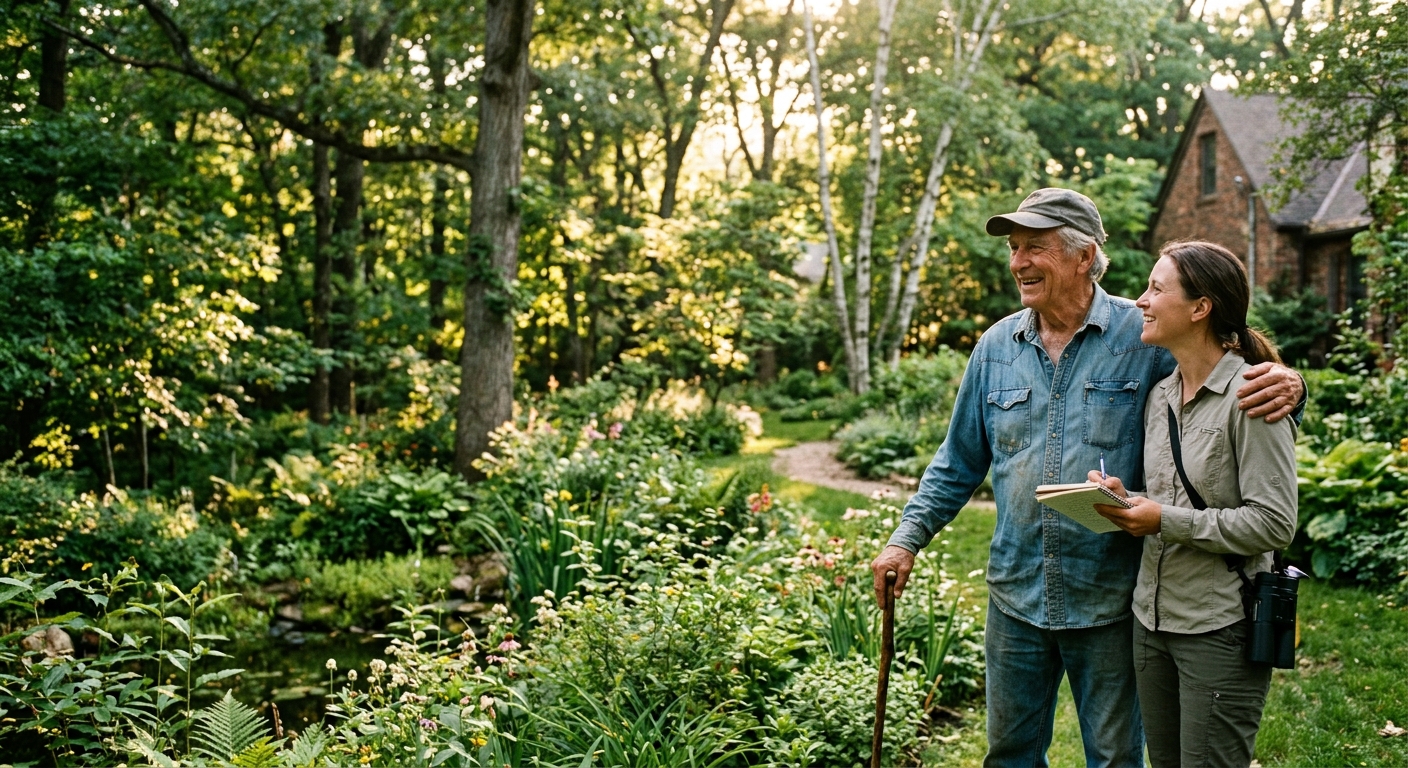
Gerald Hutchins is 79 years old now. He still keeps his journal. Patricia still occasionally shakes her head, though with considerably more affection than she did in 2003. Arthur the heron stopped visiting around 2015, which Gerald notes in his journal with a small drawn frown, and was eventually replaced by a younger bird Gerald has named Arthur II, whom he regards with respectful suspicion.
The great crested newt population on his land has been surveyed every other year for the past fifteen years. It remains robust. Dr. Patel, now a senior conservation scientist, still visits occasionally and still gets that particular look on her face when she stands at the pond’s edge in spring and watches the newts move through the water like small, improbable dragons.
When asked what he would say to someone who wanted to do something similar but felt it was too small to matter, Gerald thought for a moment and said: “The newts didn’t care that it was just a backyard. They just needed somewhere clean to put their eggs. That’s all it was, really. Just somewhere clean.”
Sometimes the most profound conservation acts begin not with policy or protest, but with a shovel, a muddy Saturday, and the quiet decision to try.