
🎧 Listen to this story
Narrated by Vindemiatrix · 7,611 characters
When the Diagnosis Changed Everything
Margaret Adamson had spent 34 years perfecting the kind of precise, photorealistic oil paintings that made collectors line up at gallery openings. Her brushstrokes were deliberate, controlled, almost architectural in their exactness. She painted portraits of ordinary people with extraordinary detail: the thread count of a grandmother’s cardigan, the tiny vessels in a child’s eyes, the glint of a wedding ring worn thin by decades of love.
Then, in the spring of 2019, her right hand began to shake.
At first, she dismissed it. Artists get tired. Muscles cramp. But when the tremors didn’t stop, when they spread to her left hand and began visiting her in the mornings before she’d even lifted a brush, she made an appointment with her neurologist. The diagnosis arrived on a Tuesday afternoon, quiet and clinical and devastating: early-onset Parkinson’s disease.
“I remember driving home and thinking, that’s it. That’s the end of the only thing I’ve ever been,” Margaret told me during a phone interview last fall. “Parkinson’s and precision don’t exactly go hand in hand. I thought my story as a painter was over.”
It wasn’t over. It was, in the most unexpected way imaginable, just beginning.
The Six Months She Didn’t Paint
Margaret didn’t touch a canvas for six months after her diagnosis. She reorganized her studio. She read. She sat in the garden and watched birds and tried not to think about the oils drying on her shelves. Her husband, Dennis, didn’t push her. Her adult children called often and said encouraging things she couldn’t quite receive.
“People kept telling me I was strong,” she said. “But strength isn’t something you feel on the inside. It’s something other people assign to you when they don’t know what else to say.”
What finally brought her back to the studio wasn’t a motivational podcast or a pep talk. It was boredom. Pure, uncomplicated boredom, and a half-finished canvas she’d abandoned the week before her diagnosis: a portrait of her youngest granddaughter, Lily, mid-laugh.
“I sat down in front of it and thought, I’ll just try. The worst that can happen is I ruin it.”
She picked up the brush. Her hand shook. The line she intended to draw became something else entirely: a soft, quivering arc that somehow caught the motion of a child in the middle of laughter better than any deliberate stroke she’d ever made. She stared at it for a long time.
Then she kept going.
The Tremors Became the Technique
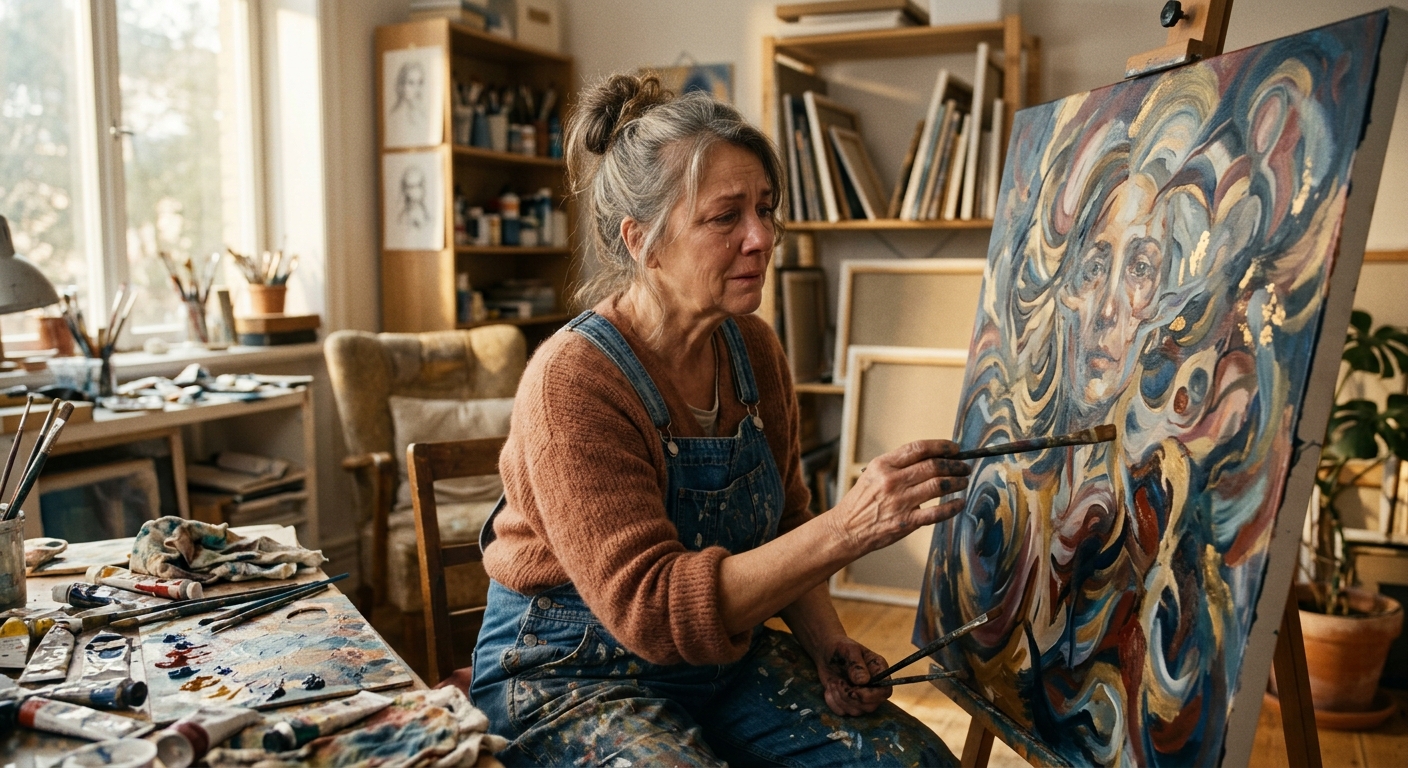
What Margaret discovered over the following months wasn’t a workaround or a coping mechanism. It was a genuine artistic evolution. The involuntary tremors in her hands, the very thing she had grieved, began producing an entirely new visual language. Her lines, once razor-sharp, became layered, vibrating, alive in a way that photorealism never quite captured.
Art critics, when they eventually saw the new work, scrambled for comparisons. Some invoked Francis Bacon. Others mentioned Lucian Freud. One reviewer wrote that her paintings now looked like “what memory actually feels like from the inside.”
Margaret laughed when I read that quote back to her. “Memory does shake a little, doesn’t it? You can never quite hold it still.”
What Changed Technically
For those curious about the mechanics of her transformation, here is what shifted in her practice:
- Line quality: Where her earlier work featured clean, confident contours, her new paintings use layered, oscillating lines that create a sense of depth and movement without traditional shading techniques.
- Color application: The tremors cause pigment to land in unpredictable clusters, producing a pointillist-adjacent texture she never planned but now actively leans into.
- Emotional tone: Reviewers consistently note that the new work feels more emotionally raw. The loss of control, ironically, removed a layer of guardedness that even she hadn’t known was there.
- Subject matter: Margaret has shifted away from portraits toward landscapes and abstract emotional states, work she describes as “painting feelings instead of faces.”
The Art World’s Response
Margaret’s first post-diagnosis exhibition opened at a small gallery in Bristol in the autumn of 2021. She almost cancelled it twice. The night before the opening, she sat in her car outside the gallery for twenty minutes, certain nobody would understand, certain the work would be received as the output of a sick woman making do rather than a real artist making something.
She was wrong.
The show sold out in three days. A piece titled “Lily Laughing” (the very painting she’d returned to after six silent months) was purchased by a private collector for a sum Margaret declined to disclose but described as “more than a little surprising.” A larger retrospective followed in London the next year, pairing her pre-diagnosis precision work alongside the new tremor-influenced paintings in a way that made the evolution staggering to witness in person.
“Standing in that room, looking at both bodies of work,” she said, “I could see my whole life. The person I was trying to be, and the person I actually am.”
What Margaret Wants Other People Living with Parkinson’s to Know
Margaret is careful not to frame her story as a triumph-over-tragedy narrative. She is clear-eyed about the reality of Parkinson’s: it is progressive, it is difficult, and her experience is not a template for everyone living with the disease.
“I don’t want anyone to read about me and feel like they’re failing because they haven’t turned their symptoms into art,” she said firmly. “That’s not the point. The point, for me, was learning that the thing I thought had been taken from me was actually still there. Just different.”
When pressed for what she would say to someone recently diagnosed, she thought for a moment before answering:
“Give yourself time to grieve. Grief is not self-pity. It’s honest. Grieve what you’ve lost, and then, when you’re ready, get curious about what’s still there. Not what you can still do in spite of the disease. What you can do because of who you are, all of it, including the hard parts.”
The Bigger Lesson Here
Margaret’s story sits at the intersection of loss and reinvention, but it resists the easy read. She didn’t simply “make the best” of a bad situation. She did something harder and more interesting: she got honest with herself. The forced surrender of control that Parkinson’s imposed removed what she now recognizes as a certain artistic ego, a need to prove technical mastery, a tendency to prioritize the impressive over the true.
The tremors stripped that away. What remained was feeling, instinct, and 34 years of deeply absorbed knowledge about color and light and the human face.
Many of us will never face a diagnosis like Margaret’s. But most of us, at some point, will have something taken from us that we built our identity around. A career. A relationship. A version of ourselves we thought was permanent. And in those moments, the question Margaret’s story keeps asking is a generous and difficult one:
What if the loss isn’t the end of the story? What if it’s the part where the story gets real?
See Margaret’s Work
Margaret’s paintings are currently represented by the Courtland Gallery in Bristol. A portion of proceeds from each sale is donated to Parkinson’s UK. She also runs a small online community for artists navigating chronic illness, which you can find through her studio website.
As for Lily, the granddaughter captured mid-laugh in that first trembling painting, she is now seven years old and, according to her grandmother, “completely unbothered by being famous.”