🎧 Listen to this story
Narrated by Sulafat · 8,934 characters
The Day Everything Changed
On a Tuesday morning in late October, Marcus Webb was doing what millions of people do every single day: driving to work. Coffee in the cupholder, a podcast playing softly through the speakers, his mind already running through the meetings ahead. It was ordinary. Unremarkable. Until it wasn’t.
A distracted driver ran a red light at 55 miles per hour and struck Marcus’s sedan on the driver’s side. The impact was so severe that first responders later told him they had expected to find a fatality. Instead, they found Marcus, barely conscious, with a fractured spine, a collapsed lung, four broken ribs, and a traumatic brain injury that would take two years to fully diagnose.
“I remember the sound,” Marcus said, speaking from his home office in Columbus, Ohio, surrounded by safety campaign posters and a shelf full of speaking awards. “It was like a thunderclap right next to your ear. And then silence. Complete silence.”
What happened next, over the course of three years of painful recovery, unexpected purpose, and relentless advocacy, is a story about how the worst moment of your life can quietly become the most meaningful one.
The Long Road Back
Marcus spent eleven days in the ICU, followed by six weeks in a rehabilitation facility. He was 34 years old, a high school athletic director with a wife, two young daughters, and a life that had been, by his own description, “perfectly on track.”
The physical recovery was grueling. Learning to walk steadily again took four months. Managing the cognitive effects of the traumatic brain injury, including memory lapses, light sensitivity, and difficulty concentrating, took far longer. There were days, he admits openly, when he questioned whether he would ever feel like himself again.
“The brain injury was the hardest part to explain to people,” he said. “You don’t look injured. You show up to family dinners and you seem fine. But inside, everything is foggy. You forget words. You lose your train of thought mid-sentence. It’s isolating in a way that’s really hard to describe.”
His wife, Denise, became his primary support system and, in her own words, his “memory external hard drive” during those early months. Their daughters, then aged six and nine, drew get-well cards that Marcus kept taped to the ceiling above his hospital bed so he could see them without lifting his head.
The Turning Point Nobody Talks About
Recovery milestones tend to get celebrated loudly. The first steps, the return home, the moment someone goes back to work. What doesn’t get talked about as often is the strange, disorienting period that follows: when the crisis has passed, but life hasn’t resumed its old shape. When you’re well enough to function but haunted enough to feel fundamentally altered.
For Marcus, that period lasted the better part of a year. And it was during that time, restless and searching, that he started reading crash statistics.
“I found out that distracted driving kills about 3,000 people a year in the United States alone,” he said. “And injures hundreds of thousands more. I found out that the driver who hit me had been texting. And I thought: people don’t know how real this is. They think it’s other people. They think it won’t happen to them. I thought that too.”
The idea started small. A blog post. A Facebook update with some statistics. A conversation with a friend who taught driver’s education at a local high school. Then that friend asked Marcus if he’d be willing to come in and speak to students.
He said yes, terrified, and stood in front of a classroom of sixteen-year-olds, told them what it sounded like when a car hit him at 55 miles per hour, and watched their faces go still.
“That silence in the room,” he said, “was the first time since the accident that I felt like something in my life made sense.”
Building a Platform From the Ground Up
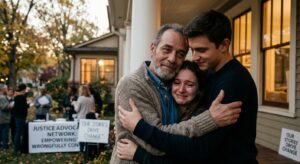
What began as a single classroom visit has grown into something that surprised even Marcus himself. Over the past three years, he has spoken at more than 200 schools, corporations, and community events across twelve states. He founded a nonprofit called Arrive Alive Ohio, which focuses on distracted driving prevention through survivor storytelling, educational workshops, and partnerships with local law enforcement.
The approach is deliberately personal rather than statistical. Marcus has found, and research supports this, that human stories change behavior in ways that data alone simply cannot.
What the Program Actually Looks Like
- Survivor Speaker Series: Crash survivors share firsthand accounts at schools, driving academies, and community centers, bringing a human face to abstract risk.
- Pledge Campaigns: Students and employees sign distracted driving pledges and are encouraged to hold family members accountable as well.
- Law Enforcement Partnerships: Local police and highway patrol officers join presentations to discuss real-world consequences, legal and physical, of distracted driving.
- Parent Education Nights: Because, as Marcus points out, teenagers learn driving habits largely by watching adults, reaching parents is just as important as reaching teens.
- Corporate Wellness Integration: Arrive Alive Ohio has partnered with several regional employers to incorporate road safety into workplace wellness programs, recognizing that many serious accidents happen during commutes.
The Responses That Keep Him Going
After nearly every presentation, Marcus lingers. He answers questions, shakes hands, and listens. And sometimes, he receives a message days or weeks later that reminds him exactly why he does this.
A high school junior wrote to him saying she had already developed the habit of glancing at her phone at red lights, a behavior she hadn’t even recognized as dangerous until his visit. A corporate manager said that after Marcus’s presentation at their company retreat, her team instituted a no-phones-while-driving policy for all work-related travel. A father emailed him simply to say: “My son told me about you at dinner. I put my phone in the glovebox the next morning. I just wanted you to know.”
“Those messages,” Marcus said, pausing to collect himself, “they’re not small things. Every person who changes their behavior is a potential crash that doesn’t happen. A family that doesn’t get a phone call. I think about that a lot.”
What Survivors Teach Us That Statistics Cannot
There is a growing body of evidence in public health and behavior change research suggesting that narrative, particularly firsthand survivor narrative, is one of the most effective tools for shifting deeply ingrained habits. People are wired to process stories. We feel them in a way we simply don’t feel numbers.
Marcus intuitively understood this before he ever read the research. His presentations never open with statistics. They open with the sound of a crash. With a Tuesday morning. With coffee in a cupholder.
“I want people to see themselves in the story before they realize it’s a safety presentation,” he explained. “Because once you see yourself in it, you can’t unsee it.”
Key Lessons From Marcus’s Advocacy Work
- Personal storytelling creates empathy that changes behavior more effectively than statistics alone.
- Recovery from trauma is not linear, and finding purpose within hardship is often part of the healing process itself.
- Community-level behavior change requires reaching multiple audiences, not just the most obvious ones.
- Survivors are uniquely positioned to communicate risk in ways that experts and data cannot replicate.
- Small behavioral changes, putting a phone in the glovebox, committing to hands-free driving, compounded across thousands of people, represent significant real-world impact.
Still Healing, Still Showing Up
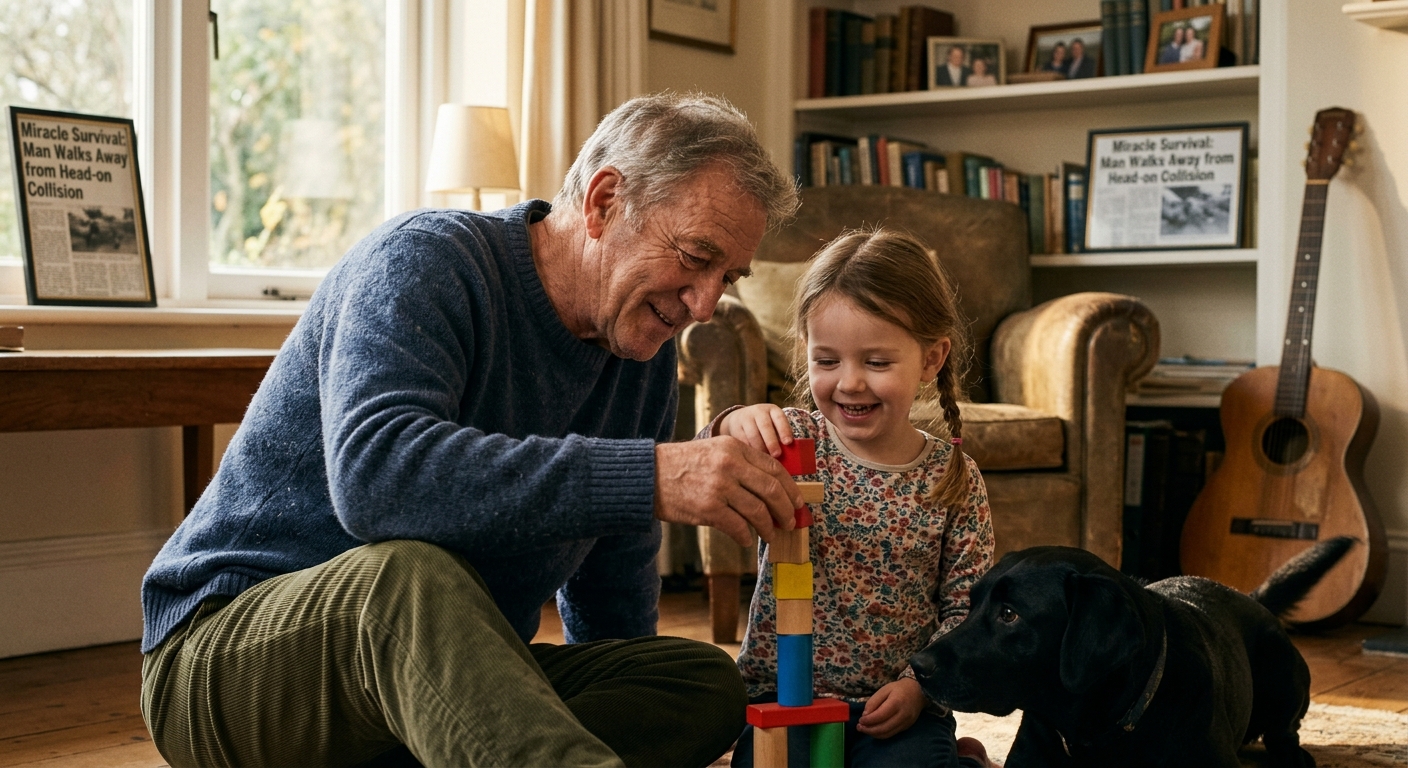
Marcus is candid about the fact that his own recovery is ongoing. He still attends regular appointments for his TBI. He still has difficult days. The chronic pain from his spinal fracture has become, in his words, “a passenger I’ve learned to travel with.”
But he is also, by any measure, thriving. He returned to work in education, now serving as a district-level administrator. He coaches his younger daughter’s soccer team on Saturday mornings. He and Denise recently celebrated their twelfth anniversary.
And every few weeks, he walks into another classroom, another conference room, another community center, and tells a room full of strangers about a Tuesday morning in late October. About the sound. About the silence that followed. About the ceiling above a hospital bed covered in his daughters’ drawings.
He tells it not because it is easy, but because it matters. Because somewhere in that room, there is a person who picks up their phone at red lights, or glances at a notification on the highway, who hasn’t yet understood, truly understood, that it could happen to them.
Marcus Webb is living proof that it can. And living proof, he has learned, is the most powerful argument there is.