
🎧 Listen to this story
Narrated by Callirrhoe · 7,612 characters
When the Healer Needs Healing
Dr. Miriam Osei had spent fourteen years sitting across from people in the worst moments of their lives. She had held space for widows, for parents who had buried children, for young men who had lost brothers to violence. She was, by every professional measure, exceptional at her job. Her colleagues called her unshakeable. Her patients called her a lifeline.
What nobody knew, not even her closest friends, was that Miriam had not cried since her mother died three years earlier. She had gone straight from the funeral home back to her practice. She had filled her calendar to the point of breathlessness. She had become, in the quiet and clinical language she used with others, ‘avoidantly coping.’
Then came Walter.
A Patient Who Refused to Play by the Rules
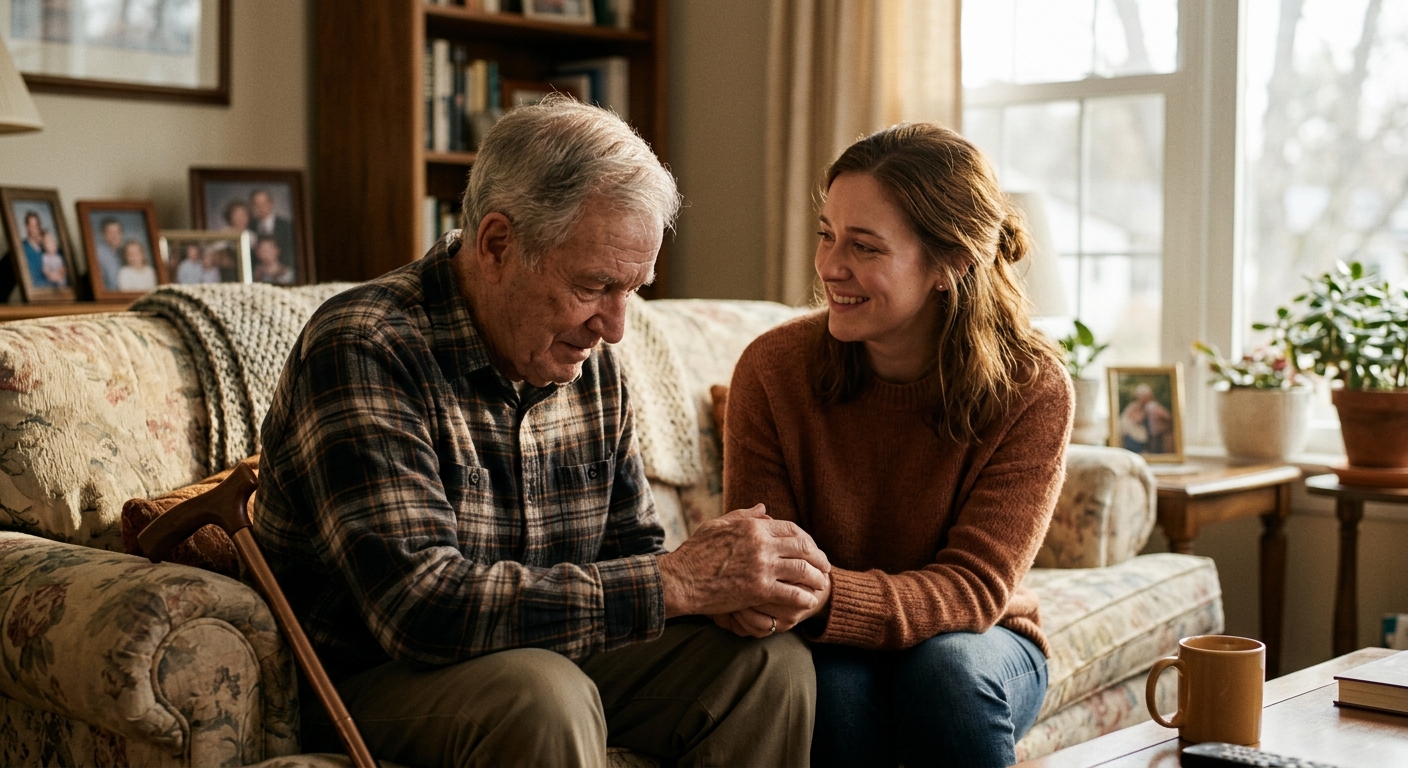
Walter Briggs was seventy-one years old when he first walked into Miriam’s office, referred by his cardiologist after losing his wife of forty-six years to pancreatic cancer. He arrived in a pressed shirt, carrying a thermos of coffee and a paperback mystery novel, as if he were simply waiting for a bus rather than sitting in a grief counselor’s office.
‘He looked at me like he was doing me a favor by showing up,’ Miriam recalled in a recent conversation. ‘And honestly, I think part of him believed he was.’
Walter was charming, stubborn, and almost pathologically resistant to conventional therapeutic techniques. When Miriam asked him to name his feelings, he named them incorrectly on purpose. When she introduced journaling, he wrote grocery lists. When she suggested a grief support group, he told her he had ‘never been much of a joiner.’
What he would do, it turned out, was talk. About his wife, Dorothy. About the garden she kept. About the way she laughed at her own jokes before she finished telling them. About the specific and devastating silence of a house that used to smell like coffee cake on Sunday mornings.
The Session That Changed Everything
Six weeks into their work together, something unexpected happened. Miriam asked Walter what he missed most about Dorothy beyond the obvious, beyond her presence and companionship. She expected him to talk about love. Instead, he talked about being known.
‘She knew things about me that I never told her,’ he said. ‘She just figured them out. Forty-six years and she could still surprise me with what she understood.’
Miriam sat very still. She wrote nothing on her notepad. Later, she would describe the moment as feeling like something had shifted slightly in the floor beneath her chair.
‘I realized I hadn’t let anyone know me like that in years,’ she said. ‘I had been so busy being the person who understands everyone else that I had completely closed the door on being understood myself.’
She did not cry in that session. But she thought about her mother on the drive home for the first time in months, and it did not feel like something to outrun.
What Grew Between the Sessions
Over the following months, something quiet and unusual developed. Walter began to show up with small observations, not advice, not pity, but genuine curiosity about the person sitting across from him. He noticed when Miriam seemed tired. He once said, quite plainly, ‘You look like someone who is carrying something heavy today.’ And then, remarkably, he waited.
Miriam maintained her professional boundaries carefully, as she should. But Walter’s presence, his way of seeing people, began to shift something in how she moved through her own life. She started calling her sister more. She pulled out a box of her mother’s photographs that had been sitting in a closet. She cried for the first time, alone on a Tuesday evening, and felt not broken but relieved.
‘Walter didn’t counsel me,’ she is careful to say. ‘But he modeled something I had forgotten. He showed me what it looks like to grieve honestly, without performance, without rushing toward being okay.’
What Walter Found in the Process
For Walter, the friendship, and that is what it became in the truest sense of the word, offered something he had not expected from therapy: a reason to articulate things he had never put into words before.
‘When you talk to someone who really listens,’ he said, ‘you end up hearing yourself differently. I said things in that room I didn’t know I believed until I said them.’
By the end of their time working together, Walter had rejoined a gardening club he had abandoned after Dorothy’s death. He was eating dinner with his son every Sunday. He had even, tentatively, begun to write down some of his memories of Dorothy, not for any particular purpose, just to have them somewhere outside his head.
The Lessons They Both Carried Out
Their story is not a Hollywood ending. Walter still has hard days. Miriam still has a tendency to overfill her schedule when life gets heavy. But both of them walk away from their unlikely connection with something neither had going in.
Here are the things their experience quietly teaches the rest of us:
- Healing is not a one-way transaction. Even in the most structured helping relationships, growth tends to move in multiple directions when both people show up honestly.
- Resistance can be a form of communication. Walter’s refusal to follow the script was not defiance. It was his way of saying: I need to do this on my own terms.
- Being seen is its own kind of medicine. Long before Walter made any measurable ‘progress,’ he began to improve simply because someone was paying close, non-judgmental attention to him.
- Helpers carry grief too. There is no professional exemption from loss, and pretending otherwise does not make anyone a better counselor. It often makes them a more distant one.
- Some friendships choose you. The connection between Miriam and Walter did not follow a predictable pattern. It grew sideways, quietly, in the spaces between formal conversation.
- You can grieve and still be curious about life. Walter’s paperback mysteries were not a sign of denial. They were a sign of a man who still believed the world had things worth figuring out.
A Note on Professional Boundaries and Human Connection
It is worth saying clearly: the relationship between Miriam and Walter remained a professional one throughout their sessions. The healing that occurred for Miriam happened internally, through reflection, not through Walter stepping into a role he was not there to fill. Good therapeutic relationships can be genuinely transformative for both parties precisely because the boundaries hold, not despite them.
What made this story unusual was not that lines were crossed. It was that within the appropriate structure of their work together, two people managed to be profoundly human with each other. And that humanity turned out to be the most therapeutic thing of all.
The Ripple You Don’t See
Miriam often thinks about all the people she has worked with over the years and wonders how many of them changed something in her that she has not yet recognized. Grief work, she says now, is humbling in the best possible way. You sit with someone in their most honest moment, and if you let yourself, it has a way of making you more honest too.
Walter finished his work with Miriam on a Thursday afternoon in early spring. He brought his thermos, as always. He shook her hand. He said, ‘You’re very good at this, you know. Whatever it is you actually do in here.’
She laughed. And later, she called her sister to tell her about it.
Some things heal slowly, on their own timeline, through the most unexpected people. And sometimes the greatest gift a grieving person can give you is the courage to finally grieve yourself.