
🎧 Listen to this story
Narrated by Orus · 8,314 characters
The Experiment That Changed How We Think About Animals
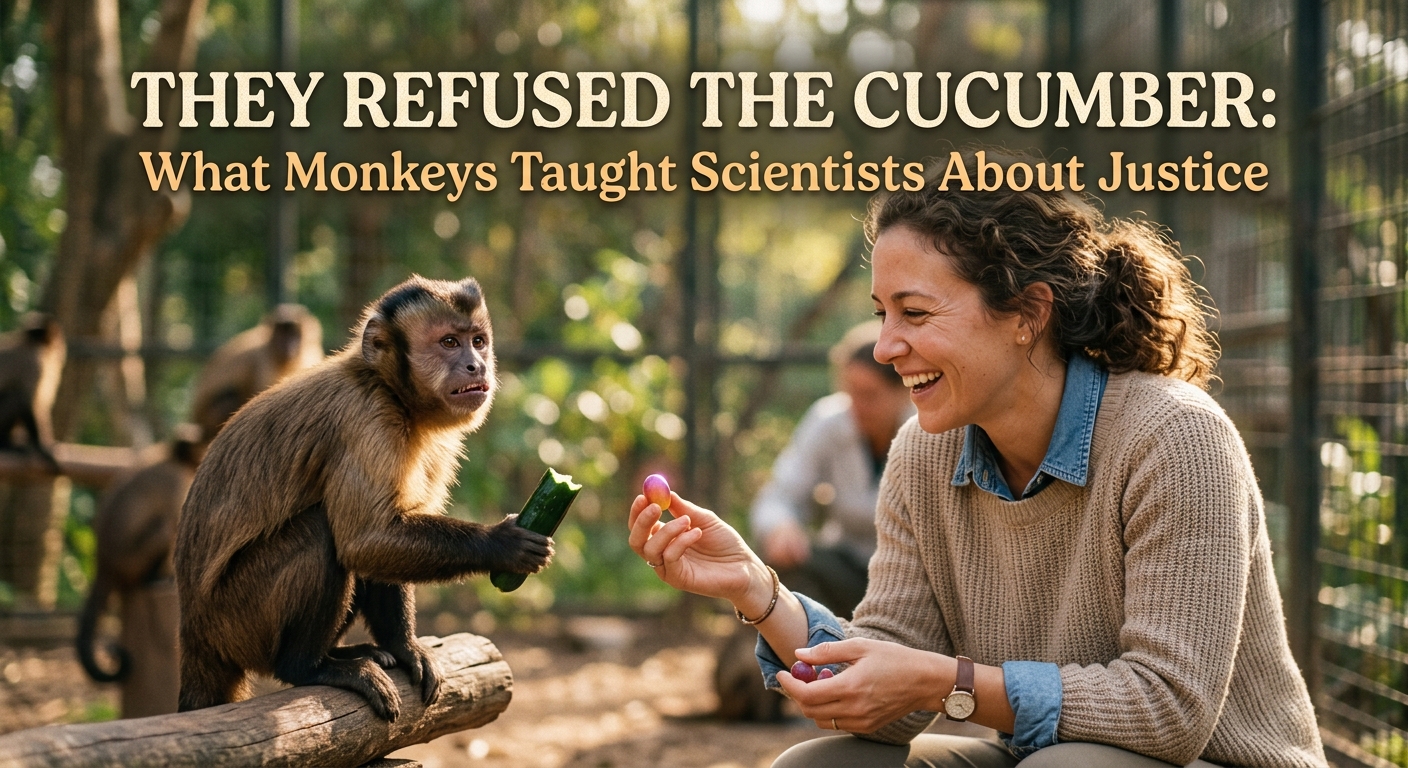
In a research lab at Emory University, two capuchin monkeys sat side by side in adjacent enclosures. Both were given the same task: hand a small stone to a researcher. One monkey received a grape as a reward. The other received a cucumber slice. The monkey with the cucumber took one look at its neighbor’s grape, threw the cucumber slice back through the bars, and erupted into what researchers could only describe as indignant protest.
The video of this moment became famous. But the implications ran far deeper than a charming viral clip. It sparked one of the most compelling questions in modern behavioral science: do animals have a sense of fairness?
According to a growing body of research, the answer appears to be yes, and it is forcing scientists to completely rethink what we believe about animal cognition, emotion, and social behavior.
What “Fairness” Actually Means in the Animal Kingdom
Before diving into the research, it helps to clarify what scientists mean when they talk about fairness in animals. They are not claiming that a dog sits and philosophizes about justice. Rather, researchers look for something called inequity aversion, which is the measurable tendency for an animal to reject a reward it would normally accept, simply because a partner received something better.
This is a surprisingly specific and nuanced behavior. It requires an animal to:
- Observe what another individual receives
- Compare that reward to its own
- Determine that a difference exists
- Choose to reject its own reward in protest
That four-step cognitive process, researchers argue, is not instinct. It is something far more sophisticated, and it has now been documented across a remarkable range of species.
The Animals That Have Passed the Fairness Test
Capuchin Monkeys
The capuchin study, led by Frans de Waal and Sarah Brosnan and published in the journal Nature in 2003, was the landmark moment. The cucumber-versus-grape experiment showed that capuchins would refuse a perfectly good reward simply because their neighbor was getting something better. Subsequent studies expanded these findings, showing that the reaction was consistent and not just random frustration.
Chimpanzees
If capuchins started the conversation, chimpanzees deepened it. Researchers found that chimps not only rejected unequal rewards but sometimes showed something even more startling: they refused to accept a better reward if their partner received nothing. This behavior, called advantageous inequity aversion, suggests a level of social conscience that goes beyond simple jealousy. Some chimps, it seemed, did not want to benefit at another’s expense.
Dogs
A 2008 study by Friederike Range and colleagues at the University of Vienna showed that dogs demonstrate a form of inequity aversion too. In the experiment, two dogs were asked to perform the same trick, such as giving a paw. When one dog received a treat and the other received nothing, the unrewarded dog began refusing to perform the trick and actively avoided making eye contact with the researcher. Dogs that performed alone showed no such reluctance, confirming that the social comparison was the critical factor.
Ravens and Crows
Perhaps the most surprising findings have come from corvids. Ravens, crows, and their relatives have long impressed scientists with their problem-solving abilities. Researchers at the University of Vienna also found that ravens reject unequal pay much like primates do. Given the vast evolutionary distance between corvids and primates, the parallel emergence of inequity aversion suggests that this trait may have evolved independently in multiple lineages, which in science is called convergent evolution. When the same trait evolves separately in very different species, it usually means there is a strong reason for it to exist.
Fish
Yes, fish. In 2020, a study published in Current Biology found that cleaner wrasses, a species of reef fish, showed signs of inequity aversion during feeding experiments. This finding pushed the boundaries of the fairness debate into territory few researchers had expected to explore. If fish can detect and react to unequal treatment, it raises fundamental questions about how far back in evolutionary history the roots of social fairness actually go.
Why Would Fairness Evolve at All?
This is the question that keeps researchers up at night, and the answers are both logical and profound.
Frans de Waal, one of the world’s leading primatologists and the author of several books on animal empathy and morality, argues that fairness evolved as a mechanism to maintain cooperative relationships. In social species, individuals depend on each other for survival. Grooming, food sharing, cooperative hunting, and group defense all require some level of reciprocity. If one individual consistently contributes less or takes more, the partnership breaks down.
Inequity aversion, then, is essentially a social enforcement tool built into the nervous system. It makes animals feel bad when they are cheated, which motivates them to walk away from unfair deals. Over time, this pressure shapes group behavior toward greater equality because unequal partnerships simply do not last.
This framework has a striking parallel in human economics. Behavioral economists have long observed that humans routinely reject profitable deals when they perceive those deals as unfair, even at a financial cost to themselves. The famous Ultimatum Game, a classic experiment in human behavioral economics, shows this clearly. When one person offers another a split of money, and the split is too skewed, the receiver often rejects it entirely, getting nothing, rather than accept what they see as an insult. Sound familiar?
What This Means for How We Treat Animals
The science of animal fairness is not just academically interesting. It carries real ethical weight.
If animals can perceive inequity and respond to it emotionally, it suggests they have inner lives that are richer and more socially complex than we have historically given them credit for. It means that animals in group settings, whether in the wild, in captivity, or in domestic environments, are actively paying attention to how others around them are treated. It means that some animals may experience something that, while not identical to human injustice, is functionally similar.
Animal welfare researchers are beginning to incorporate these findings into guidelines for how social animals should be housed and handled. Zoos, sanctuaries, and research facilities are increasingly aware that unequal treatment of animals housed together can cause measurable stress and social disruption.
The Bigger Picture: What Animals Are Teaching Us About Ourselves
One of the most quietly revolutionary aspects of this research is what it implies about human morality. For centuries, thinkers have debated whether our sense of justice is a product of culture, religion, or rational deliberation. The animal research suggests something more humbling: the roots of fairness may be biological, wired into us by evolution long before we had language or laws.
De Waal calls this the bottom-up view of morality: the idea that human ethics did not descend from abstract principles but grew upward from ancient social instincts we share with other species. Our elaborate moral philosophies, he argues, are built on a foundation of emotional responses that we share with capuchin monkeys, dogs, ravens, and possibly even fish.
That does not make human morality less meaningful. If anything, it makes it more remarkable, a small miracle of evolution that turned a basic social reflex into something capable of imagining universal rights and global justice.
A Final Thought From the Monkeys
The capuchin who threw the cucumber slice back at the researcher was not making a philosophical argument. She was not drafting a protest letter or organizing her fellow monkeys into a union. She was simply, viscerally, unmistakably saying: this is not right.
And in that small, furious gesture, she was expressing something that connects her to every creature that has ever lived in community with others, including us.
Sometimes science does not discover something new. Sometimes it just gives a name to something ancient.