🎧 Listen to this story
Narrated by Kore · 8,101 characters
The Day the Lights Went Out
In the spring of 2019, Claire Ashworth was in the middle of editing a batch of wedding photos when she noticed something strange. The screen in front of her seemed to shimmer at the edges, like heat rising from summer pavement. She rubbed her eyes, adjusted her monitor settings, and poured herself another cup of coffee. By morning, the shimmering had spread. By the following week, her central vision was almost completely gone.
The diagnosis was devastating: a rare autoimmune condition called Vogt-Koyanagi-Harada disease had attacked the pigment cells in her retinas. Doctors told her that partial vision loss was likely permanent. For a photographer who had spent twelve years building a career around her ability to see light, shadow, color, and the precise expressions that made one photograph extraordinary and another forgettable, it felt like the end of everything.
It was not the end. It was, as Claire now describes it, the strangest and most transformative beginning of her life.
What Grief Looks Like When You Cannot See It Clearly
The months following her diagnosis were brutal. Claire did not sugarcoat this when she spoke with us over a video call, her voice steady but her words deliberate. “I am not going to pretend I handled it with grace,” she said. “I cried constantly. I stopped answering the phone. I had convinced myself that my identity was entirely wrapped up in what I could see, and without that, I genuinely did not know who I was.”
Her partner, a sound engineer named Marcus, encouraged her to start listening to photography podcasts during the long hours she spent sitting in darkened rooms to rest her eyes. She resisted at first. Eventually, out of sheer boredom, she gave in. What she found surprised her. Photographers she had admired for years were talking not about technical precision or visual sharpness, but about feeling, presence, and instinct. They described their best work as almost accidental, arrived at through patience and emotional attunement rather than calculated framing.
“I had been so focused on the mechanics of seeing that I had stopped actually feeling what I was photographing,” Claire admitted. “I thought that was the disciplined, professional way to work. Turns out, I had been using technique as armor.”
Picking Up the Camera Again
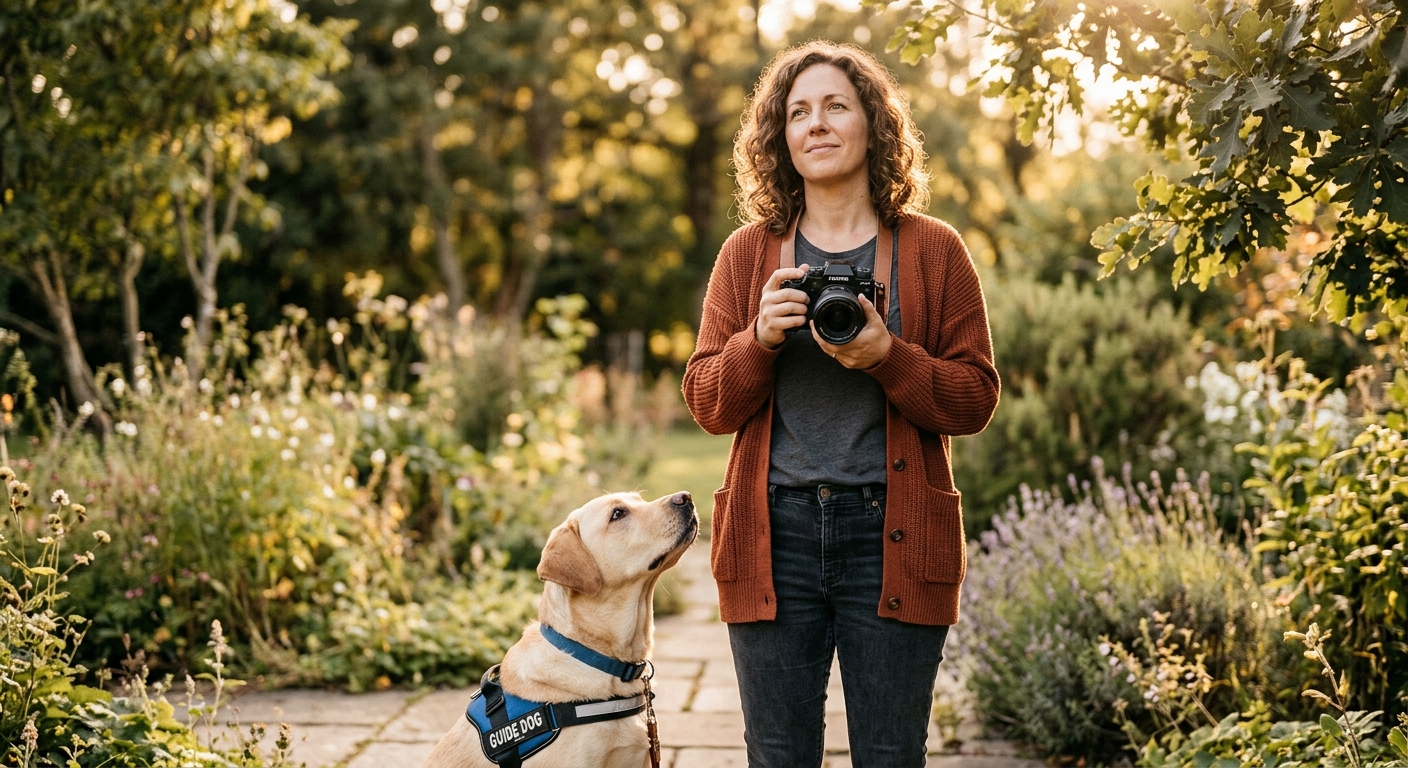
Six months after her diagnosis, with approximately 40 percent of her central vision still absent and the rest distorted, Claire did something that surprised everyone who knew her. She picked up her camera.
She did not do it because she felt ready. She did it because Marcus placed the camera in her hands one afternoon without saying a word and walked away. She stood in their backyard, holding a tool that had once felt like an extension of her body, now feeling foreign and heavy. She lifted it to her eye anyway.
What came out of that session was blurry, imperfectly exposed, and compositionally chaotic by her previous standards. She uploaded the images that evening and sat with them for a long time. Then she called her best friend and said, “I think these are the most honest photos I have ever taken.”
The Science of Shooting Without Certainty
There is actually a well-documented phenomenon in creative psychology called “desirable difficulty,” a concept developed by researchers Robert Bjork and Elizabeth Bjork at UCLA. The idea is that obstacles introduced into a learning or creative process can deepen engagement and produce more meaningful output. When the easy path is removed, the brain is forced to find new routes, and those routes are often richer and more inventive than anything the original path would have yielded.
Claire had stumbled into desirable difficulty without any theoretical framework to support her. She was simply surviving. But the creative results aligned closely with what the research predicts. Unable to rely on precise visual judgment, she began using other senses to guide her work. She listened for the sounds that indicated a moment was about to happen. She felt the warmth or coolness of light on her skin to gauge direction and quality. She asked her subjects to describe what they were feeling, turning portrait sessions into something closer to conversations.
“I started asking people to close their eyes,” she said. “Because I wanted us to be in the same place together.”
7 Things Claire Learned About Creativity After Losing Her Sight
- Imperfection holds its own kind of truth. The blurry edges and unexpected compositions in her early post-diagnosis work carried emotional weight that her technically perfect earlier work often lacked.
- Your other senses are smarter than you think. Sound, temperature, texture, and spatial awareness became sophisticated creative tools once she stopped defaulting to vision alone.
- Presence matters more than precision. Her subjects consistently told her that sessions with her felt different after her diagnosis, more intimate, more still. The photographs reflected that energy.
- Asking for help is not a creative defeat. Claire began working with an assistant who would describe scenes to her in detail. Those descriptions often unlocked angles and ideas she would never have considered independently.
- Grief is not the opposite of creativity, it is a doorway into it. Some of her most exhibited work emerged directly from her darkest months, not despite the pain but because of the honesty it forced.
- The story you tell yourself about your identity can trap you. Believing she was “a photographer who sees” kept her stuck. Redefining herself as “a person who makes people feel seen” changed everything.
- Audiences connect with vulnerability. When she began sharing her process openly, including the struggle, the adaptation, and the doubt, her following grew faster than it ever had during her years of polished, certain work.
Recognition That Arrived in the Dark
In 2021, Claire submitted a series of portraits to the International Photography Awards under the category of Fine Art. The series, titled “What I Cannot See,” consisted of twelve photographs of people with their eyes closed, shot in natural light with a slightly softened focus that she had initially considered a technical flaw. The series won an honorable mention. A gallery in Bristol offered her a solo show the following spring.
At the opening, a woman approached Claire and held her hand for a long moment before speaking. She told Claire that she had recently been diagnosed with macular degeneration and had been spending weeks convinced that her creative life was over. She had come to the show because a friend had sent her an article about Claire’s work. “You made me believe I could still make something beautiful,” the woman said.
Claire told us she cried for about twenty minutes after that conversation ended.
Vision Was Never Really the Point
There is a version of this story that frames Claire’s journey as inspirational in the most surface-level sense, the kind of narrative where disability is a plot device and triumph is the tidy conclusion. Claire resists that framing strongly. “I have not overcome my vision loss,” she said plainly. “I live with it every day. Some days it is very hard. I am not a symbol. I am just a person who found a way to keep going.”
And yet, something undeniably real happened to her creative practice in the aftermath of losing a significant portion of her sight. She became more curious, more present, and more willing to sit inside uncertainty rather than trying to engineer her way out of it. She stopped chasing the perfect image and started chasing the true one.
“I used to walk into a shoot with a shot list and a plan,” she reflected. “Now I walk in with a question. I ask myself: what is actually happening here, between these people, in this light, right now? And I try to be honest about the answer, even if the answer is blurry.”
Perhaps that is the lesson that reaches beyond photography, beyond disability, beyond any single story. The moments when we lose what we were most certain about have a way of showing us what we were never really seeing in the first place.