
🎧 Listen to this story
Narrated by Vindemiatrix · 7,535 characters
The Man Behind the Register Nobody Forgot
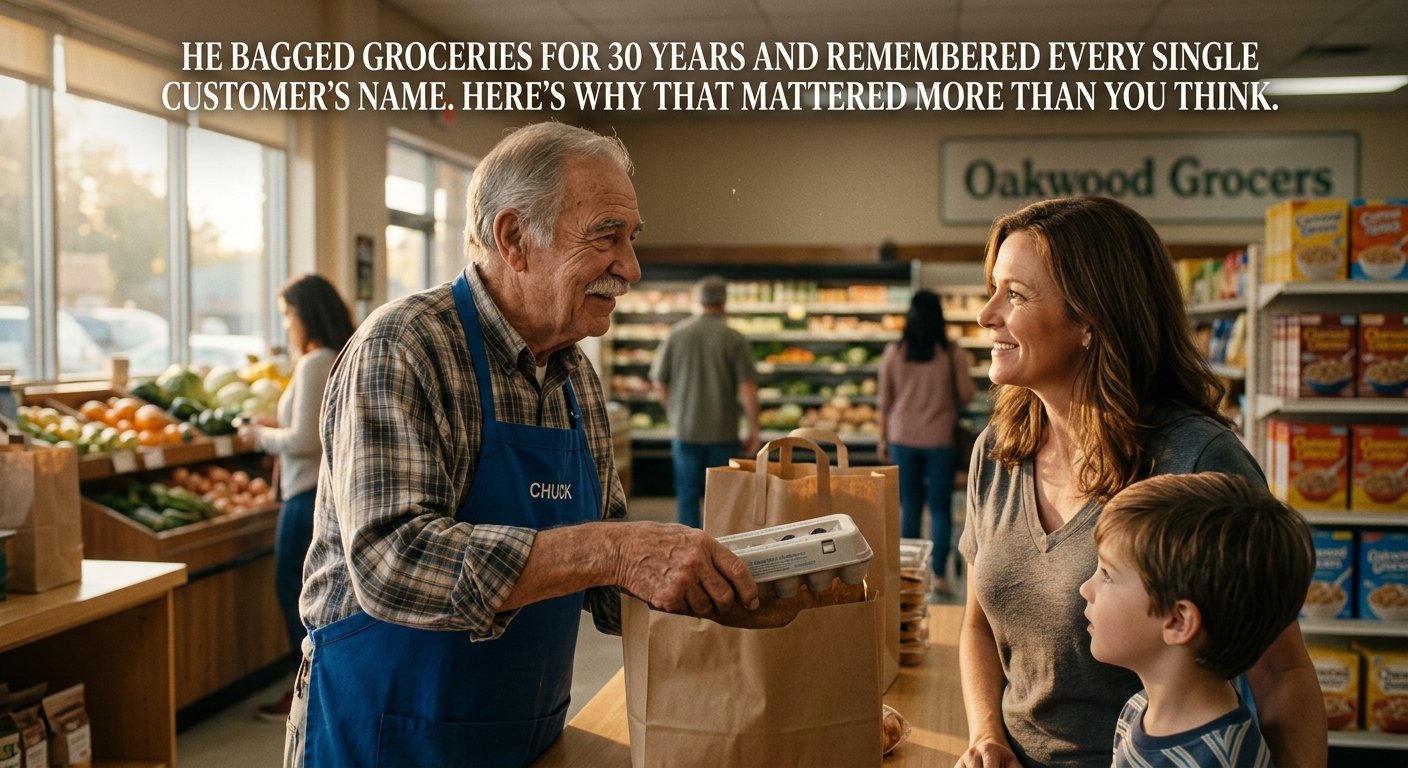
Walk into Millfield Family Grocery on a Tuesday morning and you might not notice him at first. He is not the manager in the pressed shirt. He is not the cashier with the headset. He is the man at the end of the conveyor belt, hands moving with practiced ease over canned goods and bread loaves, plastic bags opening like flowers before each item lands perfectly inside.
His name is Gerald Watkins. He has been bagging groceries at the same store for thirty years. And in three decades, he has never once forgotten a regular customer’s name.
Not one.
A Living Archive of a Community
Gerald, now 71, started working at Millfield in 1994 after leaving a career in warehouse logistics. He needed something steady, something social, he said. He got far more than that.
‘I started paying attention to names because it felt rude not to,’ Gerald explained in a recent conversation near the store’s break room, a cup of coffee going cold beside him. ‘When someone tells you their name, that’s a gift. You don’t just throw a gift away.’
Over the years, Gerald developed what he calls his ‘name system,’ a mix of association, repetition, and genuine curiosity about the people in front of him. He connects names to details. Mrs. Patterson always buys two bags of cat food and one bottle of sparkling water. Young Marcus, now in his late twenties, used to come in with his grandmother every Saturday as a child and always asked Gerald if they had any new cereals in stock.
‘I remember Marcus when he was barely tall enough to see over the belt,’ Gerald said, laughing softly. ‘Now he brings his own kids in. I call them by name too.’
What the Customers Say
The response from the community has been nothing short of extraordinary. When the store’s manager, Diane Coletti, quietly mentioned Gerald’s milestone to a few longtime shoppers, word spread fast. Within a week, customers began leaving handwritten cards at the customer service desk, all addressed to Gerald.
One letter read: ‘Gerald remembered my mother’s name even after she passed. He asked about her one day, and when I told him she was gone, he stopped what he was doing, looked at me, and said her full name. Margaret Louise Hendricks. He said it like it mattered. Because to him, it did.’
Another customer, a retired schoolteacher named Ron Abdi, described Gerald as ‘the unofficial mayor of this grocery store.’ Ron has been shopping at Millfield for twenty-two years. ‘He knows my name, my wife’s name, the names of both my dogs, and he once asked about my brother’s knee surgery two months after I had mentioned it in passing. Two months. That’s not a trick. That’s caring.’
The Science Behind Why This Feels So Powerful
There is actually research to back up what Gerald’s customers feel. Studies in social psychology consistently show that hearing your own name activates specific regions of the brain associated with identity and self-recognition. Being called by name, especially in public spaces where anonymity is the default, signals belonging. It says: you are seen. You are not invisible here.
In a world increasingly shaped by self-checkout kiosks, automated responses, and digital transactions, a human being who remembers your name is not just pleasant. It is quietly radical.
Dr. Anika Brathwaite, a behavioral psychologist who studies community well-being, put it this way in a 2022 paper: ‘Micro-moments of recognition, such as being greeted by name, have measurable effects on a person’s sense of social connectedness. These moments are small in duration but large in emotional impact, particularly for individuals experiencing loneliness or isolation.’
Gerald did not read that paper. He did not need to. He already knew.
The Days That Stood Out Most
Not every memory Gerald carries is a happy one. Some are heavier than others, and he holds those with equal care.
He remembered the week after the 2008 financial crisis when he noticed several of his regulars quietly putting items back on the shelf before reaching the register. He never said anything that would embarrass them. Instead, he learned to bag more efficiently, making sure every bag was full but not too heavy, always giving people the sense that they were leaving with more than they came for.
He remembered a woman named Carol who came in every Friday for years, always cheerful, always chatty. Then she stopped coming. Six months later, her daughter came in and told Gerald that Carol had been diagnosed with dementia and could no longer drive. Gerald asked for the daughter’s name. He wrote it down. He still asks about Carol whenever the daughter comes in.
‘Some people think I have a special memory,’ Gerald said. ‘I don’t, really. I just decided a long time ago that people were worth remembering. And once you decide that, it gets easier.’
7 Things Gerald Watkins Taught His Community Without Ever Giving a Speech
- Attention is a form of love. You do not need grand gestures. Remembering someone’s name after months apart is its own quiet declaration.
- Every job can be a calling. Gerald never climbed a corporate ladder. He found depth in staying put and doing one thing extraordinarily well.
- Consistency builds trust. Showing up, day after day, year after year, with the same warmth, creates something that money cannot manufacture.
- Small conversations carry large weight. A 45-second exchange at the end of a register can be the most meaningful part of someone’s day.
- Curiosity about others is a skill, not a personality trait. Gerald practiced it deliberately. That means anyone can.
- Grief deserves acknowledgment. Gerald never shied away from asking about someone who had passed. He understood that saying a name out loud keeps a person alive in some small way.
- Community is built one name at a time. No app, no algorithm, no loyalty program creates the feeling that Gerald creates just by looking someone in the eye and saying their name.
A Retirement That Nobody Wants to Come
Gerald has mentioned, quietly and without fanfare, that he is thinking about retiring in the next year or two. The news has not gone over well. Several customers have told Diane, the store manager, that they will genuinely grieve his absence. One woman said she was not entirely joking when she said she might stop shopping there altogether.
Diane herself got a little emotional when asked about it. ‘Gerald is irreplaceable, and I don’t use that word lightly,’ she said. ‘We can hire someone for his position. We cannot hire someone for what he does.’
Gerald, for his part, is characteristically unbothered by the fuss. He says he will miss the people more than anything else about the job. Not the routine, not the paycheck, not the structure of the workday.
The people.
‘Some of them I’ve watched get married, have kids, lose parents, go through cancer, come out the other side,’ he said. ‘You don’t just forget thirty years of people. I’ll carry them with me.’
The Lesson Hidden in the Mundane
Gerald Watkins never set out to be an inspiration. He set out to do his job with respect and attention. The inspiration was a byproduct of those two things practiced without interruption for three decades.
In a culture that celebrates disruption, hustle, and reinvention, Gerald is a gentle argument for something different: the transformative power of showing up, staying present, and deciding that the person in front of you is worth knowing by name.
That is not a small thing. That is, depending on the day and the person and the weight they are carrying, everything.