🎧 Listen to this story
Narrated by Kore · 7,967 characters
Marguerite Ellison remembers the exact sound of the first evening. It was nothing at all. No footsteps in the hallway. No car door slamming in the driveway. No holding of her breath to guess what kind of night it would be. Just the soft tick of a radiator in a rented one-bedroom apartment, and the low hum of a refrigerator that held almost nothing.
She was forty-six years old, and she had not been alone in a quiet room for nineteen years.
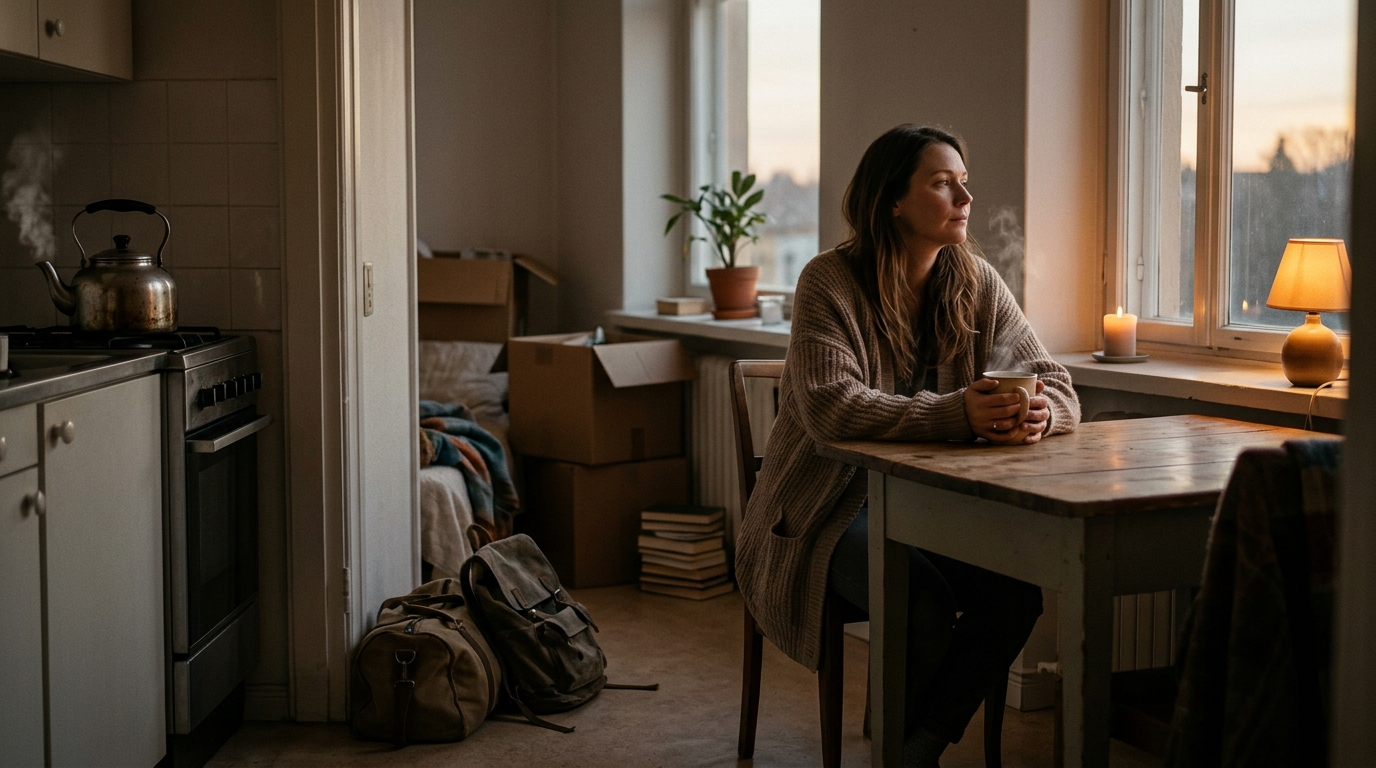
This is her story, told the way she told it to us over tea, in the golden late-afternoon light of the small kitchen she now calls her own. She asked that we change her name and a few identifying details. What she wanted to share was not the worst of what happened, but the slow, unglamorous work of what came after. She calls it the evening practice.
The Night She Left
There was no dramatic movie moment, she says. No single blow that broke the spell. It was a Tuesday, and it was an ordinary kind of terrible. Her husband had been controlling for years in ways that were easy to explain away: the monitored phone, the shrinking circle of friends, the constant low-grade fear that anything she did might be wrong. Over time, she had stopped trusting her own judgment about almost everything.
What changed that Tuesday was small. Her daughter, home from college, looked at her across the dinner table and said quietly, Mom, you flinch when he walks in the room. Did you know that?
She did not know that. And once she heard it, she could not stop hearing it.
Three weeks later, with the help of her sister, a local advocate, and a safety plan written in careful pencil, Marguerite left with two bags, a box of photographs, and the electric kettle she had bought herself years earlier and kept hidden in a closet. She laughs when she tells that part. “Of all the things to save,” she says. “But it was the one thing in that house that was mine.”
The Silence That Felt Like Danger
Here is what no one warned her about: freedom can feel frightening before it feels good.
For nineteen years, her evenings had been a performance of vigilance. She tracked moods the way a sailor tracks weather. Now the apartment was silent, and her nervous system did not know what to do with it. She would sit on the edge of the couch with her shoes still on, waiting for something to go wrong. She would check the locks three, four, five times. Sometimes she would turn on every light and the television just to fill the room with noise.
It was her therapist who suggested something gentle. Not to conquer the silence, but to get to know it.
“Start small,” she was told. “Pick one hour. Just one. Make it yours.”
The Evening Practice
Marguerite chose the hour after dinner, when the light goes amber and the world outside begins to slow. That had always been the most dangerous time in her old life. She decided it would become the safest time in her new one.
She did not begin with anything ambitious. Her practice grew, piece by piece, over many months:
- The kettle. Every evening, she made a cup of tea, slowly, paying attention to each step. The sound of the water, the steam, the warmth of the mug in both hands. A small ritual that said: you are allowed to take your time.
- The window seat. She dragged a worn armchair to the window and watched the sky change color. Some nights she only managed five minutes before the old anxiety crept in. She let it. Then she tried again the next night.
- The unfinished notebook. A therapist suggested she write down three sentences each evening, any three sentences. Some nights it was grocery lists. Some nights it was grief. Over time, it became the first place she heard her own voice again.
- One small decision. Each evening, she made a single choice purely because she wanted to: what to cook, what song to play, whether to read or sit in silence. After years of having her choices overruled, even picking a radio station felt like a muscle slowly waking up.
“People think recovery is a big, brave leap,” she told us. “Mine was a thousand tiny evenings of learning that I could sit in a room with myself and not be in danger.”
The Evenings That Went Backward
It was not a straight line, and she is quick to say so. There were months when the loneliness hit harder than the fear ever had. There were nights she picked up the phone, her thumb hovering over a number she had promised herself she would never dial again. There were evenings she cried until the tea went cold.
What helped, she says, was not pretending those nights did not happen. It was building a net underneath them.
She joined a weekly support group that met at a community center, where women who understood sat in a circle of mismatched chairs and said things out loud that she had only ever whispered inside her own head. She kept her sister on speed dial. She learned that asking for help was not weakness. It was the whole point.
If you or someone you love is in a situation like the one Marguerite escaped, please know that help exists. The National Domestic Violence Hotline (1-800-799-7233 in the United States) offers free, confidential support at any hour, and you do not need to be ready to leave to call.
What the Quiet Taught Her
About a year in, something shifted. Marguerite noticed one evening that she had been sitting by the window for forty minutes without checking the locks, without tensing at a sound on the stairs, without waiting for a storm. The tea was still warm. The sky had gone from gold to violet. And she felt, for the first time in longer than she could remember, peace.
Not happiness exactly. Peace is quieter than that. It is the absence of dread, and she had forgotten it was something a person could feel.
She began to tell us what she had learned, and it came out in simple lessons, the kind that settle in once the day’s noise fades:
Solitude and loneliness are different things
For years she had confused being alone with being abandoned. In truth, the quiet evenings were where she learned to be her own company, and to like that company more than she expected.
Safety is built, not found
It did not arrive all at once. It accumulated, one calm evening stacked on another, until her body finally believed what her mind already knew.
You are allowed to start over at any age
She was forty-six when she left. She is fifty-one now. She has taken up watercolor painting, a thing she was once told she had no talent for. She is not very good. She paints anyway, most evenings, in the last of the light.
The Kitchen Table Now
These days, Marguerite’s evenings look different. Her daughter visits on Sundays. A neighbor has become a close friend, and sometimes the two of them share a pot of tea on the back step as the porch lights flicker on. The hidden kettle sits proudly on her counter now, no longer a secret.
She still keeps the window seat. Some nights she still needs it.
When we asked what she would say to someone standing where she once stood, someone afraid of the silence on the other side, she thought for a long moment while the light slipped from the window.
“I would tell her the quiet is not empty,” she said. “It feels empty at first, because you are used to noise and fear. But give it time. The quiet is where you finally hear yourself again. And she has been waiting for you the whole time.”
A Gentle Invitation for Tonight
You do not have to be escaping anything to borrow a little of Marguerite’s wisdom. Tonight, as the day winds down, try giving yourself one small gift of stillness:
- Put the phone in another room for ten minutes.
- Make something warm to hold.
- Find a window and watch the light change.
- Ask yourself, gently, what you actually need right now.
And if you know someone who is quietly rebuilding, someone sitting alone in a new apartment learning how to breathe again, tell them tonight that they are not behind. They are not broken. They are simply in the long, tender, courageous middle of becoming themselves.
The kettle is on. The light is soft. Rest well.