🎧 Listen to this story
Narrated by Kore · 7,778 characters
There is a particular hour in the life of a small town when the shops have turned their signs, the school buses are parked for the night, and the long light of late afternoon spills sideways across the pavement. In the town of Marlow Creek, that hour used to be the loneliest of the day. These days, it belongs to something else entirely.
This is the story of how a community that lost eleven neighbors in a single winter flood learned to find its footing again, not through a grand memorial or a government program, but through a weekly gathering in the town square that began with exactly four people and one thermos of coffee.
The Winter the River Rose
Marlow Creek is the kind of place where people know which dog belongs to which porch. Its population hovers around two thousand, and for generations the river that curves along its eastern edge was a source of pride: fishing derbies in summer, lantern floats in autumn. Then came a February of relentless rain, and the river did what rivers sometimes do.
The flood took eleven lives over a single night. It took the lower mill road, the old feed store, and the sense of safety that had quietly underwritten every ordinary day. In the weeks that followed, the town did what grieving towns do. People attended funerals. They carried casseroles. They said the right things at the grocery store, and then went home and closed their doors.
That closing of doors, as it turned out, was its own kind of second loss.
Four People and a Thermos
The first gathering was not planned. On a gray Thursday in early April, a retired schoolteacher named Odalys Verrano walked to the town square at dusk because she could not bear the silence of her kitchen. She carried a folding chair and a thermos of coffee she had made out of habit, enough for her late husband and herself.
She sat down near the dry fountain. Within twenty minutes, three others had wandered over. A young father who had lost his brother. A hardware store clerk who had not spoken more than a few words to anyone in weeks. A teenage girl who said she just needed to be somewhere that was not home.
Nobody gave a speech. Nobody said it was a support group. They simply sat in the cooling air and watched the streetlamps flicker on, one by one, around the square. When the coffee ran out, someone said, “Same time next week?” And that was the whole organizing committee.
What a Gathering Learns to Be
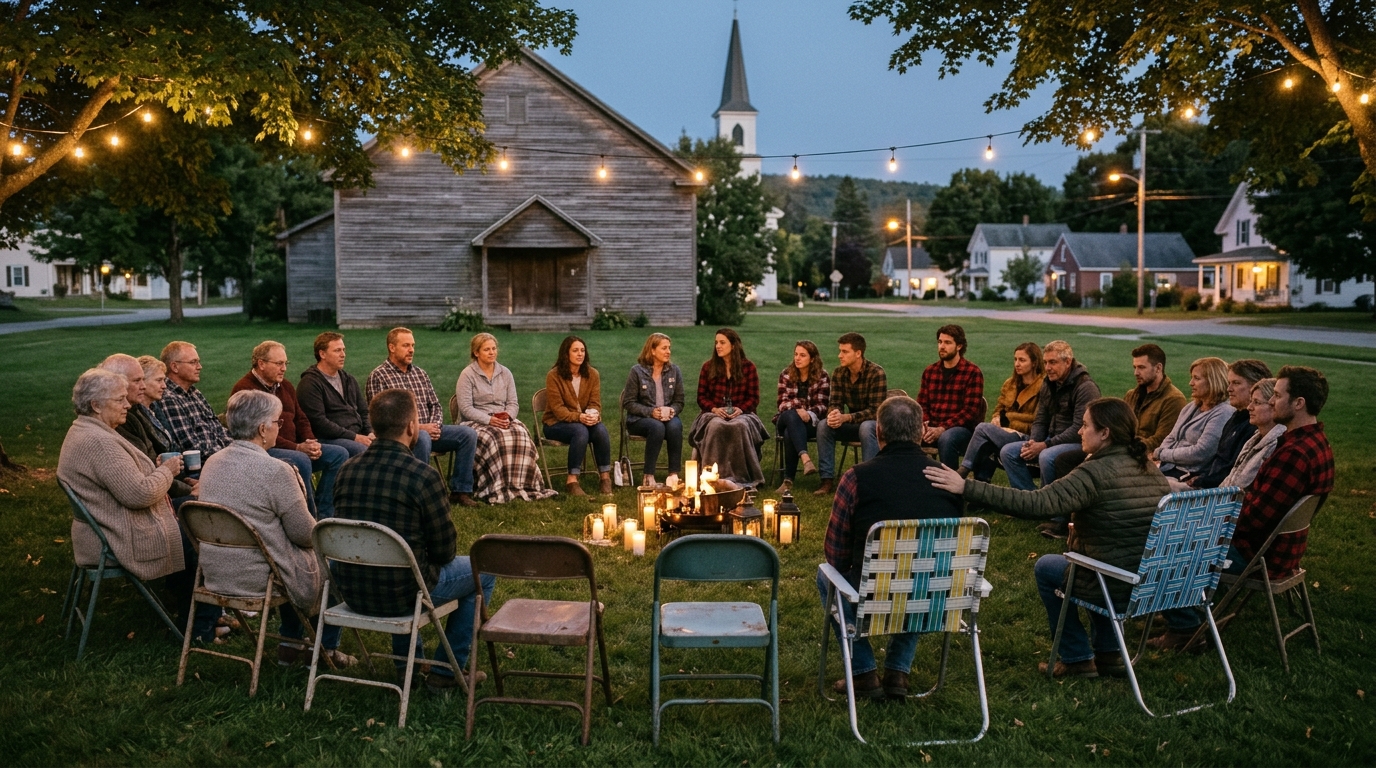
The next Thursday, there were nine people. The Thursday after that, twenty-six. By midsummer, the square held well over a hundred folding chairs, blankets, and lawn seats arranged in loose, curving rows that nobody had ever designed.
What grew was not a ceremony. It developed a few gentle customs that the town now holds dear:
- The Lighting. At the first sign of dusk, a volunteer lights a single lantern placed on the rim of the old fountain. It stays lit through the whole evening.
- The Names. Anyone who wishes may say aloud the name of someone they are carrying with them. There is no obligation, and many weeks, no one does. When someone does, the others simply say the name back, softly, like a held note.
- The Open Seat. A chair is always left empty in the front row. Newcomers are told it belongs to anyone who needs it, and to everyone who is not there.
- The Potluck Table. Neighbors bring whatever they have. Soup, store-bought cookies, a pie someone swears is not their best work. Eating together turned out to matter more than anyone expected.
The Quiet Mathematics of Evening
Ask the regulars why it works, and many will point to the hour. Mornings in Marlow Creek still felt like a performance, they say, a time for pretending the day was an ordinary one. But evening has always been the honest part of the day. The noise recedes. The errands are done. What is left is the thing you were avoiding all afternoon.
“At night, the grief used to come find me alone,” said Tobias Reyes, the young father who attended that very first Thursday. “Now, at seven o’clock, I walk toward it instead, and there are a hundred other people walking the same direction. It changes the shape of the whole thing.”
There is something to that. Evening gatherings have long been where people mark thresholds: the vigil, the campfire, the porch conversation after supper. The fading light seems to give permission for softness. Voices drop. Shoulders loosen. People say the true thing because the day has already spent its pretending.
The Ripple Beyond the Square
What began as four chairs became something that reached well past Thursday evenings. The hardware store clerk, who had barely spoken in weeks, now helps coordinate the potluck schedule. The teenage girl started a small youth group that meets at the square an hour before the main gathering, to sweep, set out chairs, and string lights along the fountain.
Local carpenters rebuilt the old bandstand, unprompted, and now a rotating cast of musicians plays quiet sets as the stars come out. A nearby orchard began donating baskets of apples. The lower mill road was eventually repaired, but townspeople note that the square did more to reconnect Marlow Creek than any road could.
Perhaps most striking is who comes. It is not only the bereaved. Newcomers who moved to town after the flood sit beside families who lost everything. Children chase fireflies at the edges while their grandparents hold hands in the middle. The gathering never asked anyone to prove their sorrow. It simply made room.
What Odalys Says About Staying
Now in her seventies, Odalys still arrives early, still carries the same dented thermos, still sets out the first chair. When people thank her for starting it, she waves them off.
“I did not start anything,” she says. “I sat down because I could not stand my own kitchen. The town did the rest. All I did was not leave.”
She pauses when asked what she hopes the gathering means to people. The lantern is lit by then, the sky gone the soft violet of a day that has finished its work.
“I think it means that you do not have to be fixed to be welcome,” she says. “You just have to show up and let the evening hold you for an hour.”
A Few Things Worth Carrying Home
Stories like this one rarely come with instructions, but they do leave a few quiet lessons behind, the kind that settle in once the day’s noise fades:
- Healing is often communal before it is personal. The most powerful step sometimes is simply being near other people who understand without needing explanation.
- Small and consistent beats grand and occasional. A weekly gathering with a thermos and four chairs outlasted countless larger gestures because it was reliable.
- You do not need a plan to begin. Marlow Creek’s tradition started with someone who could not sit alone and decided to sit somewhere else.
- Leave an open seat. Every community, every family, every friendship benefits from a space held for whoever needs it next.
When the Lantern Goes Out
The gathering ends the way it always does. Around nine, as the air cools and the children grow heavy-eyed, someone blows out the lantern on the fountain rim. There is no announcement. People fold their chairs, wrap leftover food in napkins, and drift toward home in twos and threes, their footsteps unhurried on the quiet streets.
Many will say they sleep a little better on Thursdays. Not because the grief is gone, but because it is no longer carried alone. The river still runs along the edge of town, calm now beneath the evening sky. And in the square, the empty chair waits in the front row, ready for whoever walks in next.
If there is a lonely hour in your own life, a stretch of evening that feels too quiet to bear, consider this a gentle nudge. Bring a chair. Bring a thermos. Sit somewhere other than your kitchen. You might be surprised who sits down beside you.